


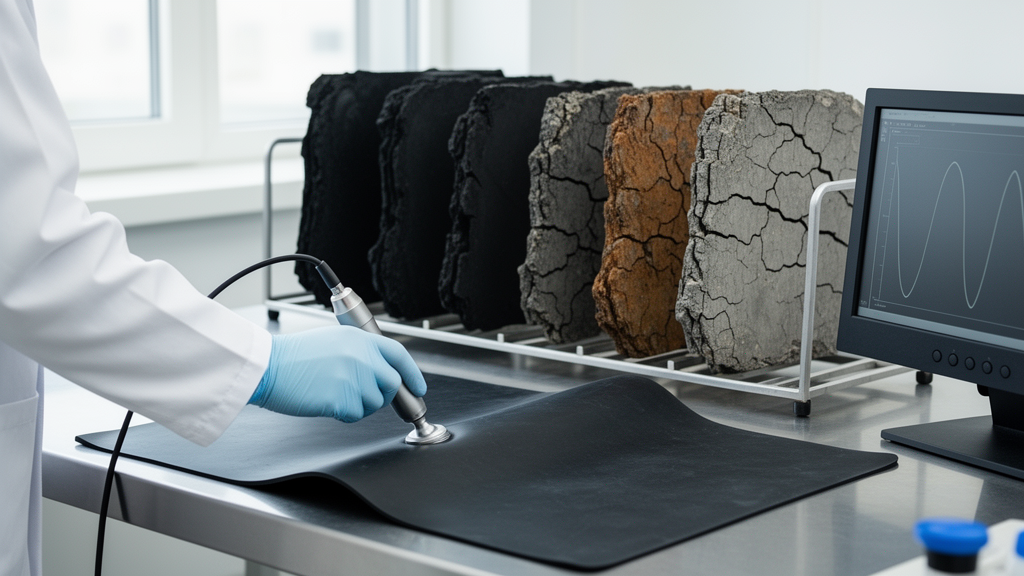
Synthetic rubber is one of those materials that quietly holds the modern world together. It cushions the harbor pads that secure massive ships to shorelines, it seals automotive systems against oil and oxygen, and it absorbs vibration in aerospace structures. But like all elastomers, it has a hidden enemy: ozone. The same trace gas that protects us from ultraviolet radiation in the stratosphere attacks rubber at ground level, hardening it, cracking its surface, and slowly eroding the mechanical integrity that safety-critical components depend on. A new study published in Results in Engineering by Jeongnam Kim and colleagues now offers an unusually honest look at how far ultrasonic testing and machine learning can go in tracking that degradation—and, just as importantly, where the science currently stops.
The research team focused on a natural rubber and chloroprene rubber (NR/CR) composite developed for marine harbor pads, a formulation chosen for its superior thermal stability and enhanced resistance to oil, oxygen, and ozone compared with natural rubber alone. Five physical specimens were followed longitudinally over a sixteen-day accelerated ozone-aging campaign, with Shore A hardness recorded at designated Left and Right measurement areas on each specimen. Those within-specimen readings were averaged to form one trajectory per specimen, and daily group means and standard deviations were then calculated across the five physical units. The design matters because it treats repeated measurement locations as what they are—repeated locations within specimens—rather than as independent experimental evidence, a distinction that many degradation studies gloss over.
The headline experimental result is striking in its clarity. The five-specimen group mean hardness rose from 53.39 Shore A at Day 0 to 61.45 Shore A at Day 16, an absolute increase of 8.06 Shore A, or 15.10 percent. But the trajectory was anything but linear in character. Most of the hardening occurred early: the Day 0 to Day 10 interval accounted for 7.38 Shore A of the increase, while the Day 10 to Day 16 interval added only 0.68 Shore A. The plateau became most apparent after approximately Day 12. When the researchers fitted models to the measured trajectory, a continuous piecewise-linear model with Day 10 fixed a priori as an engineering phase boundary outperformed a single straight line, achieving an RMSE of 0.587 and an R² of 0.935 compared with 0.921 and 0.840 for the linear model. Leave-one-specimen-out cross-validation confirmed the robustness of the piecewise description, with the fold-selected piecewise model reaching an RMSE of 0.606 and an R² of 0.932.
Here is where the study gets technically interesting—and refreshingly careful. When the breakpoint was selected directly from the data rather than fixed in advance, the minimum-residual group-mean break occurred at Day 2, and specimen bootstrap and leave-one-out analyses did not identify Day 10 as a stable data-selected change point. Day 10 is therefore retained only as an engineering modeling boundary, not as a statistically detected physical transition. This distinction between an a priori descriptive phase boundary and a detected change point is exactly the kind of methodological honesty that separates rigorous degradation science from overfitted storytelling. The two-phase description—early hardening followed by later flattening—remains a useful engineering summary, but the authors are explicit that it is an imposed description, not a discovered physical law.
Alongside the hardness campaign, the team acquired ultrasonic pulse-echo measurements using a nominal 0.5 MHz transducer and an acrylic delay medium, with a thin couplant layer supporting acoustic transmission. Ultrasonic records were available only at the two endpoints: five repeat acquisitions at Day 0 and five at Day 16. Across the repeat sets, normalized RMS amplitude decreased from 0.224218 ± 0.010291 at Day 0 to 0.206641 ± 0.001544 at Day 16, a relative decrease of 7.84 percent. Normalized signal energy fell from 75.487 ± 6.981 to 64.011 ± 0.957, a decrease of 15.20 percent. Under the documented cycles-per-sample analysis, the spectral centroid decreased by 2.09 percent and the spectral bandwidth increased by 4.71 percent. These are acquisition-level descriptors, and the authors are careful to note that the repeat files are not verified independent specimens or pairs.
The ultrasonic data also came with hard constraints that the authors refuse to paper over. Every surviving waveform record reaches the ±1.0 amplitude limit, with multiple samples at the limit, which means absolute peak-amplitude comparison is invalid—every record saturates at 1.000. The physical time unit is not stored in the surviving text exports, so physical-frequency interpretation is withheld, and no general high-frequency energy reduction is claimed despite the bandwidth increase. Amplitude limiting, missing physical sampling units, and possible coupling or gain effects all constrain material-mechanism interpretation. In an era when machine-learning papers routinely claim more than their data supports, this level of explicit boundary-setting is a technical statement in its own right.
Between the two measured endpoints lies the study’s most ambitious conceptual component: a hardness-conditioned conditional generative adversarial network (cGAN) retained as a strategy for exploring intermediate spectrogram representations for the unmeasured Days 1 through 15. In the standard conditional adversarial objective, a generator maps a noise input and a hardness condition to a spectrogram representation, while a discriminator evaluates measured endpoint and generated representations under the same condition. The generated panels illustrate a potential pathway for future temporal modeling between the measured Day 0 and Day 16 anchors. But the authors are unambiguous: these intermediate representations are generated information, not measurements. Because apparent temporal structure may reflect the imposed hardness condition rather than independently learned acoustic physics, visual continuity across the generated panels is a qualitative property of the archived representation and does not constitute independent validation.
The same conservative logic extends to the temporal and reliability components of the proposed framework. A long short-term memory (LSTM) network—whose input, forget, and output gates and cell-state update follow the classic Hochreiter and Schmidhuber formulation—is retained to describe how a future, fully traceable model could integrate acoustic descriptors, normalized hardness, and phase information across time, potentially mapping hidden states to remaining useful life estimates through a linear output layer. A Bayesian-Weibull component defines a model-conditional reliability extension for future use. But because no independent experimental RUL or failure-time labels were available, and because the exact posterior computational lineage could not be verified as a complete reproducible run, no numerical RUL trajectory, no RUL error metrics, and no quantitative posterior parameters, intervals, reliability curves, or mean-time-to-failure estimates are reported. Calculating such metrics against generated or model-derived targets would create circular validation, and the authors refuse to do it.
This explicit evidence hierarchy—distinguishing measured, generated, model-derived, and model-conditional quantities throughout the workflow—is arguably the study’s most consequential contribution. Earlier work by Kim and colleagues had estimated an approximately 25.8-year reference service life for the NR/CR composite using linear regression on hardness evolution, and related studies have derived lifetime formulas for EPDM and NBR rubbers from compression set and activation-energy changes. But the present framework withholds quantitative lifetime claims that cannot be reproduced from the archived computational record. The authors also note the broader environmental stakes: antioxidants based on p-phenylenediamine, widely used in rubber, can transform into toxic quinones detected in air, soil, and runoff, with one quinone linked to acute mortality of coho salmon—reinforcing the need for durability-prediction methods that consider mechanical degradation, reliability, and ecological risk together.
The practical implications reach from laboratory benches to harbor infrastructure. A prospective pilot could evaluate a portable pulse-echo probe at registered, accessible locations using a repeatable positioning fixture, with material-specific baselines and recorded calibration, gain, temperature, surface condition, and loading state needed to distinguish degradation from changes in acquisition conditions. Prospective hardness monitoring would use a calibrated Shore A instrument with documented measurement locations and consistent procedures for repeated readings. Inspection intervals should be selected from observed degradation rates, access constraints, component criticality, and maintenance records—the present accelerated Day 0 to Day 16 comparison does not justify a service inspection interval. The authors consolidate a five-step validation roadmap: verify measured data provenance, validate intermediate acoustic states with matched hardness records, define failure or RUL targets followed to observed outcomes, archive the complete versioned model chain, and evaluate field use in a marine or industrial pilot. Until those steps are completed, the framework stands as a disciplined blueprint for hypothesis generation and study design—a rare and valuable thing in a field where the temptation to claim validated lifetime prediction is never far away.
Subject of Research: Materials Science
Article Title: Physics-guided ultrasonic testing and a GAN-augmented LSTM framework for multi-phase degradation assessment of ozone-aged synthetic rubber
Article References: Kim, J., Chae, S., Bang, H., Kim, Y., & Kim, Y. (2026). Physics-guided ultrasonic testing and a GAN-augmented LSTM framework for multi-phase degradation assessment of ozone-aged synthetic rubber. Results in Engineering, 32, Article 113329. https://doi.org/10.1016/j.rineng.2026.113329
Image Credits: AI Generated
DOI: 10.1016/j.rineng.2026.113329
Keywords: synthetic rubber, ozone aging, ultrasonic testing, machine learning, GAN, LSTM, degradation assessment, remaining useful life, Bayesian-Weibull, nondestructive evaluation, Physics-guided, ultrasonic
Cite Scienmag News
Blake Davidson. (October 17, 2026). Ultrasonic Testing and AI Reveal How Ozone Ages Synthetic Rubber. Scienmag. https://scienmag.com/ultrasonic-testing-and-ai-reveal-how-ozone-ages-synthetic-rubber/
Blake Davidson. "Ultrasonic Testing and AI Reveal How Ozone Ages Synthetic Rubber." Scienmag, 17 October 2026, https://scienmag.com/ultrasonic-testing-and-ai-reveal-how-ozone-ages-synthetic-rubber/. Accessed 17 October 2026.
Blake Davidson. "Ultrasonic Testing and AI Reveal How Ozone Ages Synthetic Rubber." Scienmag. October 17, 2026. https://scienmag.com/ultrasonic-testing-and-ai-reveal-how-ozone-ages-synthetic-rubber/


