


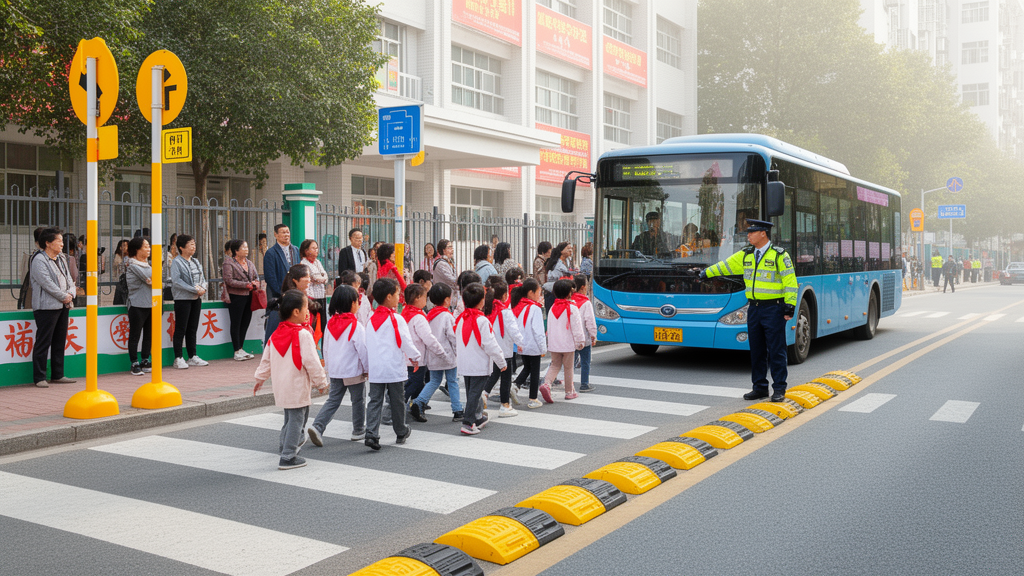
Every weekday morning, millions of children around the world navigate a gauntlet of traffic on their way to school, and road traffic injuries remain one of the leading causes of death and disability among school-age children. A new study published in BMC Public Health suggests that a decades-old analytical tool borrowed from injury epidemiology, the Haddon matrix, can be used to systematically identify and fix the environmental hazards lurking around a school zone. Researchers in Guangzhou, China, led by Wei-Quan Lin of the Guangzhou Center for Disease Control and Prevention, applied the framework to a primary school in the city’s Panyu District and found that targeted interventions were associated with markedly improved safety perceptions among both children and their parents.
The Haddon matrix, developed by epidemiologist William Haddon in the 1960s and 1970s, reframes injury prevention by crossing three phases of an injury event, namely pre-crash, crash, and post-crash, with factors relating to the host, the agent or vehicle, and the physical and social environment. Rather than treating a child struck by a car as a single unfortunate event, the matrix forces analysts to ask what could be done before the collision to prevent it, during the collision to reduce its severity, and afterward to limit the harm. In road safety terms, this means examining everything from driver behavior and vehicle speed to sidewalk design, crossing infrastructure, and the supervision culture around a school gate.
In the new study, the research team began with a baseline survey of the school community. A total of 497 schoolchildren and 484 parents with pre-intervention data were included, and the children had an average age of 9.58 years, with a standard deviation of 1.79 years. The survey captured how safe the children felt walking near the school, how they behaved when crossing streets, and how confident parents were in letting their children walk to school alone. These subjective measures were paired with an on-the-spot investigation by an expert panel, which walked the school zone itself and mapped potential road safety factors onto the cells of the Haddon matrix.
This combination of community perception data and expert environmental audit is what distinguishes the study from many school safety programs that rely on education alone. By systematically filling in the matrix, the panel could see where risks clustered. A child’s decision to cross mid-block, for example, is not simply a matter of poor judgment; it interacts with the absence of marked crossings, the timing of vehicle flows at drop-off hours, and the social environment in which other children and parents behave. The matrix turns such scattered observations into a structured inventory of modifiable risks, each assigned to a phase and a factor category where an intervention could plausibly act.
Guided by the analysis, the team implemented three coordinated interventions. The first was an expansion of road safety education for the children, targeting the host factors in the matrix by improving knowledge and self-protective behavior. The second involved physical improvements to road infrastructure around the school zone, addressing the environmental column of the matrix by altering the conditions under which vehicles and pedestrians interact. The third was the enforcement of a Family-Police-School traffic assistant mode, a supervision scheme in which families, police officers, and school staff jointly manage traffic and pedestrian movement at peak times, adding a layer of social environmental control during the highest-risk pre-crash window.
The results, measured by comparing safety perceptions and reported behaviors before and after the interventions, were striking. The proportion of schoolchildren who always felt safe when walking near the school rose by 7.87 percent. More dramatically, the share of children who reported never crossing the street at any stretch of the road, meaning they used designated crossings rather than jaywalking, increased by 23.79 percent. Among parents, the proportion who agreed it was always safe for their children to walk to school alone climbed by 11.25 percent. Most participants said they were satisfied with the intervention and believed it was worth promoting more widely.
The expert panel’s re-assessment of the school zone also found that the road safety environment had improved compared with pre-intervention conditions, corroborating the survey data with an independent technical evaluation. Notably, no road traffic injuries were reported at the school during the entire one-year study period, either before or after the interventions. The authors are careful about what this means: with no baseline injuries to compare against, the study cannot demonstrate that the program prevented crashes, and the outcome measures are largely self-reported perceptions rather than objective collision counts. Still, the consistency across child reports, parent reports, and expert evaluation lends weight to the conclusion that the Haddon matrix approach produced a genuinely safer environment.
The study’s framing within injury epidemiology matters for how the findings might travel. Road traffic injuries are not random misfortunes but the product of identifiable and modifiable factors in energy transfer between vehicles and vulnerable road users. The Haddon matrix has long underpinned interventions such as seat belts, airbags, and speed humps, each of which acts at a different phase of the event. Applying it at the scale of a single school zone demonstrates that the same logic can drive local, low-cost environmental change: repaint a crossing, retime a signal, station trained adults at the curb, and teach children where the risks concentrate. The approach is also transparent, allowing other schools to replicate the audit rather than copy interventions blindly.
There are limitations that the authors themselves acknowledge. The evaluation relied mainly on perceived safety and self-reported behaviors, which can be influenced by awareness of the program and the desire to give socially desirable answers. Children’s reports of never crossing mid-block, however encouraging, are not the same as observed crossing behavior, and the absence of recorded injuries over one year may simply reflect the rarity of such events at any single school. The authors call for future research to focus more on objective measurement, such as observed behavior, vehicle speed data, and longer follow-up periods, to establish whether the gains persist and translate into reduced crash risk over time.
Even with those caveats, the study offers a practical template for a problem that touches nearly every community. School zones concentrate the most vulnerable road users at predictable times and places, which makes them unusually tractable targets for environmental intervention. The Guangzhou experience suggests that a structured framework, a modest expert panel, and cooperation among families, police, and schools can shift both the physical environment and the culture of safety around a school gate. The work was supported by the National Natural Science Foundation of China, the Science and Technology Plan Project of Guangzhou, and Safe Kids Worldwide-China, and was carried out with the Guangdong Provincial Center for Disease Control and Prevention and local district partners. If replicated with objective outcome measures across larger and more varied settings, the Haddon matrix could become a standard tool for turning school streets from hazard zones into models of engineered safety.
Subject of Research: Application of the Haddon matrix to identify and improve environmental road safety factors around a primary school zone
Article Title: Using the Haddon matrix to improve environmental road safety factors around a school zone
Article References: Lin, W.-Q., Liao, Y.-X., Liu, H., Ruan, H.-H., Sun, S.-Y., Liu, X.-Y., Fang, Y.-Y., Tang, J., Cui, M.-Y., & Shen, J.-C. (2026). Using the Haddon matrix to improve environmental road safety factors around a school zone. BMC Public Health. https://doi.org/10.1186/s12889-026-29875-9
Image Credits: AI Generated
DOI: 10.1186/s12889-026-29875-9
Keywords: Haddon matrix, road traffic injuries, schoolchildren, school zone, road safety, injury prevention, public health, pedestrian safety, Guangzhou, safety perceptions, intervention study, BMC Public Health
Cite Scienmag News
Phoebe Ingram. (October 17, 2026). Haddon Matrix Framework Transforms Road Safety Around a Chinese School Zone. Scienmag. https://scienmag.com/haddon-matrix-framework-transforms-road-safety-around-a-chinese-school-zone/
Phoebe Ingram. "Haddon Matrix Framework Transforms Road Safety Around a Chinese School Zone." Scienmag, 17 October 2026, https://scienmag.com/haddon-matrix-framework-transforms-road-safety-around-a-chinese-school-zone/. Accessed 17 October 2026.
Phoebe Ingram. "Haddon Matrix Framework Transforms Road Safety Around a Chinese School Zone." Scienmag. October 17, 2026. https://scienmag.com/haddon-matrix-framework-transforms-road-safety-around-a-chinese-school-zone/


