


Depression has long been described as a disorder of mood, but a growing body of research suggests it is also a disorder of the body’s inner signals. People with major depressive disorder often struggle to read the sensations that rise from their own hearts, lungs, and guts—a faculty scientists call interoceptive awareness. A new randomized, sham-controlled clinical trial published in BMC Psychiatry set out to test whether two very different treatments, one electrical and one psychological, could restore that lost bodily attunement, and whether combining them would work better than either alone. The answer, according to the data, is a nuanced one: both the talk-based therapy and the combination produced striking improvements, but the brain stimulation added nothing measurable on top of the therapy.
The study, conducted by Bahman Matinpour, Rasol Roshan Chesli, Jamal Shams, and Alireza Mohammadi at Iranian medical universities including Baqiyatallah University of Medical Sciences, enrolled forty individuals diagnosed with major depressive disorder. Two participants withdrew, leaving thirty-eight adults—eighteen women and twenty men—who completed the full protocol. Each participant was randomly assigned to one of four groups: active transcranial direct current stimulation, known as tDCS; embodiment-based psychotherapy; the two interventions delivered concurrently; or a sham stimulation condition designed to mimic the sensations of real brain stimulation without delivering a therapeutic current. Assessors who measured the outcomes were blinded to which treatment each participant had received, a design feature that helps guard against biased ratings.
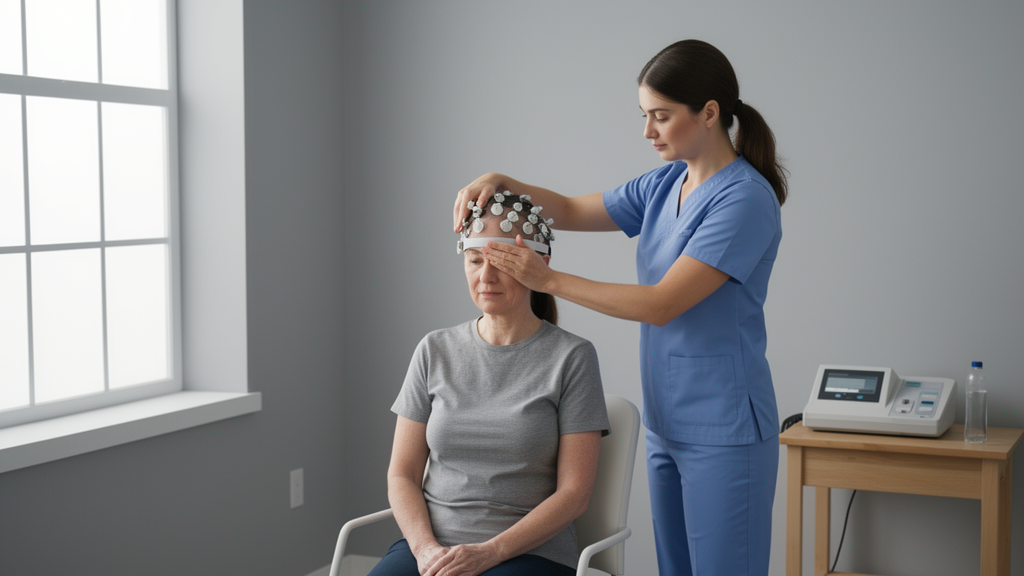
The technology half of the trial relied on a well-established stimulation protocol. Active tDCS was delivered over ten sessions, each lasting twenty minutes at a current of two milliamperes. The anode, the electrode that generally increases cortical excitability, was placed over F3—a position on the scalp corresponding to the left dorsolateral prefrontal cortex, a region repeatedly implicated in mood regulation and cognitive control over negative thoughts. The cathode was placed over Fp2, near the right forehead. This montage is one of the most commonly studied configurations in depression research, and the trial’s registration in the Iranian Registry of Clinical Trials, along with ethical approval from Baqiyatallah University’s research ethics committee, anchored the work in formal clinical research standards.
The psychological half of the trial took a different route to the same territory. Embodiment-based psychotherapy, delivered across eight sessions, draws on phenomenological ideas about how mental life is grounded in bodily experience. Rather than targeting thoughts and beliefs directly, as cognitive behavioral therapy does, this approach works with how patients inhabit and perceive their own bodies. The rationale for pairing it with tDCS was straightforward: if depression disrupts interoceptive processing—the brain’s monitoring and interpretation of internal bodily signals—then perhaps stimulating prefrontal circuits while simultaneously retraining bodily awareness through psychotherapy would attack the problem from two directions at once.
To measure whether that happened, the researchers used two validated instruments. The primary outcome was interoceptive awareness, assessed with the Multidimensional Assessment of Interoceptive Awareness, a questionnaire that captures several facets of body awareness, including noticing internal sensations, not worrying about them, and trusting bodily signals. The secondary outcome was depressive symptom severity, measured with the Beck Depression Inventory-II, one of the most widely used self-report scales in clinical depression research. Both measures were administered before treatment began and again after it ended, and the data were analyzed with a mixed-design analysis of variance followed by a pre-specified analysis of covariance with Bonferroni-corrected pairwise comparisons, a statistical approach that controls for baseline differences and guards against false positives when comparing multiple groups.
The results on the primary outcome were unambiguous. The four groups differed substantially in how much interoceptive awareness improved, with a very large effect size. Compared with the sham group, the combined treatment group gained an adjusted average of 23.24 points on the interoceptive awareness measure, the psychotherapy-only group gained 19.86 points, and the tDCS-only group gained 12.61 points. All three active treatments beat sham, but the ordering is telling: the psychotherapy produced nearly twice the gain of brain stimulation alone, and the combination landed only slightly above psychotherapy by itself.
Depressive symptoms told a similar story, with an even larger overall effect across groups. Relative to sham, depression scores fell by an adjusted 15.82 points in the combined group and 15.73 points in the psychotherapy group—essentially identical improvements. Both of those groups also outperformed tDCS alone. The tDCS-only group’s comparison with sham was more complicated: the covariate-adjusted analysis suggested a nominally significant reduction of 5.56 points, but that result did not hold up in the unadjusted analysis of change over time, which found no difference at all. The authors therefore concluded that tDCS alone did not produce a confirmed reduction in depressive symptoms in this trial, even though it did clearly improve interoceptive awareness.
The most consequential finding, however, is what did not appear. In an exploratory two-by-two factorial analysis designed specifically to test whether the two treatments interacted, both main effects were significant, but the interaction term showed no sign of synergy. The combined group did not differ from the psychotherapy-only group on either outcome, with adjusted comparisons yielding no detectable difference. In plain terms, adding electrical brain stimulation to the embodied therapy neither amplified its benefits nor accelerated them. The authors are careful about the limits of that conclusion: because the trial was powered only to detect differences between active treatments and sham, the comparison between the combined and psychotherapy-only groups is statistically inconclusive rather than a definitive null result. Still, the pattern offers no positive evidence that the combination is worth the extra sessions, equipment, and cost.
Why might the psychotherapy have done the heavy lifting? One possibility is mechanistic alignment. Embodiment-based psychotherapy directly targets the bodily self-experience that the trial measured, so large gains in interoceptive awareness are exactly what the theory predicts. tDCS, by contrast, modulates cortical excitability in a relatively blunt way, and its effects on interoceptive processing may be indirect. If the therapy already moves the needle close to the ceiling of what the intervention window allows, there may be little room left for stimulation to add benefit. Another consideration is dose: ten sessions of tDCS and eight sessions of psychotherapy are relatively brief courses, and some tDCS studies in depression use more sessions or different electrode configurations. The trial’s modest sample of thirty-eight completers also means the confidence intervals around each estimate are wide enough to leave room for smaller effects to hide.
The study nonetheless carries real weight for a field crowded with small, uncontrolled experiments. It is, according to the authors, the first single trial to compare the independent and combined effects of tDCS and embodiment-based psychotherapy on both interoceptive awareness and depressive symptoms. The sham-controlled, assessor-blinded design, the pre-specified statistical plan, and the trial registration all strengthen the credibility of the findings. For clinicians, the practical message is that a body-oriented psychotherapy, delivered alone or alongside tDCS, was associated with large improvements in both how patients sense their bodies and how depressed they feel. For researchers, the message is a challenge: the intuitive idea that stimulating the prefrontal cortex should supercharge any psychotherapy it accompanies did not survive contact with a controlled comparison. As interest in interoception as a treatment target for depression continues to grow, this trial suggests that the fastest route to a better relationship with one’s own body may run through the therapy room rather than through the electrodes.
Subject of Research: Combined tDCS and embodiment-based psychotherapy for interoceptive awareness and depressive symptoms in major depressive disorder
Article Title: Combined transcranial direct current stimulation and embodiment-based psychotherapy on interoceptive awareness and depressive symptoms in patients with major depressive disorder: a randomized, sham-controlled clinical trial
Article References: Matinpour, B., Chesli, R. R., Shams, J., & Mohammadi, A. (2026). Combined transcranial direct current stimulation and embodiment-based psychotherapy on interoceptive awareness and depressive symptoms in patients with major depressive disorder: a randomized, sham-controlled clinical trial. BMC Psychiatry. https://doi.org/10.1186/s12888-026-08779-3
Image Credits: AI Generated
DOI: 10.1186/s12888-026-08779-3
Keywords: major depressive disorder, tDCS, embodiment-based psychotherapy, interoceptive awareness, randomized controlled trial, sham stimulation, Beck Depression Inventory, prefrontal cortex, psychotherapy, brain stimulation, depression treatment, clinical trial
Cite Scienmag News
Glenn Wilkins. (October 17, 2026). Brain Stimulation Meets Body Therapy in Depression Trial, but the Combo Adds Nothing. Scienmag. https://scienmag.com/brain-stimulation-meets-body-therapy-in-depression-trial-but-the-combo-adds-nothing/
Glenn Wilkins. "Brain Stimulation Meets Body Therapy in Depression Trial, but the Combo Adds Nothing." Scienmag, 17 October 2026, https://scienmag.com/brain-stimulation-meets-body-therapy-in-depression-trial-but-the-combo-adds-nothing/. Accessed 17 October 2026.
Glenn Wilkins. "Brain Stimulation Meets Body Therapy in Depression Trial, but the Combo Adds Nothing." Scienmag. October 17, 2026. https://scienmag.com/brain-stimulation-meets-body-therapy-in-depression-trial-but-the-combo-adds-nothing/


