


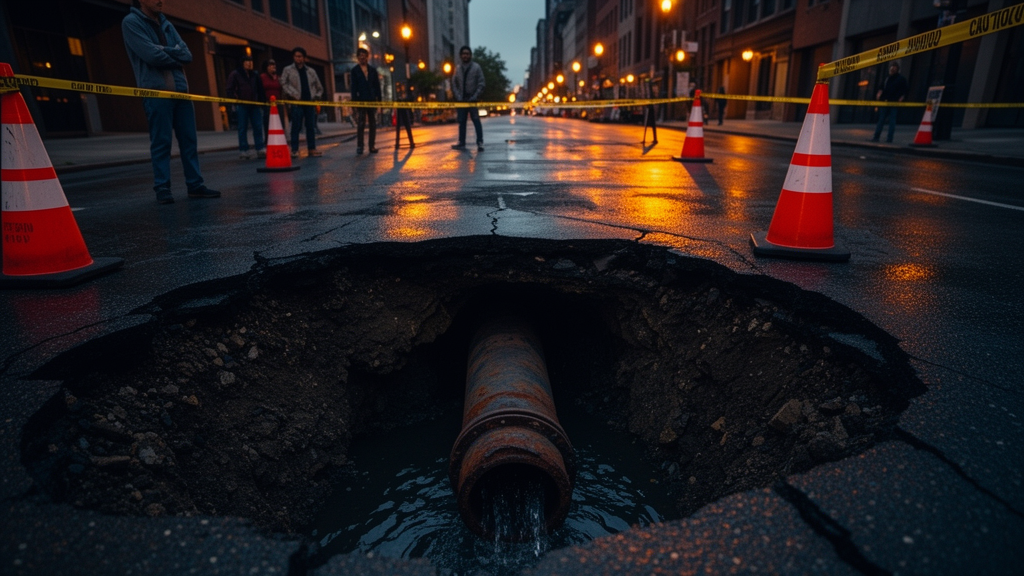
A sudden sinkhole swallowing a car on an ordinary city street rarely comes from nowhere. Behind most urban road collapses lies a slow, hidden negotiation between water and soil, and a new study published in Scientific Reports has now mapped that negotiation with unusual precision. A research team led by Liming Xue and Qiangbing Huang of Chang’an University in Xi’an combined physical model testing, finite-element simulation, and interpretable machine learning to understand how rainfall infiltration and pipeline leakage interact to bring about the hydro-mechanical failure of road surfaces in densely developed cities. Their central finding is striking: leakage pressure, not rainfall, is the dominant driver of collapse, contributing between roughly 86 and 93 percent of the variation in the key indicators of failure.
Urban ground collapse is a severe threat to public safety, road operation, and underground infrastructure, and it is becoming more frequent as cities age. Water pipes and sewers buried beneath roads leak for years, saturating the surrounding soil, while storms push additional water downward from the surface. When the two wetting zones meet, the soil between them loses strength and stiffness in ways that conventional engineering models often fail to capture. The Chang’an University team set out to quantify this coupled process, asking exactly how a wetting front descending from the surface coalesces with one expanding outward from a leaking pipe, and how that coalescence propagates deformation upward until the road can no longer support itself.
The study rested on three pillars of evidence. First, the researchers conducted physical model tests in which road sections over buried pipes were subjected to controlled rainfall and leakage, allowing them to observe the actual stages of collapse. Second, they built a validated finite-element numerical model that incorporated saturation-dependent strength and stiffness degradation, meaning the soil’s mechanical properties weaken as it becomes wetter. This model reproduced the physics observed in the tests. Third, they used the validated model to generate 120 full-factorial simulation cases spanning different pipe burial depths, rainfall intensities, and leakage pressures, creating a comprehensive dataset of how the system responds across a wide parameter space.
From these simulations, a clear four-stage failure mechanism emerged. Collapse develops through shallow-soil pre-wetting, in which rainfall first softens the upper layers of the ground. Then comes leakage-induced wetting-zone expansion, as water escaping from the pipe saturates the soil around it. The third stage is the convergence of the upper and lower wetting fronts, the critical moment when the two saturated zones meet and the intervening soil loses its load-bearing capacity. Finally, deformation propagates upward from the weakened zone toward the surface, culminating in road collapse. This sequence, the authors argue, is the hydro-mechanical fingerprint of the coupled rainfall-leakage process.
The dominance of leakage pressure is the study’s most consequential quantitative result. Leakage pressure accounted for 86.42 percent of the variation in collapse depth, 87.79 percent in the near-saturated zone area, and 92.77 percent in the wetting-front depth. Rainfall, by contrast, acts mainly as an amplifier: it intensifies the effects of leakage rather than initiating collapse on its own. Burial depth plays a regulating role, determining the path along which deformation transfers from the weakened soil to the road surface. These relative contributions give city engineers a clear priority ordering for inspection and intervention.
To make sense of the 120-case dataset without running expensive new simulations for every scenario, the team adopted a dual-surrogate machine learning strategy. Gaussian process regression and Kriging provided high-accuracy interpolation along with uncertainty estimation, achieving test-set R-squared values of 0.997 to 0.998, essentially near-perfect predictive fidelity. Meanwhile, XGBoost combined with SHAP (SHapley Additive exPlanations) enabled interpretable prediction and mechanism-consistency analysis, allowing the researchers to verify that the machine learning model’s internal reasoning aligned with the physics of the failure process rather than producing a black-box result.
Interpretability was not an afterthought but a design requirement. In engineering applications where public safety is at stake, a model that predicts collapse risk without explaining why is of limited use. By using SHAP values to attribute predictions to individual input features, the team could confirm that the surrogate models captured the same hierarchy of influence, leakage pressure first, rainfall second, burial depth third, that the underlying physics demanded. This mechanism-consistency check is what elevates the work from a statistical exercise to a genuine tool for understanding failure.
The framework also produces practical risk zoning. The researchers found that increasing rainfall shifts medium- and high-relative-risk conditions toward lower leakage pressures, particularly at intermediate burial depths. In other words, a pipe that might be tolerably leaky in dry weather becomes dangerous during a storm, and pipes at certain depths are especially vulnerable to this amplification. This kind of zoning map gives utilities a way to identify vulnerable pipeline sections before collapse occurs, supporting targeted inspection and collapse prevention rather than reactive repair after the road has already failed.
The implications for cities are broad. As climate change intensifies rainfall in many regions and as underground pipe networks in older cities continue to age, the coupled rainfall-leakage mechanism is likely to become an increasingly common trigger of urban ground collapse. The Chang’an University framework offers an efficient and interpretable tool for identifying at-risk sections, potentially saving municipalities enormous costs in emergency response and infrastructure repair. By showing that leakage pressure dominates while rainfall amplifies, the study gives engineers a clear, evidence-based starting point for prioritizing which pipes to inspect first and under what weather conditions the risk is greatest.
The research was jointly supported by the Key R&D Program Projects in Zhejiang Province, the Key Research and Development Program of Shaanxi Province, and the Fundamental Research Funds for the Central Universities. The authors declare no competing interests. The article is open access, published under a Creative Commons Attribution-NonCommercial-NoDerivatives 4.0 International License, and carries the permanent DOI 10.1038/s41598-026-73498-4. As cities worldwide grapple with aging infrastructure and intensifying storms, this study provides a rare combination of physical insight and machine learning rigor, offering a template for how interpretable AI can illuminate the hidden mechanics beneath our feet.
Subject of Research: Engineering
Article Title: From wetting-front coalescence to urban road collapse: interpretable machine learning of hydro-mechanical failure under coupled rainfall and pipeline leakage
Article References: Xue, L., Huang, Q., Liang, J., Gou, Y., & Dong, J. (2026). From wetting-front coalescence to urban road collapse: interpretable machine learning of hydro-mechanical failure under coupled rainfall and pipeline leakage. Scientific Reports. https://doi.org/10.1038/s41598-026-73498-4
Image Credits: AI Generated
DOI: 10.1038/s41598-026-73498-4
Keywords: urban ground collapse, pipeline leakage, rainfall infiltration, machine learning, hydro-mechanical failure, Scientific Reports, wetting-front, coalescence, urban, road, collapse, interpretable
Cite Scienmag News
Teresa Odom. (October 17, 2026). Pipeline leakage dominates urban road collapse risk, machine learning study finds. Scienmag. https://scienmag.com/pipeline-leakage-dominates-urban-road-collapse-risk-machine-learning-study-finds/
Teresa Odom. "Pipeline leakage dominates urban road collapse risk, machine learning study finds." Scienmag, 17 October 2026, https://scienmag.com/pipeline-leakage-dominates-urban-road-collapse-risk-machine-learning-study-finds/. Accessed 17 October 2026.
Teresa Odom. "Pipeline leakage dominates urban road collapse risk, machine learning study finds." Scienmag. October 17, 2026. https://scienmag.com/pipeline-leakage-dominates-urban-road-collapse-risk-machine-learning-study-finds/


