

Sunday, August 2, 2026
Science
No Result
View All Result
  • Login
  • HOME
  • SCIENCE NEWS
  • CONTACT US
  • HOME
  • SCIENCE NEWS
  • CONTACT US
No Result
View All Result
Scienmag
No Result
View All Result
Home Science News Technology and Engineering

The University of Tartu’s self-driving test vehicle now has remote control capabilities

April 18, 2024
in Technology and Engineering
Reading Time: 2 mins read
0
The University of Tartu’s self-driving test vehicle now has remote
66
SHARES
602
VIEWS
Share on FacebookShare on Twitter
ADVERTISEMENT

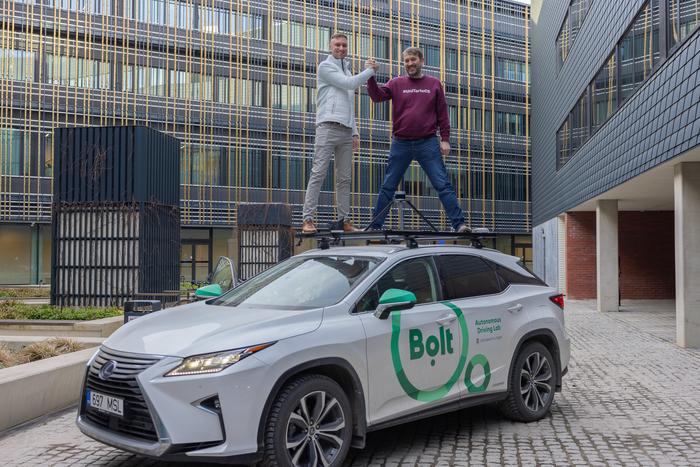
The University of Tartu Institute of Computer Science and Clevon AS have signed a three-year cooperation agreement, enabling a teleoperation system for the Autonomous Driving Lab’s test vehicle. Attendees at the technology demonstration were able to remotely control the car located nearly three kilometres away in the parking lot of the Estonian National Museum.

The University of Tartu's self-driving test vehicle now has remote-control capabilities Demonstration of the remote control system

Credit: Photos taken by Lotte Parksepp

The University of Tartu Institute of Computer Science and Clevon AS have signed a three-year cooperation agreement, enabling a teleoperation system for the Autonomous Driving Lab’s test vehicle. Attendees at the technology demonstration were able to remotely control the car located nearly three kilometres away in the parking lot of the Estonian National Museum.

According to Tambet Matiisen, the technology manager of Autonomous Driving Lab, teleoperation systems are important. “Remote control is an important technical solution in today’s autonomous vehicles, allowing the vehicle to seek assistance from a human in unexpected traffic situations, such as roadworks or traffic jams,” said Matiisen. He added that this allows the self-driving car to travel outside the mapped area, for example, to drop off passengers at their doorstep instead of the nearest bus stop.

Clevon emphasises the importance of cooperation with the university. “Collaboration provides us with valuable feedback to further develop our platform and create new solutions that meet both current and future transportation needs,” explains Clevon CEO Sander Sebastian Agur. In addition to new development directions, Clevon is interested in contributing to science and potential research focusing on autonomy or teleoperations.

According to Tambet Matiisen, further research is warranted on the remote control solution. “For example, we plan to investigate the situational awareness of the remote operator: how well does a person who is not actually in the car perceive the traffic situation? We also want to test the cybersecurity of the technology, and how easy it would be for a potential attacker to take over control of the car. Finally, we aim to develop alternative control methods, such as an option for the remote operator to see their surroundings from a bird’s-eye view or through virtual reality glasses,” Matiisen explained.

Clevon and the University of Tartu believe that the three-year cooperation agreement will yield many fruitful projects in the field of self-driving vehicles.


Method of Research

Meta-analysis

Subject of Research

Not applicable

Share26Tweet17
Previous Post

Materiobiology: revolutionizing aging bone regeneration material development

Next Post

Surprising role of female sex pheromone in crop pest: new biocontrol possibilities?

Related Posts

Bentham Science Launches International Journal of Wireless and Communication Engineering Innovation
Technology and Engineering

Bentham Science Launches International Journal of Wireless and Communication Engineering Innovation

August 2, 2026
What Long-Term Evidence Reveals About Hypoglycemia in Late-Preterm Infants
Technology and Engineering

What Long-Term Evidence Reveals About Hypoglycemia in Late-Preterm Infants

August 2, 2026
Scalable In-Process Inspection for Direct-Ink-Writing Additive Manufacturing
Technology and Engineering

Scalable In-Process Inspection for Direct-Ink-Writing Additive Manufacturing

August 1, 2026
New study finds shampoo routines may increase household water waste
Technology and Engineering

New study finds shampoo routines may increase household water waste

August 1, 2026
Johns Hopkins study finds deep disagreement on AI priorities for older adults
Technology and Engineering

Johns Hopkins study finds deep disagreement on AI priorities for older adults

August 1, 2026
Cage-confined catalysis enables asymmetric intermolecular photocycloaddition of (benzo)furans and excited alkenes
Technology and Engineering

Cage-confined catalysis enables asymmetric intermolecular photocycloaddition of (benzo)furans and excited alkenes

August 1, 2026
Next Post
Surprising role of female sex pheromone in crop pest: new

Surprising role of female sex pheromone in crop pest: new biocontrol possibilities?

  • Mothers who receive childcare support from maternal grandparents show more

    Mothers who receive childcare support from maternal grandparents show more parental warmth, finds NTU Singapore study

    27656 shares
    Share 11059 Tweet 6912
  • University of Seville Breaks 120-Year-Old Mystery, Revises a Key Einstein Concept

    1061 shares
    Share 424 Tweet 265
  • Bee body mass, pathogens and local climate influence heat tolerance

    682 shares
    Share 273 Tweet 171
  • Researchers record first-ever images and data of a shark experiencing a boat strike

    546 shares
    Share 218 Tweet 137
  • Groundbreaking Clinical Trial Reveals Lubiprostone Enhances Kidney Function

    531 shares
    Share 212 Tweet 133
Science

Embark on a thrilling journey of discovery with Scienmag.com—your ultimate source for cutting-edge breakthroughs. Immerse yourself in a world where curiosity knows no limits and tomorrow’s possibilities become today’s reality!

RECENT NEWS

  • Older Adults’ Views on Managing Chronic Pain in Primary Care
  • Brain-region microstructure and gene activity reveal Alzheimer’s neurodegeneration
  • Bentham Science Launches International Journal of Wireless and Communication Engineering Innovation
  • Deep brain stimulation restores social behavior after early-life pain by rebalancing circuits

Categories

  • Agriculture
  • Anthropology
  • Archaeology
  • Athmospheric
  • Biology
  • Biotechnology
  • Blog
  • Bussines
  • Cancer
  • Chemistry
  • Climate
  • Earth Science
  • Editorial Policy
  • Marine
  • Mathematics
  • Medicine
  • Pediatry
  • Policy
  • Psychology & Psychiatry
  • Science Education
  • Social Science
  • Space
  • Technology and Engineering

Subscribe to Blog via Email

Success! An email was just sent to confirm your subscription. Please find the email now and click 'Confirm Follow' to start subscribing.

Join 5,147 other subscribers

© 2025 Scienmag - Science Magazine

Welcome Back!

Login to your account below

Forgotten Password?

Retrieve your password

Please enter your username or email address to reset your password.

Log In
No Result
View All Result
  • HOME
  • SCIENCE NEWS
  • CONTACT US

© 2025 Scienmag - Science Magazine
