


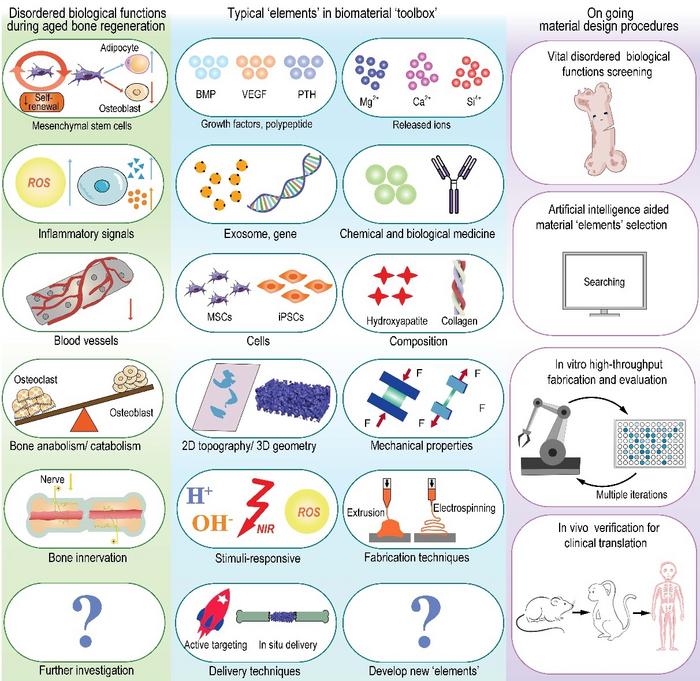
In the elderly, a multitude of factors contribute to diminished bone regeneration capabilities, including a reduction in the self-renewal and differentiation abilities of mesenchymal stem cells, an excessive accumulation of inflammatory signals, compromised blood vessel regeneration capacity, an imbalance between bone anabolism and catabolism, and inadequate bone innervation. While biomaterials have enhanced the therapeutic outcomes for bone regeneration, their efficacy is notably reduced in the context of aged bone regeneration. Consequently, it is imperative to devise new biomaterial design strategies specifically aimed at rejuvenating aged bone.

Credit: ©Science China Press
In the elderly, a multitude of factors contribute to diminished bone regeneration capabilities, including a reduction in the self-renewal and differentiation abilities of mesenchymal stem cells, an excessive accumulation of inflammatory signals, compromised blood vessel regeneration capacity, an imbalance between bone anabolism and catabolism, and inadequate bone innervation. While biomaterials have enhanced the therapeutic outcomes for bone regeneration, their efficacy is notably reduced in the context of aged bone regeneration. Consequently, it is imperative to devise new biomaterial design strategies specifically aimed at rejuvenating aged bone.
In the realm of aged bone repair, materiobiology emphasizes the meticulous modulation and restoration of biological functions at various levels—cellular, tissue, organ, and organism—through the use of functionalized biomaterials. This approach leverages a systematic amalgamation of ‘elements’ from the biomaterial ‘toolbox’, which encompasses biochemical factors (such as growth factors, polypeptides, chemical and biological drugs, and genes) and tailored biophysical effects (including composition, mechanical properties, two-dimensional topography, three-dimensional geometry, as well as advanced delivery and fabrication technologies).
The authors comprehensively discuss the current characteristics of aged bone regeneration, typical ‘elements’ within the biomaterial ‘toolbox’, and the ongoing procedures for material design. To enhance the design of biomaterials for correcting disordered biological functions in aged bone, a ‘toolbox’ comprising various essential ‘elements’ has been established. Guided by this material design strategy, standard material design procedures can be summarized as follows: (1) identifying critical disordered biological functions as therapeutic targets for bone repair in the elderly; (2) based on the characteristics of the selected biological functions, synergistically combining ‘elements’ from the biomaterial ‘toolbox’ with artificial intelligence (AI) support; (3) optimizing the ‘elements’ of modular biomaterials for aged bone regeneration through iterative refinements of composition and structure using in vitro high-throughput fabrication and evaluation technologies; (4) conducting in vivo validation of the optimized biomaterials in small animals and non-human primates to facilitate clinical translation. Further refinement of this material design strategy focuses on uncovering new aspects of biological functions that impede aged bone regeneration and developing novel ‘elements’ targeting specific biological functions. The establishment of a specialized database to match specific biological functions with modular biomaterial ‘elements’ through artificial intelligence presents a promising avenue for accelerating aged bone regeneration.
As a nascent interdisciplinary field, materiobiology requires the involvement of researchers from diverse domains to expand its scope and depth continually. This involves elucidating the intrinsic connections between the fundamental physicochemical properties of materials and their biological functions and establishing reliable predictive models to foster a genuine convergence of materials with biology, thereby expediting the development process of biomaterials.
This review lists Kay Dai, an associate professor at East China University of Science and Technology; Zhen Geng, an associate professor at Shanghai University; and Wenchao Zhang, a doctoral student at East China University of Science and Technology, as its first authors. The corresponding authors are Changsheng Liu, an academician of Chinese academy, at East China University of Science and Technology; Jing Wang, a professor at the same institution, and Guangjun Nie, a distinguished professor at the National Center for Nanoscience and Technology.
###
See the article:
Biomaterial design for regenerating aged bone: materiobiological advances and paradigmatic shifts
Journal
National Science Review
Cite Scienmag News
Beatrice Stafford. (April 9, 2024). Materiobiology: revolutionizing aging bone regeneration material development. Scienmag. https://scienmag.com/materiobiology-revolutionizing-aging-bone-regeneration-material-development/
Beatrice Stafford. "Materiobiology: revolutionizing aging bone regeneration material development." Scienmag, 9 April 2024, https://scienmag.com/materiobiology-revolutionizing-aging-bone-regeneration-material-development/. Accessed 3 September 2026.
Beatrice Stafford. "Materiobiology: revolutionizing aging bone regeneration material development." Scienmag. April 9, 2024. https://scienmag.com/materiobiology-revolutionizing-aging-bone-regeneration-material-development/

