


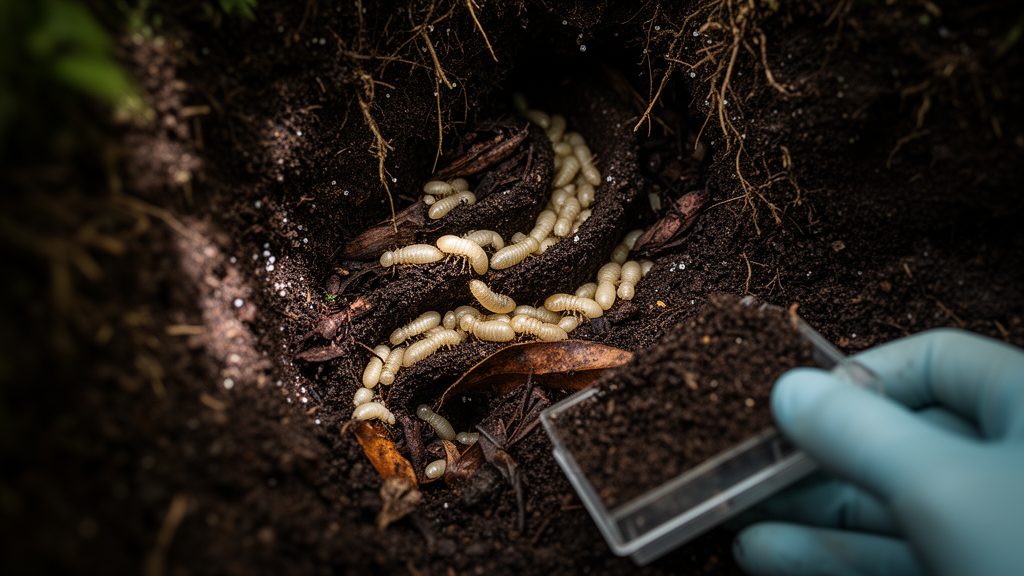
Deep in the soils of the Colombian Amazon, an unassuming termite has been hiding in plain sight. Researchers have now formally named it Ekueitermes alerosinus, a new genus and species of soldierless termite collected from forest floors, pastures, and agroforestry plots in the departments of Caquetá and Antioquia. The discovery, published in the journal ZooKeys, is based on a meticulous blend of worker gut anatomy and mitochondrial DNA sequencing, and it adds a fresh branch to one of the least understood termite lineages in the Neotropics.
Soldierless termites belong almost entirely to the subfamily Apicotermitinae, a group of soil-feeding insects that recycle organic matter and drive nutrient dynamics in tropical ecosystems. Unlike most termites, these species lack a soldier caste altogether, which makes them notoriously difficult to identify from external appearance alone. In some Neotropical assemblages they can represent up to half of all termite species present, yet their taxonomy has lagged far behind their ecological importance. Before 2009, only five genera had been described in the New World; today, 67 species in 25 genera are recorded, and many lineages are still believed to remain undescribed.
The new species was described exclusively from the worker caste, the sterile individuals that do the foraging and soil processing. The diagnostic characters lie hidden inside the digestive tract. Ekueitermes alerosinus possesses a mixed segment with a short, non-inflated mesenteric tongue, a very short and tubular P1 segment, and a well-differentiated tubular enteric valve seating. Most striking is the enteric valve armature itself: six conical cushions, each covered with 18 to 25 fringed polygonal scales and armed at the distal end with 7 to 17 strongly sclerotised spines arranged in a palmate, hand-like shape. This intricate internal machinery, invisible without dissection and microscopy, serves as the species’ fingerprint.
These characters matter because soldierless termites have evolved convergent body plans that confound traditional identification. The enteric valve armature has proven essential for delimiting lineages where external morphology offers few clues. In this case, the armature distinguishes Ekueitermes from its closest lookalikes. Patawatermes cushions bear roughly 50 to 80 scales with posterior spiny fringes, whereas Ekueitermes presents only 18 to 25. Hirsutitermes has a very long enteric valve seating with three distinctive lobes, absent in the new genus. Even Disjunctitermes, recovered as the sister group, lacks sclerotised spiny armature altogether.
To confirm the new lineage’s independence, the team extracted DNA from three independent pools of five workers each and amplified two mitochondrial regions: COI using universal Folmer primers and 16S rRNA. Sequencing via the Sanger method produced haplotypes that were aligned and concatenated into a final matrix of 941 base pairs for 34 terminals, including published records of Neotropical Apicotermitinae and the outgroup Sphaerotermes sphaerothorax. Phylogenetic relationships were inferred under both Bayesian inference in BEAST and maximum likelihood in IQ-TREE, with node support assessed through 1,000 SH-aLRT replicates and 10,000 ultrafast bootstrap replicates.
The results were unambiguous. Both inference criteria recovered Ekueitermes alerosinus as a strongly supported monophyletic clade with maximum support, positioned as the sister group to Disjunctitermes insularis. Genetic distances between the two haplotypes of the new species were minimal, confirming a single lineage, while the closest relative showed a divergence exceeding that observed between several established genera included in the analysis. This high level of divergence, combined with the diagnostic gut characters, identifies the lineage as an independent evolutionary unit and justifies the erection of a new genus.
Interestingly, the phylogenetic position and the enteric valve armature tell somewhat different stories. While Ekueitermes and Disjunctitermes are sister taxa, their valve armatures differ markedly, with Ekueitermes more closely resembling those of Patawatermes and Hirsutitermes. A comparable mismatch was reported in previous work on Anoplotermes susanae, adding to evidence that the enteric valve armature alone may be insufficient to infer relationships within the subfamily. The combined use of additional gut characters and molecular data, as applied here, offers a more robust framework.
Ecologically, the species was collected mainly in soil up to 20 centimetres deep and, like many Apicotermitinae in the New World, does not build above-ground structures. It inhabits natural forests, pastures, and agroforestry systems, and its range stretches from the Amazonian foothills of Caquetá at 260 metres above sea level to the Central Andes of Antioquia at nearly 1,000 metres. In the Andean region it has been recorded in association with the rhinotermitid species Dolichorhinotermes longidens. Previous literature records from Caquetá had provisionally designated this lineage as Apicotermitinae sp. 4, a name consistent with the paratypes examined in the present study.
The formal description highlights how much biodiversity remains undocumented even in relatively common habitats. The species had been collected in two different biogeographic regions, Amazonia and the Andes, suggesting a wider distribution than initial records indicated, particularly given that the Andean region is one of the least sampled areas in Colombia. Many Apicotermitinae taxa appear to possess broader ranges than early surveys suggested, a pattern related to the Wallacean Shortfall, the gap between known and actual distributions. Recent inventories incorporating photographs of enteric valves of morphotypes have helped report additional records, but insufficiently detailed descriptions have historically complicated species delimitation, underscoring the importance of comprehensive descriptions with high-quality images.
Resolving the evolution of Neotropical soldierless lineages remains a challenge. While COI provided a reliable taxonomic proxy, single mitochondrial markers can be insufficient to resolve deeper relationships, as evidenced by paraphyly detected in genera like Anoplotermes and Astalotermes. In the present study, COI and 16S rRNA were combined to increase informative positions, yet deeper nodes within the Neotropical clade remained weakly supported under both criteria. Future mitogenomic or phylogenomic analyses will be essential to confirm whether the current placement of Ekueitermes remains stable or whether broader genomic sampling reveals deeper affinities with other lineages. For now, the naming of this hidden soil engineer, whose genus name honours the Uitoto word for spine and the Uitoto indigenous community of the Colombian Amazon, marks a meaningful step toward documenting biodiversity in regions undergoing land-use change.
Subject of Research: Zoology
Article Title: Ekueitermes alerosinus , a new genus and species of soldierless termite from Colombia ( Isoptera , Termitidae , Apicotermitinae )
Article References: Duran-Bautista, E. H., Celis-Daza, F., Poveda Quezada, N. S., Ortiz-Morea, F. A., Scheffrahn, R. H., & Castro, D. (2026). Ekueitermes alerosinus, a new genus and species of soldierless termite from Colombia (Isoptera, Termitidae, Apicotermitinae). ZooKeys, 1292, 275-292. https://doi.org/10.3897/zookeys.1292.195853
Image Credits: AI Generated
DOI: 10.3897/zookeys.1292.195853
Keywords: Ekueitermes, alerosinus, genus, species, soldierless, termite, Colombia, Isoptera, Termitidae, Apicotermitinae, scientific research
Cite Scienmag News
Drew Townsend. (October 17, 2026). Hidden soldierless termite species discovered in Colombian Amazon soils. Scienmag. https://scienmag.com/hidden-soldierless-termite-species-discovered-in-colombian-amazon-soils/
Drew Townsend. "Hidden soldierless termite species discovered in Colombian Amazon soils." Scienmag, 17 October 2026, https://scienmag.com/hidden-soldierless-termite-species-discovered-in-colombian-amazon-soils/. Accessed 17 October 2026.
Drew Townsend. "Hidden soldierless termite species discovered in Colombian Amazon soils." Scienmag. October 17, 2026. https://scienmag.com/hidden-soldierless-termite-species-discovered-in-colombian-amazon-soils/


