


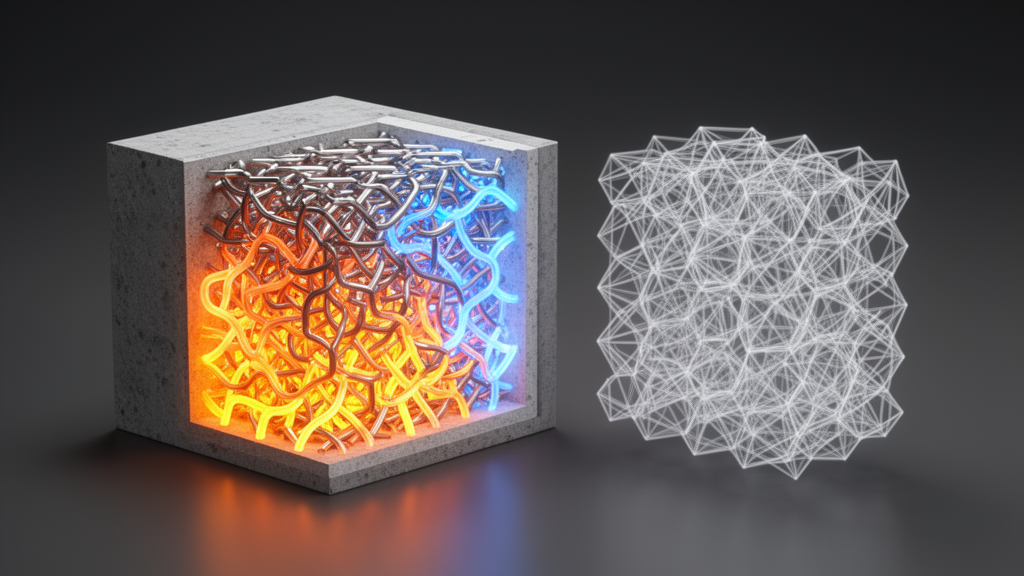
High-power electronic devices generate heat at rates that push conventional cooling strategies to their limits, and composite phase-change materials have emerged as one of the most promising answers to this challenge. These materials absorb thermal energy by melting at a carefully chosen temperature, storing it as latent heat rather than allowing it to drive up component temperatures. Yet for decades, engineers designing such composites have faced a frustrating reality: improving one property almost invariably degrades another. Boost thermal conductivity and electrical insulation suffers; preserve storage density and heat transfer slows. A research team reporting in National Science Review now describes a machine learning framework, called PHICS, that confronts this trade-off problem directly, using physics-based constraints rather than blind data fitting to guide the design of multifunctional composites from the molecule up.
The core weakness of conventional AI-driven materials discovery, according to the researchers, lies in the black-box character of most end-to-end models. A neural network trained purely on input-output pairs can interpolate well within its training data, but it learns nothing about the causal mechanisms that connect a microscopic formulation to a macroscopic property. When asked to extrapolate beyond its dataset, such a model can produce physically impossible predictions. Worse still, when the design task involves multiple conflicting objectives, black-box optimizers tend to wander into local optima, missing the true best solutions entirely. PHICS, short for a physics-constrained inverse design system, was built to overcome precisely these limitations by embedding physical law into the architecture of the model itself rather than hoping the data will reveal it.
The structural backbone of PHICS is a directed acyclic graph, a topology in which information flows in one direction only and no circular dependencies exist. This choice is not merely computational convenience; it enforces a transparent causal chain that mirrors the actual multiscale hierarchy of a composite material. At the base of the chain sits microscale composition, the choice of fillers, matrix materials, and additives. These determine mesoscale interfaces, the thin regions where different phases meet and where heat and charge carriers must pass. Interfaces in turn shape multiphase networks, the connected pathways that span the bulk material, and those networks ultimately dictate macroscale functional properties such as thermal conductivity, electrical resistivity, and latent heat capacity. By decoupling the problem into this explicit sequence, PHICS retains the fitting efficiency of data-driven regression while strictly adhering to fundamental conservation laws and boundary constraints at every step.
This architecture yields a practical benefit that pure machine learning cannot match: superior extrapolation and generalization fidelity. Because each link in the causal graph is constrained by physics, the framework can make credible predictions in regions of the design space where experimental data are sparse or absent. That capability matters enormously for inverse design, the task of working backward from a desired set of properties to the formulation and microstructure that will deliver them. Inverse design is mathematically demanding because the mapping from properties back to parameters is rarely unique and the search space is high-dimensional. PHICS addresses this by coupling its physics-causal surrogate model with NSGA-II, the non-dominated sorting genetic algorithm II, a well-established evolutionary optimizer designed for multi-objective problems.
The choice of NSGA-II reflects the mathematical character of the problem. When a material must simultaneously optimize several conflicting properties, the set of best possible solutions forms a Pareto front, a surface in performance space where no objective can be improved without sacrificing another. For composite phase-change materials, this front is complex and non-convex, meaning that simple weighted combinations of objectives can easily steer an optimizer into a local optimum that looks good but falls far short of the true frontier. Traditional trial-and-error experimentation fares even worse, requiring exhaustive synthesis campaigns to map even a fraction of the design space. By contrast, the PHICS-plus-NSGA-II combination performs high-throughput evaluations within seconds and carries out high-precision inversion of optimal microstructural parameters across high-dimensional, non-convex target spaces, tracing the Pareto front with a completeness that manual methods cannot approach.
The framework was put to a demanding practical test: the design of graphite fiber and n-octacosane composite phase-change materials intended for the thermal management of high-power electronics. N-octacosane, a paraffin wax, offers excellent latent heat storage, but on its own it conducts heat poorly. Graphite fibers provide conductive highways for thermal transport, yet graphite is also electrically conductive, which creates a serious risk of short circuits in dense electronic assemblies. Guided by the inverse design output of PHICS, the team introduced an ultrathin amorphous alumina interface transition layer precisely at the boundaries between the graphite fibers and the paraffin matrix. This nanoscale intervention was not an arbitrary choice but a direct product of the framework’s causal reasoning about how interface engineering propagates through the multiscale chain to affect final properties.
The amorphous alumina layer performs a remarkable double duty. It acts simultaneously as a phonon transmission bridge and an electron insulation barrier. Phonons, the quantum vibrations that carry heat in non-metallic solids, can pass across the alumina layer with acceptable resistance, so the graphite fibers retain their ability to spread heat rapidly through the composite. Electrons, by contrast, are blocked by the insulating alumina, so the composite as a whole remains electrically resistive even though it contains a conductive filler. The result is a concurrent leap in both thermal conductivity and electrical resistivity while preserving high latent heat storage density. In effect, the design breaks the long-standing seesaw effect among competing properties, achieving simultaneous enhancements that traditional formulation strategies had treated as mutually exclusive.
Beyond the specific material achievement, the work establishes a methodological paradigm that its authors describe as a full closed loop spanning multiscale inverse design and experimental validation. The loop runs from physics-constrained modeling through multi-objective inverse optimization to synthesized materials and back to measured performance, allowing the model to be refined against reality rather than against assumptions. Leveraging interface, phase, and carrier engineering in combination, the approach demonstrates how causal structure and evolutionary search can be woven together to navigate design spaces that overwhelm both human intuition and conventional optimization. The researchers suggest that this paradigm of physics-constrained modeling coupled with multi-objective inverse optimization paves a pathway for the intelligent inverse design of next-generation functional composites well beyond thermal management.
The study was conducted by researchers led by Professors Shih-Chi Chen, Jianbin Xu, and Ni Zhao of The Chinese University of Hong Kong, with support from the Centre for Heterogeneous Integration and Production under SEAM@InnoHK, the third InnoHK research cluster of the Hong Kong Special Administrative Region. The centre is dedicated to advancing next-generation electronics through innovations in semiconductor equipment and materials processing powered by heterogeneous integration technologies, a mission that aligns closely with the thermal management needs the new materials address. As electronic devices continue to concentrate power into ever smaller volumes, the ability to design materials that conduct heat, block current, and store thermal energy all at once may prove essential, and PHICS offers a blueprint for finding such materials not by accident but by design.
Subject of Research: Physics-constrained machine learning for the inverse design of multifunctional composites
Article Title: Physics-constrained machine learning for the inverse design of multifunctional composites
Article References: Physics-constrained machine learning for the inverse design of multifunctional composites. (n.d.). Original publication
Image Credits: AI Generated
DOI: Not provided
Keywords: Physics-constrained, machine, learning, inverse, design, multifunctional, composites, scientific research
Cite Scienmag News
Katie Riggs. (October 17, 2026). Physics-Constrained AI Breaks Long-Standing Trade-Offs in Composite Thermal Materials. Scienmag. https://scienmag.com/physics-constrained-ai-breaks-long-standing-trade-offs-in-composite-thermal-materials/
Katie Riggs. "Physics-Constrained AI Breaks Long-Standing Trade-Offs in Composite Thermal Materials." Scienmag, 17 October 2026, https://scienmag.com/physics-constrained-ai-breaks-long-standing-trade-offs-in-composite-thermal-materials/. Accessed 17 October 2026.
Katie Riggs. "Physics-Constrained AI Breaks Long-Standing Trade-Offs in Composite Thermal Materials." Scienmag. October 17, 2026. https://scienmag.com/physics-constrained-ai-breaks-long-standing-trade-offs-in-composite-thermal-materials/


