


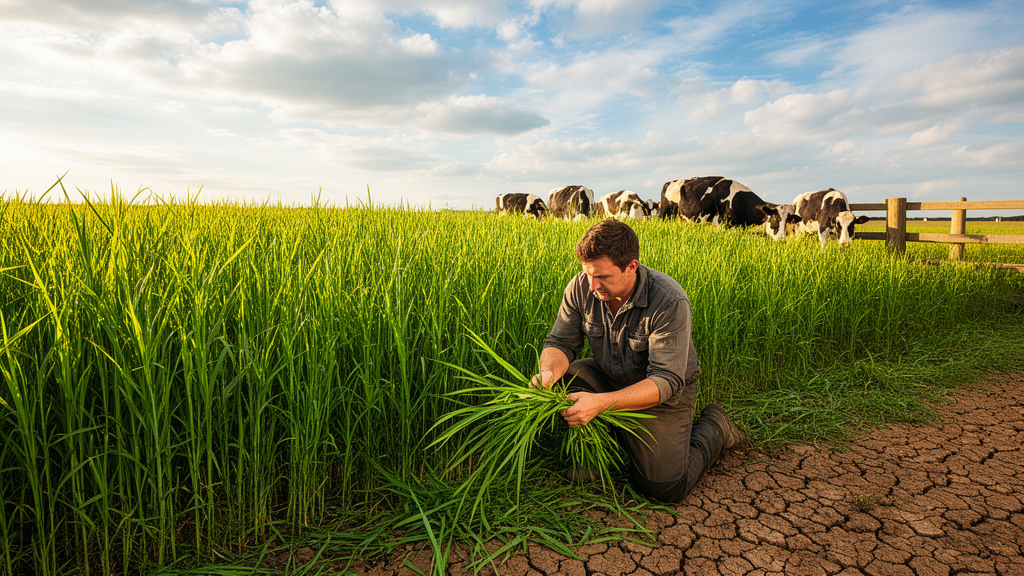
A sweeping new review published in Innovations in Agriculture argues that one of the biggest untapped opportunities in global food security lies at the intersection of two disciplines that rarely talk to each other: plant breeding and animal nutrition. The analysis, focused on forage grasses and legumes for ruminant livestock, makes the case that climate-resilient, nutrient-dense pastures could dramatically improve milk and beef production in drought-prone regions, but only if breeders start designing plants around the nutritional demands of the animals that will eat them. In much of sub-Saharan Africa, where livestock can account for up to 44 percent of agricultural GDP in West Africa, the stakes could hardly be higher.
The core problem the review identifies is what researchers call the breeder’s dilemma. Conventional forage breeding has historically prioritized yield, stress tolerance, and pest resistance, while traits that matter enormously to ruminant nutrition, such as digestibility, crude protein content, and the reduction of anti-nutritional compounds, have received far less attention. The result is a generation of improved cultivars that perform beautifully in agronomic trials yet fail to deliver meaningful gains in animal productivity. Improved cereal and forage varieties often produce more biomass but retain high lignin or phytate levels that limit how much energy and protein livestock can actually extract from them.
The consequences of this mismatch are most visible during the dry season. Studies from Tanzania and Ethiopia cited in the review show that crude protein and metabolizable energy levels in available forages can drop by 20 to 28 percent when the rains fail, driving milk production down by as much as 40 percent. In Nigeria, ruminant systems face acute forage scarcity during dry months, forcing farmers to rely on low-nutrient crop residues or expensive commercial supplements. These seasonal feed gaps are compounded by drought-induced pasture loss, livestock mortality, and declining soil fertility, undermining household food security and the long-term viability of mixed farms across the tropics.
Forages are not a minor input in these systems. Grasses and legumes supply more than 90 percent of the feed energy consumed by herbivorous livestock worldwide, effectively converting non-human-edible biomass into high-quality animal protein. The review catalogs the workhorses of tropical pasture science: Brachiaria grasses such as the Marandu, Piata, and Xaraes cultivars, prized for drought tolerance and persistence; Guinea grass, which offers high biomass but demands fertile soils; and Napier grass, a staple of cut-and-carry systems despite its vulnerability to stunt and smut diseases. On the legume side, species like Stylosanthes, Leucaena leucocephala, Desmodium, and Lablab purpureus boost crude protein in forage mixtures and fix nitrogen biologically, enriching the soil in the process.
The nutritional chemistry of these plants tells a striking story. Many tropical grasses, including Urochloa brizantha and the Urochloa hybrid Cayman, deliver crude protein concentrations of just 68 to 77 grams per kilogram of dry matter, below the threshold needed for efficient rumen microbial function. Legumes such as Leucaena diversifolia and Canavalia brasiliensis reach 195 to 256 grams per kilogram, while also contributing more metabolizable energy and lowering neutral detergent fiber and acid detergent lignin, both of which improve digestibility. Mineral deficits in calcium, phosphorus, and magnesium are common in dry-season tropical grasses and must be corrected through supplementation or by integrating mineral-rich legumes into pastures.
But legumes come with their own chemical complications. Leucaena diversifolia can carry condensed tannin concentrations of up to 47 grams per kilogram of dry matter, along with phenolics that bind proteins and reduce digestibility. The review notes that moderate tannin levels can actually be beneficial, slowing ruminal protein degradation and reducing nitrogen losses, but excessive amounts depress intake and nutrient absorption. Palatability adds another layer of complexity: birdsfoot trefoil, for example, is often less palatable than lucerne or white clover, and rapidly degradable legume proteins can cause ruminal ammonia accumulation and environmental nitrogen losses if not balanced with sufficient dietary energy.
On the resilience side, the review details the physiological traits that separate drought survivors from casualties. Deep and dense root systems allow plants like cocksfoot and tall fescue to tap subsoil moisture; deep-rooting tall fescue cultivars such as Flecha and Centurion demonstrate improved survival by accessing deeper water reserves. Osmotic adjustment, the accumulation of compatible solutes like proline, glycine betaine, and trehalose, maintains cell turgor and stabilizes membranes and proteins during water stress. Transpiration efficiency matters too, and C4 grasses including several Brachiaria cultivars hold an inherent advantage thanks to their photosynthetic pathway and reduced stomatal conductance. The cocksfoot cultivar Kasbah takes an even more dramatic approach, entering complete summer dormancy to survive prolonged drought, though at the cost of relatively low water-use efficiency during active growth.
The breeding toolkit itself is evolving, though unevenly. Conventional methods remain the cornerstone: mass selection, recurrent selection, and hybridization have produced landmark cultivars such as Marandu in Brazil, which combined high biomass yield with adaptation to acidic soils. Yet these approaches are slow, typically requiring 10 to 15 years to release a new cultivar, and apomictic grasses that propagate clonally through seeds complicate genetic recombination. Modern molecular tools promise acceleration but face real barriers. Marker-assisted selection has underperformed in forages because traits like digestibility and drought tolerance are polygenic and expensive to screen for. Genomic selection and genome-wide association studies have transformed maize, wheat, and dairy cattle breeding but lag in forage crops, where large training populations are required and commercial investment is thin. CRISPR gene editing offers tantalizing prospects for tailoring lignin and tannin levels, but regulatory restrictions and public acceptance remain significant hurdles.
Perhaps the most compelling section of the review addresses what happens when the two disciplines genuinely collaborate. Australia’s EverCrop initiative provides a working model, integrating crop improvement with animal performance trials from the design stage of breeding programs. Feed evaluation trials, including in vitro digestibility assays and animal model studies measuring intake, growth, reproduction, and feed efficiency, should become integral to selection pipelines rather than afterthoughts. Case examples show the payoff: forage sorghum delivers both biomass and energy density for dry-season feeding, while Desmodium intortum grown with Napier grass and Brachiaria improves crude protein, metabolizable energy, feed intake, and animal productivity while simultaneously enriching soil through nitrogen fixation. Trials with different ryegrass cultivars similarly demonstrate that evaluating plant and animal outcomes together identifies genuinely superior forages.
The review is candid about the obstacles that go beyond the laboratory. Adoption of improved forages in sub-Saharan Africa has been hampered by weak seed markets, high establishment costs, and limited extension services, in sharp contrast to Brazil, where strong seed systems and government-private sector partnerships enabled large-scale uptake of Brachiaria cultivars and measurable gains in beef productivity. Genetic trade-offs also persist: breeding for drought tolerance often raises lignin content or delays maturity, both of which reduce digestibility, while selecting for high protein or reduced fiber can compromise persistence and pest resistance. The authors call for holistic breeding programs with embedded nutritional testing, integrated forage innovation hubs connecting research institutions, seed companies, and extension networks, and policies that fund integrative research and guarantee seed availability. They also acknowledge the limitations of their own evidence base, noting that most cultivar evaluations remain confined to controlled experiments and that socioeconomic factors such as labor availability, gender roles, and market incentives are poorly integrated into breeding priorities. The message is clear: resilient, nutritious forages exist on the drawing board, but turning them into farm-level transformation will require sustained investment, participatory research, and delivery systems that finally connect plant science to the animals and farmers who depend on it.
Subject of Research: Integrating plant breeding and animal nutrition to develop drought-tolerant, high-nutrient forage grasses and legumes for sustainable ruminant livestock production
Article Title: Synergizing plant breeding and animal nutrition: A review on the development of drought-tolerant and high-nutrient forage grasses and legumes
Article References: Adepoju, S. A., & Faniyi, T. O. (2025). Synergizing plant breeding and animal nutrition: A review on the development of drought-tolerant and high-nutrient forage grasses and legumes. Innovations in Agriculture, 8, 1-10. https://doi.org/10.3897/ia.2025.163461
Image Credits: AI Generated
Keywords: forage breeding, drought tolerance, ruminant nutrition, forage legumes, forage grasses, crude protein, digestibility, sub-Saharan Africa, livestock productivity, seed systems, genomic selection, climate resilience
Cite Scienmag News
William Thompson. (October 17, 2026). Breeding Drought-Proof, Nutrient-Rich Forages Could Transform Livestock Farming. Scienmag. https://scienmag.com/breeding-drought-proof-nutrient-rich-forages-could-transform-livestock-farming/
William Thompson. "Breeding Drought-Proof, Nutrient-Rich Forages Could Transform Livestock Farming." Scienmag, 17 October 2026, https://scienmag.com/breeding-drought-proof-nutrient-rich-forages-could-transform-livestock-farming/. Accessed 17 October 2026.
William Thompson. "Breeding Drought-Proof, Nutrient-Rich Forages Could Transform Livestock Farming." Scienmag. October 17, 2026. https://scienmag.com/breeding-drought-proof-nutrient-rich-forages-could-transform-livestock-farming/


