


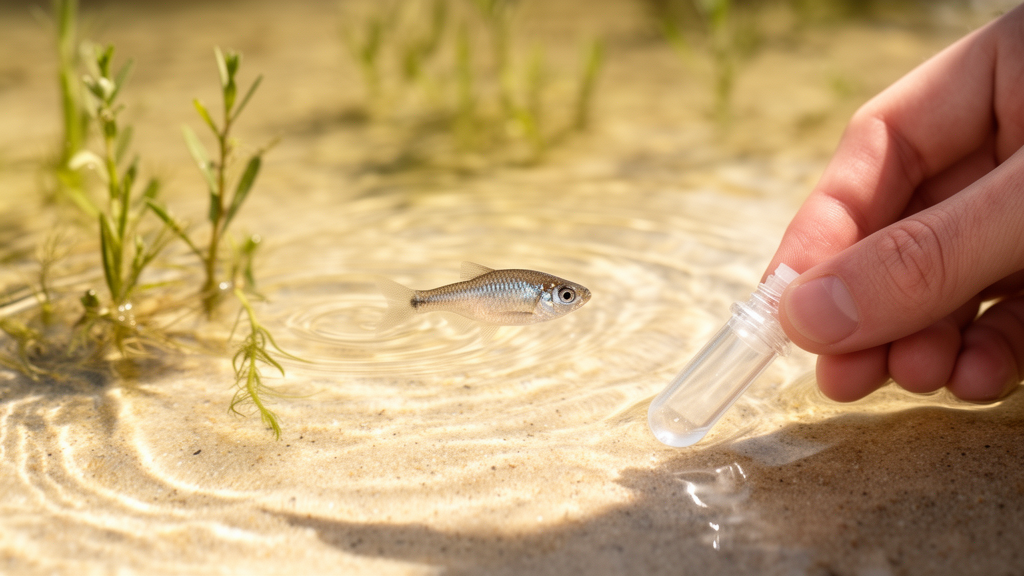
Deep in the Szada Pilot Area of Hungary, a cluster of small artificial ponds has quietly become the proving ground for one of conservation science’s most pressing questions: how do we objectively measure whether a reintroduction actually worked? A new study published in Nature Conservation has applied a recently proposed standardised assessment framework to the European mudminnow (Umbra krameri), a vulnerable fish rarely exceeding ten centimetres in length, and the results carry implications far beyond these groundwater-fed ponds. For the first time, an independent research team has tested the multi-criteria framework of Birot et al. (2025) on a real translocation programme, offering a template that could transform how thousands of conservation translocations worldwide are evaluated and compared.
Conservation translocation, the intentional movement and release of organisms for conservation benefit, has become one of the most widely deployed tools in the global conservation arsenal. Preliminary estimates suggest that programmes involving plant and animal species number in the thousands worldwide, yet the field lacks a universally adopted method for measuring success. This gap matters enormously. At least twelve different definitions of reintroduction success have been identified in the literature, and programme managers have developed a bewildering range of approaches for assessing outcomes. Without standardisation, meaningful comparison across programmes, sites, and species remains nearly impossible, stalling the synthesis studies needed to advance translocation science and reveal emerging ecological patterns.
The scale of the problem becomes apparent when examining the published record. A comprehensive review by Fischer and Lindenmayer (2000) covering 180 studies found that only 26% of programmes were successful, 47% had unknown outcomes, and 27% were classified as failures. But these figures should be treated with caution. Because the assessment relied on published studies, it necessarily reflects the biases of the literature itself, including the likely overrepresentation of successful programmes. The Hungarian experience illustrates this vividly: of 27 animal reintroduction projects that reached implementation, only 33% resulted in an English-language publication, and most of those publications describe programmes considered successful. A substantial proportion of programmes may therefore remain undocumented, their failures invisible to the international community.
The European mudminnow programme in Hungary offered an ideal test case for the new framework. Launched by the Tavirózsa Association, the comprehensive project aimed to preserve and strengthen populations of this vulnerable fish, which lives in shallow waters rich in aquatic plants. Egg production is low and highly variable, ranging from 75 to 2528 eggs, but females care for their eggs, a trait that shapes the species’ demographic potential. Between 2010 and 2024, the programme introduced mudminnows into six artificially created refuge habitats in the Szada Pilot Area, with stocked fish produced through ex situ laboratory breeding and in situ cage breeding of rescued individuals. The goal was to establish suitable habitats providing safety and refuge for this endangered species.
The study focused on two sites: Illés Pond VI and the combined Illés Pond IV + Pócos Pond B. These groundwater-fed artificial water bodies each cover roughly 40 square metres with an average depth of 1.5 metres, and crucially, none is connected to any watercourse. This hydrological isolation prevents different mudminnow populations from mixing and reduces the chances of the invasive Amur sleeper (Perccottus glenii) establishing and spreading. The last introductions took place in 2012 and 2015 respectively, meaning that by 2022 the populations had persisted for 10 and 7 years without further releases. Given that mudminnow can reach sexual maturity at one year old and the maximum expected lifespan is 6 to 7 years, every fish caught after seven years was demonstrably born locally, the offspring of released individuals.
Monitoring between 2013 and 2022 used electric fishing devices covering two-thirds of the pond shoreline, with captured fish identified, measured, counted, and released immediately. Because capture probability was not estimated directly, the researchers assumed 50% capture efficiency, consistent with previous European studies indicating that single-pass electrofishing capture probability varies between approximately 31% and 65% among species and habitats. The size-class structure analysis divided caught fish into five classes ranging from 0-20 mm to ≥81 mm standard length. The coexistence of multiple size classes within years, combined with repeated occurrences of larvae and young-of-the-year fish, demonstrated regular recruitment and survival across generations in both ponds, entirely consistent with self-sustaining, multi-cohort populations.
Applying the Birot et al. (2025) framework, which evaluates four key dimensions of translocated population development including survival and persistence, recruitment, spatial distribution, and population dynamics, the researchers assigned overall progress scores of 0.56 for Illés Pond IV + Pócos Pond B and 0.70 for Illés Pond VI. Population dynamics were classified as Establishing/Growing in the former and Growing in the latter. The apparent-survival criteria yielded contrasting outcomes: the 2022 abundance estimate for Illés Pond IV + Pócos Pond B was 34 individuals relative to 420 released, corresponding to the Failing category, while Illés Pond VI showed an estimated abundance of 140 relative to 109 released, supporting a Growing/Regulating classification. These scenario-based estimates should not be interpreted as direct survival rates of released individuals because the populations also contained locally born descendants.
The contrasting A2 outcomes between the two ponds reveal the complexity of assessing small populations. In Illés Pond IV + Pócos Pond B, the 2022 abundance estimate remained substantially below the cumulative number released, potentially reflecting releases above the pond’s carrying capacity, imperfect detection, environmental fluctuations, and management-related removals. The ponds’ carrying capacities were limited by their small size, with the 60 cubic metre volume typically reduced by up to 40% by the end of a dry summer. Severe droughts in 2021 and 2022 caused significant drops in water levels, prompting emergency rescue operations in Illés Pond VI, where some individuals were temporarily relocated and reintroduced in October 2022. The researchers deliberately introduced more fry than the estimated carrying capacity would allow, ensuring that a population well adapted to the new environment could develop through natural selection.
Notably, despite long-term persistence, recurrent reproduction, and an apparently stable population near the pond’s carrying capacity, the dominant framework category for Illés Pond IV + Pócos Pond B remained Establishing. This discrepancy illustrates a potential limitation of the framework when applied to small, isolated populations, where strong interannual fluctuations may reflect normal dynamics rather than incomplete establishment. The researchers also observed a moderate negative association between mean catch per survey and mean body size, likely reflecting the combined effects of episodic recruitment, small sample sizes, and substantial environmental variability typical of small artificial ponds. Density-dependent growth is a widespread regulatory mechanism in fish populations, and such effects may be particularly pronounced in small water bodies where strong environmental fluctuations can override simple density-growth relationships.
The broader significance of this work extends well beyond Hungarian ponds. The framework proved suitable for evaluating the programme, though the researchers caution that smaller programmes with more limited resources may find such comprehensive assessment challenging to implement. They suggest complementing the framework with a simpler assessment option based on Seddon’s (1999) approach for programmes lacking the detailed information required. Looking forward, the team recommends that funding organisations require conservation translocation programmes to be adequately monitored, documented, and published according to a standardised framework developed by the professional community. The results demonstrate that small, isolated, groundwater-fed artificial ponds can support persistent, self-recruiting European mudminnow populations over multiple generations despite the species’ relatively low fecundity, establishing suitable habitats that provide safety and refuge for this endangered species. Further testing across a wider range of programmes and ecological contexts would help assess the framework’s broader applicability, potentially ushering in an era where conservation translocation science finally speaks a common language.
Subject of Research: conservation translocation science
Article Title: Testing a recently proposed framework for assessing the success of conservation translocations: the European mudminnow ( Umbra krameri ) programme in Hungary
Article References: Bajomi, B., Tatár, S., Tóth, B., Dukay, I., Nyeste, K., & Müller, T. (2026). Testing a recently proposed framework for assessing the success of conservation translocations: the European mudminnow (Umbra krameri) programme in Hungary. Nature Conservation, 65, 173-195. https://doi.org/10.3897/natureconservation.65.189862
Image Credits: AI Generated
DOI: 10.3897/natureconservation.65.189862
Keywords: conservation translocation, European mudminnow, Umbra krameri, reintroduction biology, Hungary, population monitoring, species conservation, ecological assessment framework, Testing, recently, proposed, framework
Cite Scienmag News
Margaret Porter. (October 17, 2026). A Tiny Endangered Fish Is Rewriting the Rules of Conservation Success. Scienmag. https://scienmag.com/a-tiny-endangered-fish-is-rewriting-the-rules-of-conservation-success/
Margaret Porter. "A Tiny Endangered Fish Is Rewriting the Rules of Conservation Success." Scienmag, 17 October 2026, https://scienmag.com/a-tiny-endangered-fish-is-rewriting-the-rules-of-conservation-success/. Accessed 17 October 2026.
Margaret Porter. "A Tiny Endangered Fish Is Rewriting the Rules of Conservation Success." Scienmag. October 17, 2026. https://scienmag.com/a-tiny-endangered-fish-is-rewriting-the-rules-of-conservation-success/


