


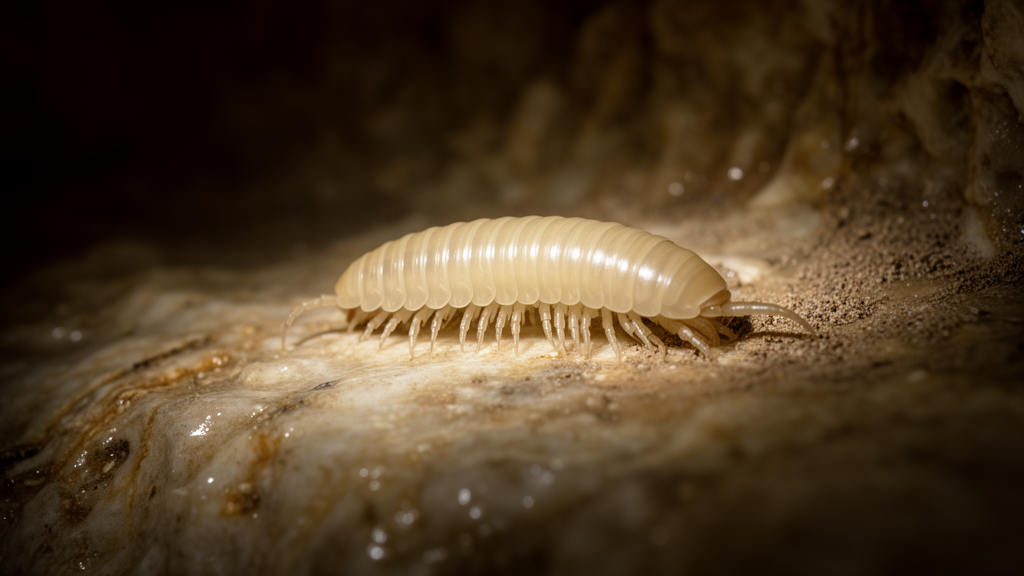
Deep in the caves of White Pine County, Nevada, a tiny creature has been quietly rewriting the history of an entire region. Scientists surveying caves in Great Basin National Park and Humboldt-Toiyabe National Forest have discovered a new species of millipede, Bollmanella amorensis, living in Labor of Love Cave. The find, published in the journal Subterranean Biology, is remarkable not just because the species is new to science, but because its closest relatives live more than 600 miles away in the moist forests of Oregon and Washington, separated from the Nevada cave by hundreds of miles of semidesert grassland that millipedes simply cannot cross.
The discovery was the product of faunal surveys conducted from 2022 to 2025 across the caves of White Pine County, an area that sits in the middle of the Great Basin hydrologic region and the Basin and Range geologic province. The county contains three primary mountain ranges, the Snake, Schell Creek, and Egan Ranges, each stretching more than 80 kilometers long and separated by basins typically 20 to 40 kilometers wide. The Snake Range is home to Wheeler Peak, the second highest summit in Nevada at 3982 meters. The mountains consist primarily of Cambrian-age carbonate rocks that have experienced multiple deformational events, creating a complex geology that has produced numerous and varied caves at elevations ranging from about 2000 to 3400 meters.
The new species was formally described from specimens collected in Labor of Love Cave on 7 November 2022 by A. Mildice, S. McCollum, and J. Krejca, with additional material gathered on 13 April 2023. The types are deposited in the United States National Museum of Natural History in Washington, D.C. The species belongs to the family Conotylidae within the order Chordeumatida, a group of small millipedes whose classification depends heavily on the intricate anatomy of the male gonopods, the modified reproductive legs that serve as the primary diagnostic feature separating closely related species.
Under the microscope, Bollmanella amorensis reveals a suite of distinctive technical characters. The male is about 11 millimeters long and 1 millimeter wide, tan in color with brown pigment concentrated on the head, collum, and anterior rings. It possesses 20 to 24 pigmented but poorly developed ommatidia, the simple eye units that in this species remain only moderately reduced despite the animal’s cave-dwelling lifestyle. The metatergal setae are long and acute, and the third and fourth leg pairs bear distal femoral knobs equipped with teeth and small gland pores. The anterior gonopods are medially divergent with a distinct shelf about two-thirds their length bearing a cluster of six to eight acute spines, while the posterior gonopods carry a broad robust sternum and coxae bearing a complex process with three long pseudoflagella, all longer than the anterior branch. These gonopod details separate the new species from its closest relative, Bollmanella washingtonensis, which has simpler parallel anterior gonopods and posterior gonopod coxites with only a single pseudoflagellum and a decurved basal hook.
The placement of the new species in the genus Bollmanella is ecologically puzzling. All other known species of the genus occur in Oregon and Washington, west of the Cascade Mountains and Coast Ranges, where they occupy moist forested biotopes utterly different from the dry woodlands surrounding the Nevada type locality. Nonetheless, the gonopod anatomy clearly supports this placement. There is precedent for such a disjunct distribution: the related genus Complicatella, with most of its species in Oregon and Washington, also has a cave-limited species in Nevada, Complicatella neili, found in the Humboldt Range in the northern part of the state.
The surveys also produced new records of two other cave-limited millipede species. Idagona lehmanensis, a conotylid first described in 2007 from Water Trough Cave, was found in numerous additional caves across the county, including Broken, Bristlecone, Cave 24, Halliday’s Deep, Drumming, Model, Monument, Lower Pictograph, Pinecone, Roaring Wind, Systems Key, and Water Trough Caves. The species shows a strong affinity for water and high elevations, appearing in caves with small streams running through them and in sites above 9000 feet. Despite extensive searching over many years, it has never been found in the famous Lehman Caves, perhaps because of a lack of water there. The macrosternodesmid Nevadesmus ophimontis, described in 2009, was recorded from Labor of Love, Lehman, Model, and Snake Creek Caves, where it appears to be quite abundant.
Labor of Love Cave itself is an extraordinary site. Located on the lower slopes of the Schell Creek Range along a low-angle normal fault contact called the Schell Creek Range Detachment, the cave formed from surface water infiltrating along fractures to create a stream that runs through most of the passage before exiting through a hole too small for humans. The cave is entered through a manhole-style gate installed in the 1980s, followed by a tight crawl under highly unstable breakdown and a hole dug out by local cavers in 1981 and 1982 to reach the stream passage. Most of the cave is 3 to 5 meters wide and 2 to 3 meters high, relatively muddy, and terminates in impassible breakdown and an upstream sump. Abundant stream sediments suggest the cave is a relict of a wetter Pleistocene climate, and delicate active speleothems throughout the passage, some just a meter above the current stream, indicate a lack of high-energy flooding.
The cave is perhaps best known as a paleontological site with late Pleistocene fossils, including a nearly complete skeleton of the extinct short-faced bear Arctodus simus, a copy of which is displayed at the White Pine Public Museum in Ely, Nevada. Other remains include black bear, grizzly bear, American lion, Canada lynx, pika, Harrington’s mountain goat, bighorn sheep, shrub-ox, and bison. These animals entered the cave before the entrance collapsed, which restricted access and preserved their bones. The cave is also biologically significant, harboring the two millipede species discussed in the new paper along with a possible new species of flatworm and cave-adapted dipluran, plus mites, springtails, beetles, and flies. Abundant roots within the stream passage provide an influx of nutrients supporting this biodiversity, and the average cave air temperature appears to be about 10 to 12 degrees Celsius.
The broader context of the discovery is what gives it viral scientific appeal. The three millipede species are only somewhat morphologically adapted to life underground. Bollmanella amorensis and Idagona lehmanensis have numbers of ommatidia similar to those of surface-dwelling conotylids in the same size range, and neither shows the striking troglobitic adaptations, such as complete eye loss and elongated appendages, typical of long-term cave dwellers. This suggests their occupancy of caves is not of long standing. The researchers speculate that the retreat of the most recent continental glaciers some 14,000 to 12,000 years ago and the subsequent aridification of the Great Basin landscape stranded these animals in caves. As the climate dried, forests at higher and sequentially higher elevations became extinct, and along with them the soil and litter animals that depended on moist conditions. The only populations that could survive were those inhabiting caves, where moisture remained.
If this model is correct, it implies that the Great Basin once supported a millipede fauna with affinities to the present fauna of the Pacific Northwest, and that the drying climate led to the natural extirpation of most of this fauna, leaving behind only cave-dwelling relicts of a past climate. The researchers note that some caves in the upper and middle Mississippi valley are inhabited by millipede species with far western affinities, hinting at even wider historical distributions. The work was conducted as part of the Wild Caves Project, funded by the Southern Nevada Public Land Management Act and managed by Great Basin National Park and Humboldt-Toiyabe National Forest. Over two years, from June 2022 to October 2023, a team of experts conducted detailed inventories of paleontological, archeological, biological, hydrological, and geologic resources in 45 caves. Because the studied caves are ecologically sensitive and of paleontological, archaeological, and ethnographic importance, the researchers declined to publish their coordinates. Many new and unexplored caves remain in the county, and new species of millipedes and other cave animals await discovery and documentation in this hidden archive of a vanished, wetter world.
Subject of Research: Cave Millipedes of the United States. XVIII. A new species and new records from caves in White Pine County, Nevada ( Chordeumatida , Conotylidae and Polydesmida , Macrosternodesmidae )
Article Title: Cave Millipedes of the United States. XVIII. A new species and new records from caves in White Pine County, Nevada ( Chordeumatida , Conotylidae and Polydesmida , Macrosternodesmidae )
Article References: Shear, W. A., McCollum, S., Krejca, J., Baker, G. M., & Marek, P. E. (2026). Cave Millipedes of the United States. XVIII. A new species and new records from caves in White Pine County, Nevada (Chordeumatida, Conotylidae and Polydesmida, Macrosternodesmidae). Subterranean Biology, 58, 43-56. https://doi.org/10.3897/subtbiol.58.201189
Image Credits: AI Generated
DOI: 10.3897/subtbiol.58.201189
Keywords: Cave, Millipedes, United, States, XVIII, species, records, caves, White, Pine, County, Nevada
Cite Scienmag News
Violet Maxwell. (October 17, 2026). New Millipede Species Found in Nevada Cave Reveals Ancient Pacific Northwest Legacy. Scienmag. https://scienmag.com/new-millipede-species-found-in-nevada-cave-reveals-ancient-pacific-northwest-legacy/
Violet Maxwell. "New Millipede Species Found in Nevada Cave Reveals Ancient Pacific Northwest Legacy." Scienmag, 17 October 2026, https://scienmag.com/new-millipede-species-found-in-nevada-cave-reveals-ancient-pacific-northwest-legacy/. Accessed 17 October 2026.
Violet Maxwell. "New Millipede Species Found in Nevada Cave Reveals Ancient Pacific Northwest Legacy." Scienmag. October 17, 2026. https://scienmag.com/new-millipede-species-found-in-nevada-cave-reveals-ancient-pacific-northwest-legacy/


