


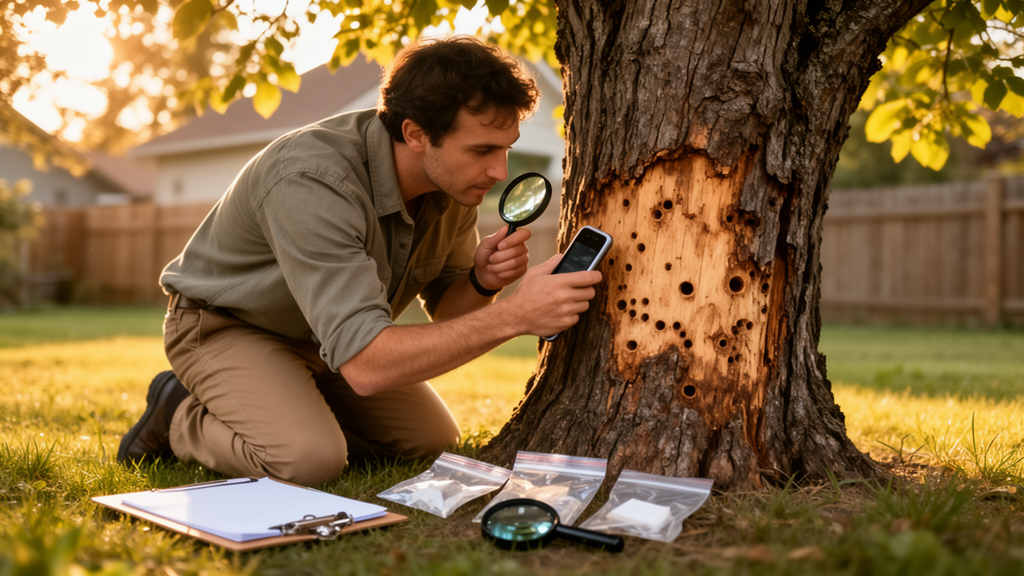
Invasive forest wood-boring pests are among the most destructive biological invaders on the planet, killing trees, degrading timber, and quietly reshaping forest ecosystems long before anyone notices they have arrived. For decades, scientists have hoped that the explosion of citizen science platforms such as iNaturalist could act as an early warning system, with thousands of sharp-eyed naturalists effectively serving as a distributed detection network. A new study published in NeoBiota puts that hope to a rigorous global test, and the results are sobering: for this notoriously cryptic group of insects, public observations almost never beat official records to the scene of an invasion.
The research team, led by investigators analyzing twenty of the world’s most consequential invasive wood-boring pests, assembled an unprecedented dual-scale dataset spanning national and municipal levels. The focal species ranged across four families, including jewel-toned buprestids such as the emerald ash borer, imposing longhorn beetles like the Asian longhorned beetle, diminutive bark and ambrosia beetles, and the notorious sirex woodwasp. Each species was confirmed as invasive using at least one of four authoritative sources: the EPPO Global Database, the CABI Compendium, the Global Invasive Species Database, and peer-reviewed scientific publications.
From official reports, peer-reviewed first-record publications, and authoritative databases including the Alien Species First Record Database, FAO, and the USDA Forest Service, the researchers compiled 129 official first species-country records from 49 countries. On the citizen science side, they turned to the Global Biodiversity Information Facility, or GBIF, applying a strict stepwise filtering protocol. Records labeled as Human Observations were only a starting point, since that category can include professional surveys and institutional monitoring. By screening source fields such as dataset names, institution codes, and collection codes, the team isolated records from seven genuine citizen science platforms, including iNaturalist, Artportalen, and BioDiversity4All. The final citizen science dataset contained 14,889 records from 70 countries and areas.
The core analytical question was deceptively simple: when a citizen scientist first photographs a pest in a given country, does that moment typically precede or follow the official first record filed by a government or regulatory authority? The researchers defined a time lag as the citizen science first record year minus the official first record year, and restricted their paired analysis to the 79 species-country combinations where both record types existed, involving 17 species and 38 countries.
The verdict was lopsided. Citizen science first records preceded official records in only two cases, or 2.5 percent of pairs, and occurred in the same year in just three cases, or 3.8 percent. In 74 cases, or 93.7 percent, the public record came later. The overall mean lag was a staggering 24.82 years, with a median of 15 years. Even when the analysis was restricted to the post-2010 era, when citizen science platforms had matured and participation surged, the mean lag dropped to 5.18 years but positive lags still dominated. A continuous analysis across all 79 pairs revealed a strong declining trend in the lag over time, with a Spearman correlation of -0.84 and a Theil-Sen robust slope of -0.92 years per year, but the authors caution that this decline likely reflects the growing adoption of citizen science platforms since around 2010 rather than a genuine improvement in detection capacity.
Why does the public miss these invaders? The answer lies partly in the biology of the insects themselves. Many wood-boring pests have cryptic life stages, with larvae tunneling hidden inside xylem or phloem tissue, and adults that are small, seasonal, or short-lived. Bark and ambrosia beetles such as Hylurgus ligniperda and Xylosandrus crassiusculus measure just a few millimeters and spend most of their lives concealed within host trees, making them nearly invisible to casual observers. Formal identification often requires subtle diagnostic characters, specialist knowledge, or even microscopic examination. In contrast, larger and more visually striking species such as the Asian longhorned beetle or the emerald ash borer are far more likely to be noticed, photographed, and uploaded.
The trait analysis confirmed this intuition quantitatively. Adult detectability, a composite variable combining adult body size and adult body coloration, emerged as the best-supported single predictor of citizen science recording intensity, with a Mann-Whitney U test yielding a p-value of 0.010. Adult body size alone was positively associated with recording intensity, with a Spearman correlation of 0.52 and a p-value of 0.022. Crucially, the researchers tested two potential confounders, range size and invasion history length, and found neither was significantly associated with recording intensity, supporting a genuine link between how visible an insect is and how often the public records it. Research attention showed no association, and public attention measured through Google Trends showed only a non-significant positive trend.
Recording intensity varied enormously among species, from just 15 records for the redbay ambrosia beetle to 4,174 records for the emerald ash borer. Geographically, the records were also wildly uneven, concentrated in the United States with 3,969 records, Sweden with 2,656, and China with 1,540, while many other countries had few or none. This spatial heterogeneity underscores a critical caveat: areas lacking citizen science records cannot be interpreted as areas free of invasion, and record abundance does not directly reflect pest occurrence. The patterns instead capture differences in public participation, platform activity, and monitoring infrastructure across countries.
To probe whether citizen science could at least supplement spatial coverage at a finer scale, the team turned to China, compiling 36 official species-city records across 11 provinces for four invasive pests: Dendroctonus valens, Hylurgus ligniperda, Sirex noctilio, and Phoracantha semipunctata. Strict filtering of GBIF records retained 1,318 occurrences from nine focal wood-boring species in China, but these were dominated by three conspicuous longhorn beetles, Anoplophora chinensis, Aromia bungii, and Anoplophora glabripennis, which together accounted for 93.9 percent of all retained records. Spatially, records clustered in eastern China, with Beijing, Zhejiang, Shandong, Shanghai, and Jiangsu accounting for 57.5 percent of records with province-level information. Notably, of the four officially documented invasive species, only P. semipunctata and D. valens appeared in citizen science data, and no citizen science records existed at all for H. ligniperda or S. noctilio.
Yet the study did uncover a handful of compelling exceptions that hint at what citizen science can achieve under the right conditions. In China, the citizen science first record of P. semipunctata came in 2022, two years before its official first record in 2024, and public observations documented the species in both Guangdong and Yunnan, whereas official records listed only Guangdong. Similarly, the citizen science first record of Trichoferus campestris in Hungary preceded the official record by one year. These cases suggest that when a pest is sufficiently visible and public engagement is strong, citizen scientists can occasionally provide genuine early warning and valuable spatial supplementation. The authors also note that their analysis was restricted to GBIF-indexed platforms and did not capture public reports submitted directly to biosecurity agencies, meaning the true contribution of community-initiated detections is likely underestimated, as such reports are often absorbed into official records rather than cataloged as citizen science.
The broader implications are clear. For invasive forest wood-boring pests, the primary value of citizen science lies not in shortening the detection lag but in expanding spatial surveillance and tracking the subsequent spread of established populations. Prevention and early interception should continue to rely on phytosanitary measures aimed at reducing arrival risk, including treatment and inspection of wood packaging materials, strengthened quarantine protocols, professional surveillance networks, and expert-based identification. Future efforts should strengthen the links between citizen science platforms, forest-health agencies, quarantine authorities, and taxonomic experts, while providing targeted public guidance on host symptoms, boring damage, frass, and exit holes. The study also draws a useful contrast with systems like Mosquito Alert, which has successfully contributed to first detections of invasive mosquitoes at the municipal scale, demonstrating that citizen science can advance detection timing when the target organisms are frequently encountered, easy to photograph, and relatively easy to recognize. For the hidden borers gnawing silently inside the world’s trees, however, the eyes of the public are not yet a substitute for the trained gaze of the professional entomologist.
Subject of Research: The role of citizen science in early detection and spatial monitoring of invasive forest wood-boring pests
Article Title: Opportunistic citizen science expands spatial monitoring but rarely advances early detection of invasive forest wood-boring pests
Article References: Bao, Z., Pawson, S., Chang, X., Cheng, L., Xie, Q., Yang, W., & Shi, J. (2026). Opportunistic citizen science expands spatial monitoring but rarely advances early detection of invasive forest wood-boring pests. NeoBiota, 109, 107-128. https://doi.org/10.3897/neobiota.109.204328
Image Credits: AI Generated
DOI: 10.3897/neobiota.109.204328
Keywords: citizen science, invasive species, forest pests, wood-boring beetles, early detection, biosecurity, GBIF, emerald ash borer, bark beetles, surveillance, species detectability, China
Cite Scienmag News
Gavin Prescott. (October 17, 2026). Citizen Science Maps Invasive Wood-Boring Pests but Rarely Catches Them Early. Scienmag. https://scienmag.com/citizen-science-maps-invasive-wood-boring-pests-but-rarely-catches-them-early/
Gavin Prescott. "Citizen Science Maps Invasive Wood-Boring Pests but Rarely Catches Them Early." Scienmag, 17 October 2026, https://scienmag.com/citizen-science-maps-invasive-wood-boring-pests-but-rarely-catches-them-early/. Accessed 17 October 2026.
Gavin Prescott. "Citizen Science Maps Invasive Wood-Boring Pests but Rarely Catches Them Early." Scienmag. October 17, 2026. https://scienmag.com/citizen-science-maps-invasive-wood-boring-pests-but-rarely-catches-them-early/


