


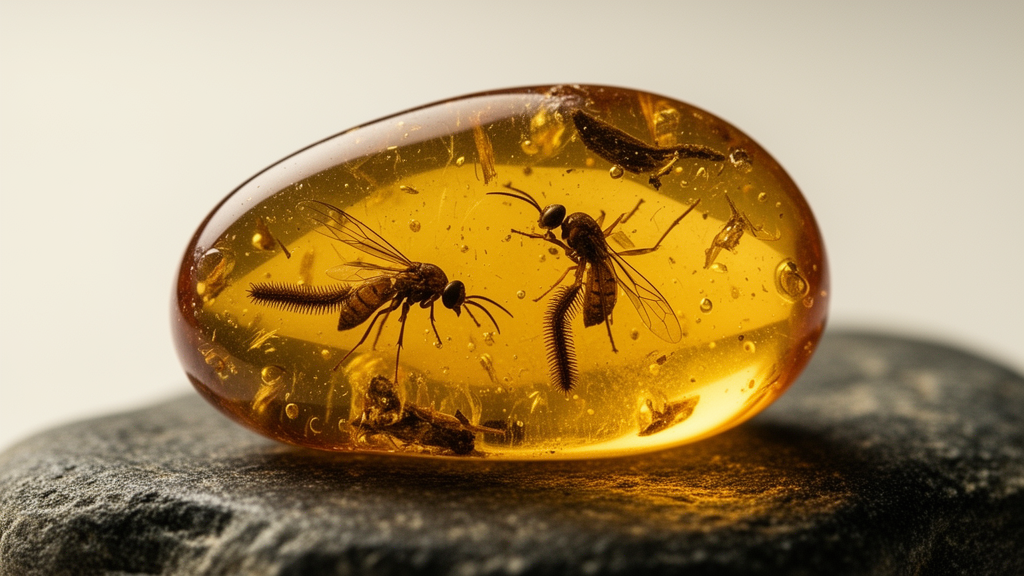
Deep inside hunks of golden amber from the mid-Cretaceous, roughly 99 million years old, two previously unknown species of parasitoid wasp have been waiting to be recognized. Described in the Journal of Hymenoptera Research by Si-Xun Ge, Li-Li Ren and Jiang-Li Tan of Beijing Forestry University, the new species belong to the extinct genus Tichostephanus, an enigmatic lineage of apocritan hymenopterans whose anatomy is so unusual that scientists have already moved it once between wasp families. With the addition of Tichostephanus qinshubao sp. nov. and Tichostephanus yuchijingde sp. nov., the genus now contains five known species, all preserved as exquisitely detailed three-dimensional fossils in Burmese amber from the Hukawng Valley of Kachin State, Myanmar.
The genus Tichostephanus was first established in 2019 by paleoentomologist Michael Engel on the basis of a single male specimen, Tichostephanus hui. At the time, the animal was assigned to the family Stephanidae, a group of parasitoid wasps known for the crown-like ring of tubercles on their heads. Those coronal tubercles, distinct bumps arranged around the ocelli on the top of the head, are exactly what misled the original classification, because they are a hallmark of stephanid wasps. But everything else about the insect told a different story, and subsequent work has steadily pulled the genus toward a new home.
That home turned out to be Gasteruptiidae, a family of 511 described living species placed in the superfamily Evanioidea. Modern gasteruptiids are instantly recognizable to entomologists: they have an elongated propleuron, hind tibiae that appear conspicuously dilated, and a slender, highly mobile metasoma attached high on the body. Adults sip nectar as free-living fliers, but their larvae lead a more sinister life as kleptoparasites inside the nests of solitary bees, where they consume both the host offspring and the pollen provisions stockpiled for it. Phylogenetic analyses published by Wang and colleagues in 2024, and reinforced by Ge and colleagues in 2025, demonstrated that Tichostephanus fits best within this family based on its wing venation, slender hind femur, apically flattened hind tibia and metasomal structure, formally relocating the genus from Stephanidae to Gasteruptiidae.
The most striking discovery came when female specimens of the genus finally surfaced. Their ovipositor sheaths bear a unique structure the researchers describe as a bottle brush: a dense apical array of plate-shaped sensilla unlike anything seen in related wasps. This specialized sensory equipment suggests that these Cretaceous wasps possessed refined host-detection capabilities, likely tuned to locating wood-boring insects in which to lay their eggs. The finding hints that the ecological repertoire of early gasteruptiids was broader and stranger than the bee-nest kleptoparasitism of their modern relatives, and that the family once harbored significant morphological and possibly ecological diversity that has since been lost.
The two new species were not found on fresh expeditions but recognized among specimens already in hand. Both holotypes come from the Si-Xun Ge Collection, housed at the College of Forestry, Beijing Forestry University, and both pieces of amber were acquired before 2017. In fact, the two insects had already participated in science: they were previously included in the 2025 phylogenetic analysis under the temporary designations Tichostephanus sp1 and sp2, meaning their evolutionary positions were established before they received formal names. Specimens were examined and photographed with a Canon G9 camera mounted on an Olympus CX31 microscope, with morphological terminology following established frameworks for fossil hymenopterans.
Tichostephanus qinshubao, whose sex remains unknown because the antennae and genitalia are not preserved, is a small wasp with a partially preserved body length of 6.2 millimeters and a fore wing of roughly 2.4 millimeters. Its globular head carries two unpaired anterior teeth on the frons followed by three pairs of coronal teeth around the ocelli, and its compound eyes occupy about two-thirds of the lateral head surface. What sets it apart from its relatives is a precise combination of characters: a neck bearing two distinct carinae and sitting at a lower level than the middle of the pronotum, a pterostigma that is elongate and narrow at about twelve times as long as its maximum width, a vein 1Cu that curves slightly toward the posterior margin at its distal end, and a first subdiscal cell that is approximately rectangular. The species is named after Qin Shubao, a famous minister of the Tang Dynasty who is honored as one of the door gods of Chinese culture.
Tichostephanus yuchijingde, known from a male holotype measuring 6.4 millimeters excluding the antenna, with a fore wing of 2.1 millimeters, is distinguished by a complementary set of traits. Its pterostigma, while still elongated, is comparatively broad at less than ten times its maximum width; its vein 1Cu is straight rather than curved; its first subdiscal cell is parallelogram-shaped rather than rectangular; and its vein 2Cu-a runs obliquely to vein A. The male antenna is short and robust with twelve flagellomeres, the head bears two unpaired triangular tubercles anteriorly plus three pairs of coronal teeth, and the hind tibia is about 1.5 times longer than the hind femur with a distinctly flattened apex. Its genitalia are only partly exserted, with long, broad parameres ending in rounded apices. The species honors Yu Chijingde, another Tang Dynasty minister who serves as the second door god alongside Qin Shubao, a fittingly paired set of names for two species described side by side.
These fine-grained differences in wing architecture may sound arcane, but they are the bread and butter of fossil insect taxonomy. The fore wing of Tichostephanus is strongly reduced, with a very large submarginal cell formed by the fusion of veins 2Rs+M and 1m-cu into a single continuous vein, and with vein M falling short of the wing margin. The hind wing is even more stripped down, retaining only the Sc+R vein. Because venation patterns are rigidly heritable and easily compared across specimens, ratios such as the length-to-width proportion of the pterostigma and the degree of curvature of vein 1Cu serve as reliable species-level fingerprints even when soft tissues have vanished. To help future researchers navigate the expanded genus, the authors provide an updated identification key covering all five known species, separating them by coronal tubercles, petiole segmentation, pronotal striae and venational proportions.
The phylogenetic picture that emerges is provocative. The 2025 analysis supports the monophyly of Tichostephanus as currently sampled, with Tichostephanus longus occupying a sister position to all the other species. Yet longus is the odd one out in nearly every visible way: it lacks the prominent coronal teeth of its congeners, and its petiole consists of two segments rather than one. It does, however, share the key synapomorphies that define the genus, namely the reduced fore wing venation and the specialized brush-like sensilla on the ovipositor sheath. The authors argue that this combination suggests Tichostephanus, as presently defined, may not be a natural group, and that longus could ultimately represent a distinct genus in its own right, pending future fossil discoveries that might clarify the branching pattern within this early-diverging gasteruptiid clade.
Every new species from Burmese amber carries a weight beyond taxonomy, because the Hukawng Valley deposits are a finite and increasingly contested scientific resource. The authors note that all new fossil specimens are available for re-examination by any researcher on request, and that no large language models were used in preparing the work. For now, the two door-god wasps stand as the latest ambassadors of a Cretaceous world in which gasteruptiid wasps experimented with body plans and sensory tools that no living species possesses, their bottle-brush ovipositors and crown-toothed heads frozen mid-evolution in amber for paleontologists to decode nearly a hundred million years later.
Subject of Research: Two new mid-Cretaceous parasitoid wasp species of the genus Tichostephanus described from Burmese amber
Article Title: Description of two new species of the mid-Cretaceous genus † Tichostephanus Engel ( Hymenoptera , Gasteruptiidae )
Article References: Ge, S.-X., Ren, L.-L., & Tan, J.-L. (2026). Description of two new species of the mid-Cretaceous genus † Tichostephanus Engel (Hymenoptera, Gasteruptiidae). Journal of Hymenoptera Research, 99, 47-57. https://doi.org/10.3897/jhr.99.175957
Image Credits: AI Generated
Keywords: Tichostephanus, Gasteruptiidae, Burmese amber, Cretaceous, paleontology, Hymenoptera, parasitoid wasps, fossil insects, taxonomy, Evanioidea, Myanmar amber, ovipositor
Cite Scienmag News
Gavin Prescott. (October 17, 2026). Two New Wasp Species Emerge from 99-Million-Year-Old Amber with Bizarre Bottle-Brush Ovipositors. Scienmag. https://scienmag.com/two-new-wasp-species-emerge-from-99-million-year-old-amber-with-bizarre-bottle-brush-ovipositors/
Gavin Prescott. "Two New Wasp Species Emerge from 99-Million-Year-Old Amber with Bizarre Bottle-Brush Ovipositors." Scienmag, 17 October 2026, https://scienmag.com/two-new-wasp-species-emerge-from-99-million-year-old-amber-with-bizarre-bottle-brush-ovipositors/. Accessed 17 October 2026.
Gavin Prescott. "Two New Wasp Species Emerge from 99-Million-Year-Old Amber with Bizarre Bottle-Brush Ovipositors." Scienmag. October 17, 2026. https://scienmag.com/two-new-wasp-species-emerge-from-99-million-year-old-amber-with-bizarre-bottle-brush-ovipositors/


