


Duchenne muscular dystrophy has long presented gene therapists with a deceptively simple question: how much dystrophin does a patient need, and how much benefit does each increment of restored protein actually buy? A new post-hoc analysis published in Gene Therapy now offers one of the clearest statistical answers to date in a rat model of the disease. Researchers led by J. M. Walsh, A. McIntosh and Hendrik Neubert of Pfizer, working with collaborators at Nantes Université in France, report a direct correlation between mini-dystrophin protein expression in skeletal muscle and whole-body strength following administration of fordadistrogene movaparvovec, an adeno-associated virus serotype 9 (rAAV9) gene therapy candidate carrying a miniaturised dystrophin gene. The findings, drawn from muscle samples and functional testing at three and six months after a single intravenous dose, suggest that the expression–function relationship in dystrophin-deficient muscle is measurable, sustained and dose-dependent.
Duchenne muscular dystrophy is an X-linked recessive disorder caused by loss-of-function mutations in the dystrophin gene, the largest known human protein-coding locus. Without dystrophin, the cytoskeletal protein that anchors muscle fibres’ contractile apparatus to the surrounding extracellular matrix, muscle fibres are progressively damaged by the mechanical stress of normal contraction. The result is chronic inflammation, fibrosis, fatty replacement of muscle tissue, progressive wasting and, ultimately, premature death. Because the dystrophin gene is far too large to fit inside any viral delivery vector, gene therapy strategies rely on miniaturised versions of the gene — micro-dystrophin or mini-dystrophin constructs — that retain the essential domains needed to stabilise the muscle membrane while omitting large portions of the central rod region.
Fordadistrogene movaparvovec is one such candidate: an rAAV9 vector engineered to carry a mini-dystrophin transgene. The AAV9 capsid was chosen for its well-documented ability to cross the vascular endothelium and transduce skeletal and cardiac muscle throughout the body after systemic delivery, a property first demonstrated in larger animal models including dogs. In the study, four treatment groups of dystrophin-deficient DMDmdx rats aged roughly seven to nine weeks received the vector at doses spanning four orders of magnitude — 1E+13, 3E+13, 1E+14 or 3E+14 vector genomes per kilogram — while two control groups, one wild-type and one untreated DMDmdx cohort, received formulation buffer. Muscle samples were harvested from the biceps femoris and pectoralis at either three or six months post-administration.
The analytical centrepiece of the work is the quantification of mini-dystrophin protein itself, rather than the transgene mRNA or vector genomes. The team measured mini-dystrophin levels using mass spectrometry, tracking a signature peptide designated LLQV as a proxy for the expressed protein. This approach, developed previously by the same group for dystrophin and mini-dystrophin quantification in skeletal muscle, allows researchers to distinguish the therapeutic mini-dystrophin protein from endogenous rodent dystrophin and to express levels relative to normal wild-type dystrophin — a critical benchmark, since the ultimate goal of any dystrophin restoration therapy is to approach the protein complement of healthy muscle.
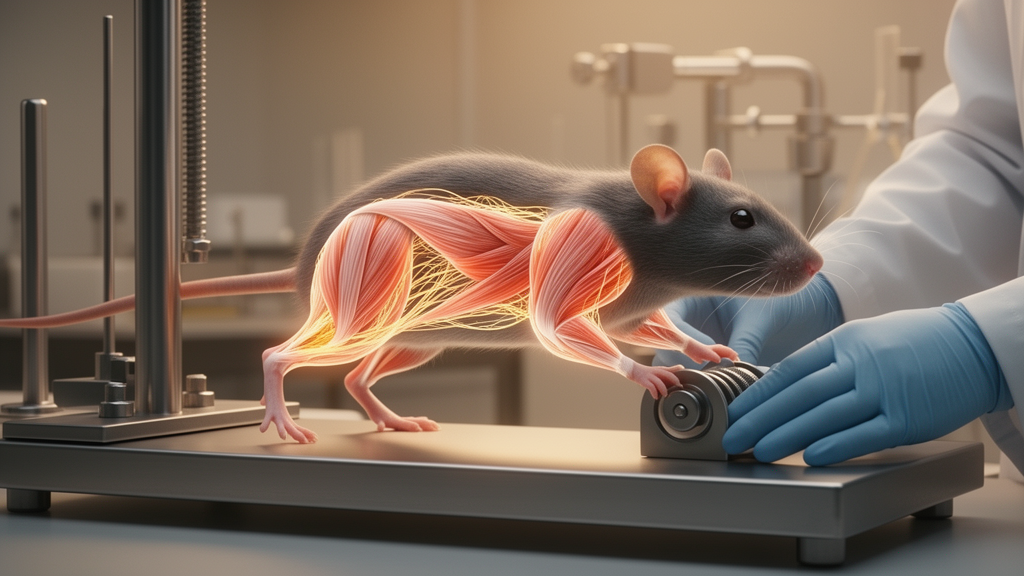
Function was assessed in parallel using maximum grip strength, a whole-body functional readout that integrates the contractile capacity of forelimb and hindlimb muscle groups. Previously reported results from the same animal cohort showed that treatment with fordadistrogene movaparvovec increased body weight, improved clinical chemistry parameters, ameliorated skeletal and cardiac muscle histopathology and improved both muscle and cardiac function, all in a dose-dependent manner. The new post-hoc analysis extends those findings by asking a more granular question: within individual animals, does the amount of mini-dystrophin protein present in specific muscles statistically predict the strength those animals can generate?
The answer, according to the data, is yes. Across the dose range studied, increasing mini-dystrophin protein levels in the biceps femoris and pectoralis muscles correlated with increasing maximum grip strength in the treated DMDmdx rats. The relationship was evident at both the three-month and six-month time points, indicating that the expression–function link is not a transient artifact of early transgene expression but a durable property of the treated muscle. Notably, the analysis also showed that mini-dystrophin protein expression was sustained or, at the lower doses, actually increased from three to six months post-dose — a finding with important implications for the durability of therapeutic benefit, since protein persistence over time is a prerequisite for long-term functional rescue.
Why does this statistical correlation matter for the field? For years, dystrophin gene therapy has been evaluated primarily through histological endpoints — the percentage of dystrophin-positive fibres on muscle biopsy — and through functional scales such as the North Star Ambulatory Assessment in boys with the disease. But the quantitative relationship between the amount of restored protein and the degree of functional improvement has remained frustratingly opaque, partly because human biopsies yield small samples and partly because different muscles express different levels of the therapeutic protein. The DMDmdx rat model, which carries a loss-of-function mutation in the dystrophin gene and recapitulates key features of the human disease more faithfully than the widely used mdx mouse, offers a system in which protein levels and function can be measured in the same animals with statistical rigor.
The work also carries translational weight because fordadistrogene movaparvovec is the same candidate evaluated in CIFFREO, a phase 3, double-blind, randomised, placebo-controlled study in ambulatory participants with Duchenne muscular dystrophy, reported in The Lancet Neurology in 2026. Establishing a statistically significant correlation between mini-dystrophin expression and strength in a rat model provides a preclinical anchor for interpreting clinical biomarker data — in particular, mass spectrometry-based dystrophin quantification from patient biopsies, which the same Pfizer group has pioneered as a pharmacodynamic assay for gene therapy development. If protein levels in accessible muscles can predict functional trajectories in patients, as the rat data suggest they can in rodents, clinicians may eventually be able to use dystrophin quantification not merely as a descriptive biomarker but as a predictive one.
Several caveats temper the enthusiasm. The analysis is post-hoc, drawn from a fixed animal cohort rather than a prospectively powered correlation study, and the grip strength readout, while integrative, does not isolate the contractile contribution of the specific muscles sampled. The mini-dystrophin construct, larger than the micro-dystrophin used in some competing candidates, may elicit different immunological and biomechanical responses in humans than in rats. And the six-month durability window, while encouraging, is short relative to the lifelong protein persistence that a one-time gene therapy must achieve in growing children. Nonetheless, the demonstration that strength scales statistically with mini-dystrophin expression in dystrophin-deficient muscle — across a 30-fold dose range, in two distinct muscle groups, at two time points — represents a methodological advance for the field. It transforms the expression–function question from a qualitative hope into a quantitative, testable relationship, and it provides the preclinical statistical framework that future clinical studies of dystrophin restoration therapies will need to interpret protein biomarker data in the context of patient function.
Subject of Research: Statistical correlation between strength and mini-dystrophin expression in skeletal muscle after an rAAV9-mini-dystrophin gene therapy candidate in DMDmdx rats
Article Title: Statistical correlation between strength and mini-dystrophin expression in skeletal muscle after an rAAV9-mini-dystrophin gene therapy candidate in DMDmdx rats
Article References: Walsh, J. M., McIntosh, A., Owens, J., Le Guiner, C., Lafoux, A., Huchet, C., Binks, M., Neelakantan, S., Farrokhi, V., & Neubert, H. (2026). Statistical correlation between strength and mini-dystrophin expression in skeletal muscle after an rAAV9-mini-dystrophin gene therapy candidate in DMDmdx rats. Gene Therapy. https://doi.org/10.1038/s41434-026-00648-8
Image Credits: AI Generated
DOI: 10.1038/s41434-026-00648-8
Keywords: Statistical, correlation, between, strength, mini-dystrophin, expression, skeletal, muscle, rAAV9-mini-dystrophin, gene, therapy, candidate
Cite Scienmag News
Juliet Wilcox. (October 17, 2026). Mini-Dystrophin Levels Track With Muscle Strength in Rat Gene Therapy Study. Scienmag. https://scienmag.com/mini-dystrophin-levels-track-with-muscle-strength-in-rat-gene-therapy-study/
Juliet Wilcox. "Mini-Dystrophin Levels Track With Muscle Strength in Rat Gene Therapy Study." Scienmag, 17 October 2026, https://scienmag.com/mini-dystrophin-levels-track-with-muscle-strength-in-rat-gene-therapy-study/. Accessed 17 October 2026.
Juliet Wilcox. "Mini-Dystrophin Levels Track With Muscle Strength in Rat Gene Therapy Study." Scienmag. October 17, 2026. https://scienmag.com/mini-dystrophin-levels-track-with-muscle-strength-in-rat-gene-therapy-study/


