


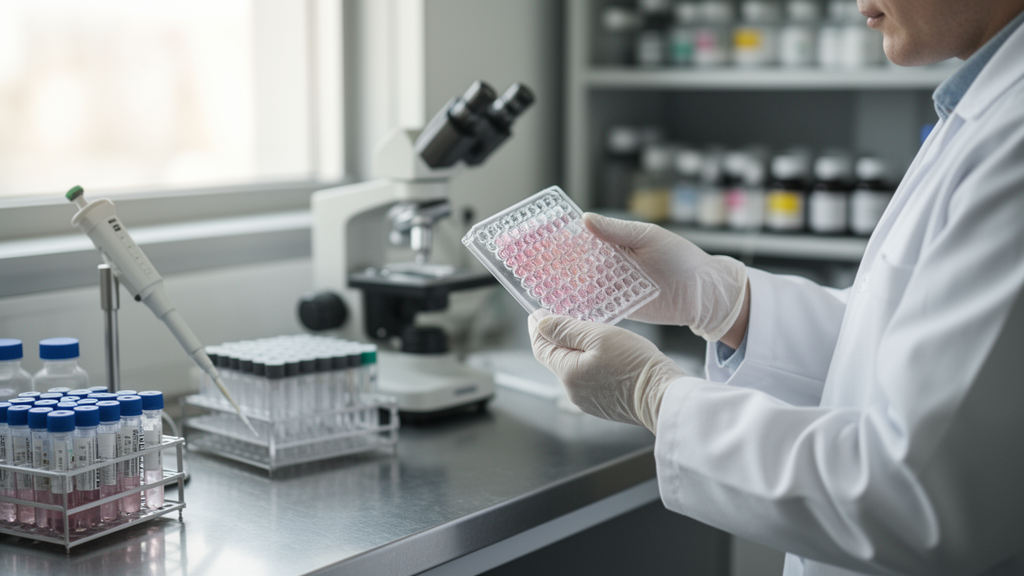
Exposure to hazardous chemicals is a growing concern in public health, contributing to the rising burden of non-communicable diseases worldwide. Yet for most of the chemicals used in consumer products, including those found in food packaging, there is simply not enough data to determine whether they are fully safe. A new study published in the peer-reviewed journal Environment International offers a promising way forward: researchers have developed a robust approach for identifying chemical hazards using an informed selection of in vitro bioassays, mapping toxicological endpoints to six groups of common diseases.
The research, conducted by scientists at the Helmholtz Centre for Environmental Research (UFZ) together with the Food Packaging Forum, forms part of the co-creation project CoModHaz, led by Professor Escher of UFZ. The project’s ambitious goal is to develop high-throughput, animal-free testing methods for hazard screening of chemicals, their transformation products, and mixtures. The Food Packaging Forum participates as a project partner alongside regulators and industry stakeholders, ensuring the resulting tools reflect the needs of those who will ultimately use them.
At the heart of the study lies a sophisticated analysis of Adverse Outcome Pathways, or AOPs. These frameworks describe the chain of biological events that link a molecular initiating event, such as a chemical binding to a receptor or disrupting an enzyme, through successive levels of biological organization, ultimately culminating in an adverse health outcome like cancer or metabolic disease. The researchers systematically mapped 266 AOPs associated with six major disease groups: cancer, reproductive disorders, metabolic disease, immunological disorders, cardiovascular disease, and brain-related disorders.
Rather than treating each pathway as an isolated chain of events, the team analyzed the pathways as interconnected networks. This network-based perspective revealed biological events where the pathways diverge, converge, or occupy central positions in promoting the different diseases. Such convergence points are scientifically valuable because a single toxicological effect at a key node can ripple outward to influence multiple disease outcomes, meaning a relatively compact set of tests can capture a broad spectrum of potential hazards.
From this analysis emerged a practical outcome: a set of 15 high-throughput bioassay tests capable of checking whether a product on the market contains chemicals that could contribute to any of the six disease groups. The panel was selected according to criteria of simplicity, robustness, and high-throughput compatibility, meaning the assays can process large numbers of samples efficiently. Crucially, the multiplexed design allows screening of individual chemicals or chemical mixtures, addressing a major gap in conventional testing regimes.
That gap is substantial. Current testing approaches cannot effectively check for all possible health outcomes, and many regulatory testing requirements examine only genotoxicity, whether a substance damages genetic material, while testing just one substance at a time. This stands in stark contrast to real-world exposure. Widespread evidence shows that consumers are simultaneously exposed to complex mixtures of different chemicals from all types of products, so single-substance assessments may miss interactive effects and cumulative risks that matter for health.
One immediate application of the new tests involves food contact materials. Food packaging can contain many non-intentionally added substances, chemicals that migrate from inks, adhesives, coatings, recycled materials, or processing aids and are often unknown and therefore untested. Screening the food packaging actually available on the market with the proposed assay panel would provide a systematic way to flag hazardous compounds that have escaped regulatory scrutiny, turning an intractable data gap into a manageable testing workflow.
Dr. Sarah Stevens, lead author of the study from the Helmholtz Centre for Environmental Research, emphasized the practical significance of the work. By translating the prioritized endpoints into in-vitro assays suitable for high-throughput screening, she said, the results become actionable, and the proposed panel of 15 assays could enable much broader toxicological screening of chemicals than is currently standard practice. She described this as a significant improvement in protecting public health from hazardous chemicals present across a wide range of products used daily.
Dr. Jane Muncke, co-author of the study from the Food Packaging Forum, framed the research as an important milestone in improving how chemicals are tested. New testing methods of this kind, she noted, can lead to breakthroughs in disease prevention because they enable systematic identification of exposures to hazardous chemicals in everyday products. Since non-communicable diseases such as cancer, cardiovascular disease, and metabolic disorders account for the majority of deaths globally, tools that help identify and mitigate chemical contributors could carry substantial preventive value.
Important work remains before the panel can be deployed at scale. In a next step, the proposed bioassay tests must be validated to determine how effectively they flag chemicals already known to be hazardous, establishing the method’s sensitivity and reliability against established toxicological benchmarks. A study applying the approach to food contact chemicals from food packaging is already underway, providing an early real-world test of the concept. The researchers describe the proposed tests as a pragmatic and promising starting point, one designed to evolve as new knowledge and testing technology become available, with the ultimate aim of better protecting consumers from the chemical exposures woven into modern daily life. The study, Mapping disease-linked AOPs to inform bioassay selection for chemical hazard assessment, was published in Environment International.
Subject of Research: Mapping adverse outcome pathways to select in vitro bioassays for chemical hazard screening across six disease groups
Article Title: Scientists make progress in mapping chemicals to six groups of common diseases
Article References: Scientists make progress in mapping chemicals to six groups of common diseases. (n.d.). Original publication
Image Credits: AI Generated
DOI: Not provided
Keywords: chemical hazard assessment, adverse outcome pathways, in vitro bioassays, food packaging, high-throughput screening, non-communicable diseases, toxicology, chemical mixtures, Environment International, public health, CoModHaz, animal-free testing
Cite Scienmag News
Bethany Barker. (October 17, 2026). New Assay Panel Maps Chemical Hazards to Six Major Disease Groups. Scienmag. https://scienmag.com/new-assay-panel-maps-chemical-hazards-to-six-major-disease-groups/
Bethany Barker. "New Assay Panel Maps Chemical Hazards to Six Major Disease Groups." Scienmag, 17 October 2026, https://scienmag.com/new-assay-panel-maps-chemical-hazards-to-six-major-disease-groups/. Accessed 17 October 2026.
Bethany Barker. "New Assay Panel Maps Chemical Hazards to Six Major Disease Groups." Scienmag. October 17, 2026. https://scienmag.com/new-assay-panel-maps-chemical-hazards-to-six-major-disease-groups/


