


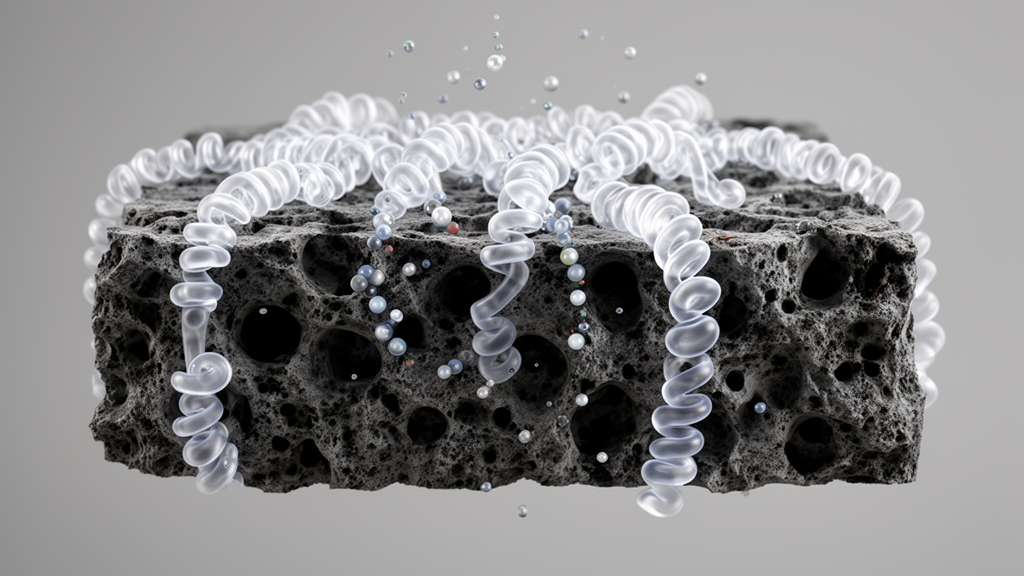
High-entropy oxides (HEOs) have attracted considerable attention for energy storage applications because of their multi-principal synergistic effects and excellent structural stability. In this study, polyethylene glycol (PEG) was used as a surfactant to synthesize (CrMnFeCoNi)3O4 HEOs by tuning the molar ratio of PEG to metal cations (P/M). The results show that PEG plays three roles during synthesis, serving simultaneously as a coordinating dispersant, a structure-directing agent, and an in situ porogen. The optimized HEO (P/M = 4/5) exhibits a uniform nanoparticle morphology and a well-developed pore architecture, delivering a specific capacitance of 557.6 F g−1. Kinetic analysis further indicates that its pseudocapacitive behavior arises from a cooperative effect involving both capacitive-controlled and diffusion-dominated mechanisms. The assembled asymmetric supercapacitor device achieves an energy density of 64.2 Wh kg−1 at a power density of 375.3 W kg−1 and retains 81.3% of its capacitance after 10,000 charge/discharge cycles. These outstanding electrochemical properties highlight the promise of PEG-templated (CrMnFeCoNi)3O4 HEOs for advanced energy storage applications.
High-entropy oxides (HEOs) have attracted considerable attention for energy storage applications because of their multi-principal synergistic effects and excellent structural stability. In this study, polyethylene glycol (PEG) was used as a surfactant to synthesize (CrMnFeCoNi)3O4 HEOs by tuning the molar ratio of PEG to metal cations (P/M). The results show that PEG plays three roles during synthesis, serving simultaneously as a coordinating dispersant, a structure-directing agent, and an in situ porogen. The optimized HEO (P/M = 4/5) exhibits a uniform nanoparticle morphology and a well-developed pore architecture, delivering a specific capacitance of 557.6 F g−1. Kinetic analysis further indicates that its pseudocapacitive behavior arises from a cooperative effect involving both capacitive-controlled and diffusion-dominated mechanisms. The assembled asymmetric supercapacitor device achieves an energy density of 64.2 Wh kg−1 at a power density of 375.3 W kg−1 and retains 81.3% of its capacitance after 10,000 charge/discharge cycles. These outstanding electrochemical properties highlight the promise of PEG-templated (CrMnFeCoNi)3O4 HEOs for advanced energy storage applications.
High-entropy oxides (HEOs) have attracted considerable attention for energy storage applications because of their multi-principal synergistic effects and excellent structural stability. In this study, polyethylene glycol (PEG) was used as a surfactant to synthesize (CrMnFeCoNi)3O4 HEOs by tuning the molar ratio of PEG to metal cations (P/M). The results show that PEG plays three roles during synthesis, serving simultaneously as a coordinating dispersant, a structure-directing agent, and an in situ porogen. The optimized HEO (P/M = 4/5) exhibits a uniform nanoparticle morphology and a well-developed pore architecture, delivering a specific capacitance of 557.6 F g−1. Kinetic analysis further indicates that its pseudocapacitive behavior arises from a cooperative effect involving both capacitive-controlled and diffusion-dominated mechanisms. The assembled asymmetric supercapacitor device achieves an energy density of 64.2 Wh kg−1 at a power density of 375.3 W kg−1 and retains 81.3% of its capacitance after 10,000 charge/discharge cycles. These outstanding electrochemical properties highlight the promise of PEG-templated (CrMnFeCoNi)3O4 HEOs for advanced energy storage applications.
High-entropy oxides (HEOs) have attracted considerable attention for energy storage applications because of their multi-principal synergistic effects and excellent structural stability. In this study, polyethylene glycol (PEG) was used as a surfactant to synthesize (CrMnFeCoNi)3O4 HEOs by tuning the molar ratio of PEG to metal cations (P/M). The results show that PEG plays three roles during synthesis, serving simultaneously as a coordinating dispersant, a structure-directing agent, and an in situ porogen. The optimized HEO (P/M = 4/5) exhibits a uniform nanoparticle morphology and a well-developed pore architecture, delivering a specific capacitance of 557.6 F g−1. Kinetic analysis further indicates that its pseudocapacitive behavior arises from a cooperative effect involving both capacitive-controlled and diffusion-dominated mechanisms. The assembled asymmetric supercapacitor device achieves an energy density of 64.2 Wh kg−1 at a power density of 375.3 W kg−1 and retains 81.3% of its capacitance after 10,000 charge/discharge cycles. These outstanding electrochemical properties highlight the promise of PEG-templated (CrMnFeCoNi)3O4 HEOs for advanced energy storage applications.
High-entropy oxides (HEOs) have attracted considerable attention for energy storage applications because of their multi-principal synergistic effects and excellent structural stability. In this study, polyethylene glycol (PEG) was used as a surfactant to synthesize (CrMnFeCoNi)3O4 HEOs by tuning the molar ratio of PEG to metal cations (P/M). The results show that PEG plays three roles during synthesis, serving simultaneously as a coordinating dispersant, a structure-directing agent, and an in situ porogen. The optimized HEO (P/M = 4/5) exhibits a uniform nanoparticle morphology and a well-developed pore architecture, delivering a specific capacitance of 557.6 F g−1. Kinetic analysis further indicates that its pseudocapacitive behavior arises from a cooperative effect involving both capacitive-controlled and diffusion-dominated mechanisms. The assembled asymmetric supercapacitor device achieves an energy density of 64.2 Wh kg−1 at a power density of 375.3 W kg−1 and retains 81.3% of its capacitance after 10,000 charge/discharge cycles. These outstanding electrochemical properties highlight the promise of PEG-templated (CrMnFeCoNi)3O4 HEOs for advanced energy storage applications.
High-entropy oxides (HEOs) have attracted considerable attention for energy storage applications because of their multi-principal synergistic effects and excellent structural stability. In this study, polyethylene glycol (PEG) was used as a surfactant to synthesize (CrMnFeCoNi)3O4 HEOs by tuning the molar ratio of PEG to metal cations (P/M). The results show that PEG plays three roles during synthesis, serving simultaneously as a coordinating dispersant, a structure-directing agent, and an in situ porogen. The optimized HEO (P/M = 4/5) exhibits a uniform nanoparticle morphology and a well-developed pore architecture, delivering a specific capacitance of 557.6 F g−1. Kinetic analysis further indicates that its pseudocapacitive behavior arises from a cooperative effect involving both capacitive-controlled and diffusion-dominated mechanisms. The assembled asymmetric supercapacitor device achieves an energy density of 64.2 Wh kg−1 at a power density of 375.3 W kg−1 and retains 81.3% of its capacitance after 10,000 charge/discharge cycles. These outstanding electrochemical properties highlight the promise of PEG-templated (CrMnFeCoNi)3O4 HEOs for advanced energy storage applications.
High-entropy oxides (HEOs) have attracted considerable attention for energy storage applications because of their multi-principal synergistic effects and excellent structural stability. In this study, polyethylene glycol (PEG) was used as a surfactant to synthesize (CrMnFeCoNi)3O4 HEOs by tuning the molar ratio of PEG to metal cations (P/M). The results show that PEG plays three roles during synthesis, serving simultaneously as a coordinating dispersant, a structure-directing agent, and an in situ porogen. The optimized HEO (P/M = 4/5) exhibits a uniform nanoparticle morphology and a well-developed pore architecture, delivering a specific capacitance of 557.6 F g−1. Kinetic analysis further indicates that its pseudocapacitive behavior arises from a cooperative effect involving both capacitive-controlled and diffusion-dominated mechanisms. The assembled asymmetric supercapacitor device achieves an energy density of 64.2 Wh kg−1 at a power density of 375.3 W kg−1 and retains 81.3% of its capacitance after 10,000 charge/discharge cycles. These outstanding electrochemical properties highlight the promise of PEG-templated (CrMnFeCoNi)3O4 HEOs for advanced energy storage applications.
High-entropy oxides (HEOs) have attracted considerable attention for energy storage applications because of their multi-principal synergistic effects and excellent structural stability. In this study, polyethylene glycol (PEG) was used as a surfactant to synthesize (CrMnFeCoNi)3O4 HEOs by tuning the molar ratio of PEG to metal cations (P/M). The results show that PEG plays three roles during synthesis, serving simultaneously as a coordinating dispersant, a structure-directing agent, and an in situ porogen. The optimized HEO (P/M = 4/5) exhibits a uniform nanoparticle morphology and a well-developed pore architecture, delivering a specific capacitance of 557.6 F g−1. Kinetic analysis further indicates that its pseudocapacitive behavior arises from a cooperative effect involving both capacitive-controlled and diffusion-dominated mechanisms. The assembled asymmetric supercapacitor device achieves an energy density of 64.2 Wh kg−1 at a power density of 375.3 W kg−1 and retains 81.3% of its capacitance after 10,000 charge/discharge cycles. These outstanding electrochemical properties highlight the promise of PEG-templated (CrMnFeCoNi)3O4 HEOs for advanced energy storage applications.
High-entropy oxides (HEOs) have attracted considerable attention for energy storage applications because of their multi-principal synergistic effects and excellent structural stability. In this study, polyethylene glycol (PEG) was used as a surfactant to synthesize (CrMnFeCoNi)3O4 HEOs by tuning the molar ratio of PEG to metal cations (P/M). The results show that PEG plays three roles during synthesis, serving simultaneously as a coordinating dispersant, a structure-directing agent, and an in situ porogen. The optimized HEO (P/M = 4/5) exhibits a uniform nanoparticle morphology and a well-developed pore architecture, delivering a specific capacitance of 557.6 F g−1. Kinetic analysis further indicates that its pseudocapacitive behavior arises from a cooperative effect involving both capacitive-controlled and diffusion-dominated mechanisms. The assembled asymmetric supercapacitor device achieves an energy density of 64.2 Wh kg−1 at a power density of 375.3 W kg−1 and retains 81.3% of its capacitance after 10,000 charge/discharge cycles. These outstanding electrochemical properties highlight the promise of PEG-templated (CrMnFeCoNi)3O4 HEOs for advanced energy storage applications.
Subject of Research: PEG polymer shapes a five-metal high-entropy oxide into a porous supercapacitor electrode delivering 557.6 F g−1 and 64.2 Wh kg−1.
Article Title: PEG-mediated particle assembly and pore evolution in a Cr–Mn–Fe–Co–Ni spinel high-entropy oxide
Article References: Zeng, F., Xu, B., Jing, C., He, X., Li, C., & Li, G. (2026). PEG-mediated particle assembly and pore evolution in a Cr–Mn–Fe–Co–Ni spinel high-entropy oxide. Journal of Materials Science. https://doi.org/10.1007/s10853-026-13928-w
Image Credits: AI Generated
DOI: 10.1007/s10853-026-13928-w
Keywords: high-entropy oxide, supercapacitor, polyethylene glycol, energy storage, spinel oxide, pseudocapacitance, PEG-mediated, particle, assembly, pore, evolution, spinel
Cite Scienmag News
Neil Sanderson. (October 17, 2026). PEG Polymer Doubles as Dispersant, Template and Porogen in High-Entropy Oxide Supercapacitor Electrode. Scienmag. https://scienmag.com/peg-polymer-doubles-as-dispersant-template-and-porogen-in-high-entropy-oxide-supercapacitor-electrode/
Neil Sanderson. "PEG Polymer Doubles as Dispersant, Template and Porogen in High-Entropy Oxide Supercapacitor Electrode." Scienmag, 17 October 2026, https://scienmag.com/peg-polymer-doubles-as-dispersant-template-and-porogen-in-high-entropy-oxide-supercapacitor-electrode/. Accessed 17 October 2026.
Neil Sanderson. "PEG Polymer Doubles as Dispersant, Template and Porogen in High-Entropy Oxide Supercapacitor Electrode." Scienmag. October 17, 2026. https://scienmag.com/peg-polymer-doubles-as-dispersant-template-and-porogen-in-high-entropy-oxide-supercapacitor-electrode/


