


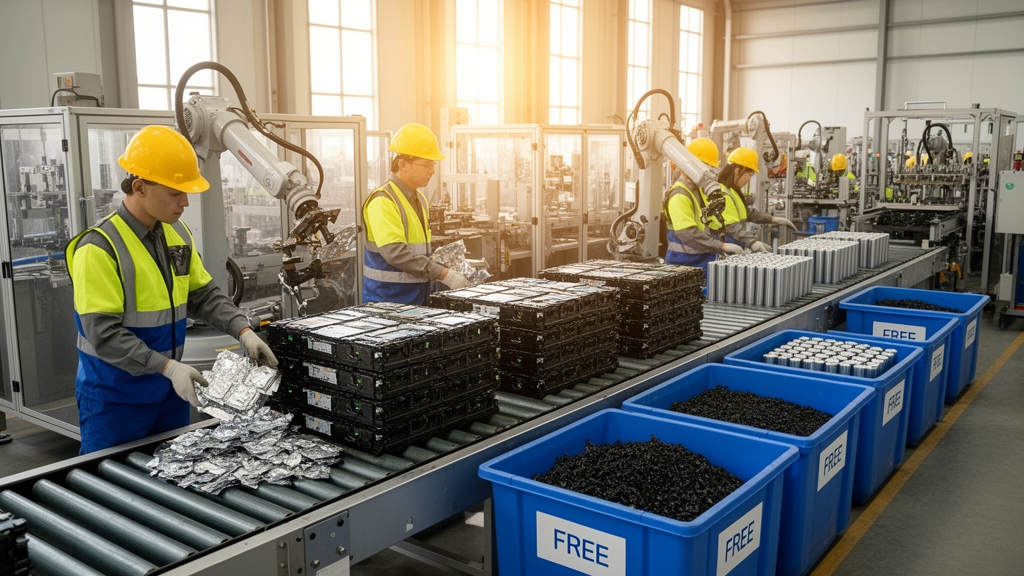
The electric vehicle boom has turned lithium-ion batteries into one of the most strategically important industrial products on Earth, but it has also exposed an uncomfortable truth: the supply chains that produce them remain overwhelmingly linear. Lithium, cobalt, nickel, and manganese are mined in a handful of geographically concentrated regions, subject to wild price swings and geopolitical uncertainty, and then largely discarded at end of life. A new study published in Clean Technologies and Environmental Policy argues that the way out of this trap is not any single fix, but a carefully synchronized combination of circular economy practices and policy support. Drawing on more than a decade of data from nine major European battery-producing and electric vehicle manufacturing economies, the research shows that cost efficiency in circular battery supply chains emerges from the joint action of recycling performance, government incentives, and coordinated reverse logistics rather than from any one intervention.
The research team, led by A. K. M. Mohsin of the University of Applied Sciences Upper Austria and the Supply Chain Intelligence Institute Austria, compiled a balanced country-year panel covering 2010 to 2023, yielding 126 observations from Eurostat, the European Alternative Fuels Observatory, the International Energy Agency, the World Bank Logistics Performance Index, BloombergNEF, and publicly disclosed corporate sustainability reports. The dependent variable, cost efficiency, was measured as the average production cost of lithium-ion batteries in euros per kilowatt-hour after accounting for the economic benefits of circular resource recovery. Across the sample, this figure averaged 86.65 euros per kilowatt-hour with a standard deviation of just 4.66, indicating that production costs were remarkably similar across countries even though the underlying technological, operational, and policy conditions varied enormously.
That heterogeneity is striking. Production capacity ranged from 29 to 148 gigawatt-hours, research and development investment spanned from 22.08 to 498.86 million euros, and logistics costs varied from 100.56 to 982.99 euros per unit. Recycling efficiency, by contrast, was already well developed, averaging 82.09 percent with values between 70 and 93 percent. The pattern suggests that broadly comparable cost outcomes can be reached through very different combinations of industrial scale, innovation spending, logistics coordination, and policy support, a possibility the authors set out to test formally rather than assume.
To do so, the team deployed an unusually rich methodological arsenal. Panel autoregressive distributed lag models estimated short-run and long-run relationships between cost efficiency and its operational, technological, and policy determinants. Nonlinear ARDL models then examined whether positive and negative changes in logistics costs and government subsidies produce asymmetric responses. Necessary Condition Analysis identified minimum constraint levels associated with higher cost efficiency, and fuzzy-set Qualitative Comparative Analysis explored alternative configurations through which conditions jointly contribute to efficient circular supply chain outcomes. The combination is novel in the battery circularity literature, where most prior work has relied on static regression techniques or small-scale case studies.
The econometric results are technically revealing. In the long run, a 1 percent increase in recycling efficiency leads to a 0.019 percent rise in cost efficiency, while a 1 percent increase in production capacity produces a 0.128 percent gain, reflecting economies of scale in manufacturing. Counterintuitively, logistics costs also show a positive long-run effect, with a 1 percent increase associated with a 0.016 percent improvement in cost efficiency. The authors interpret this as evidence that higher logistics expenditure often reflects strategic investment in reverse logistics infrastructure, digital traceability systems, and battery collection networks rather than operational waste. In the short run, research and development investment shows a significant positive effect, with a 1 percent increase yielding a 0.024 percent cost efficiency gain, and the error correction term of negative 0.726 indicates that roughly 72.6 percent of any disequilibrium is corrected each period, a relatively fast adaptation.
The nonlinear analysis confirms that these relationships are asymmetric. A positive shock in logistics costs produces a 0.028 percent long-run gain in cost efficiency, while a positive shock in government subsidies delivers a much larger 0.218 percent improvement, underscoring the outsized role of public financial support. Wald tests reveal long-run asymmetry for logistics costs, meaning efficiency gains from logistics investment persist and are not reversible, and short-run asymmetry for subsidies, meaning cost efficiencies achieved through government incentives remain intact even if subsidies later decline. Granger causality tests, using heteroskedasticity-robust estimation, provide comparatively stronger evidence that changes in government support precede changes in cost efficiency, though the authors caution this reflects predictive temporal precedence rather than proof of direct causation.
The Necessary Condition Analysis adds a crucial structural insight: government subsidies are the only condition whose necessity effect exceeds the minimum threshold, establishing that adequate financial backing is an indispensable enabler of cost efficiency. Bottleneck analysis shows that achieving cost efficiency outcomes above 60 percent requires minimum threshold levels of 1.626 percent for government subsidies, 4.065 percent for logistics cost, 0.813 percent for production capacity, and 0.813 percent for research and development investment. To gain an additional 10 percent in cost efficiency, subsidies must rise from 1.626 to 7.317 percent, and for outcomes above 80 percent, the model recommends combinations of 28.45 to 34.959 percent subsidies, 8.13 to 12.195 percent logistics cost, and 0.813 percent each for capacity and research investment. Recycling efficiency, logistics cost, production capacity, and research investment all contribute, but none functions as an absolute constraint on its own.
The fuzzy-set Qualitative Comparative Analysis then reveals that there is no universal pathway to cost-efficient circularity. Multiple configurations, each with high consistency scores, lead to favorable outcomes. One solution combines high recycling efficiency with optimized logistics cost, with subsidies as a peripheral factor. Another pairs production capacity, research investment, and logistics optimization. A third places government subsidies at the core, amplified when combined with recycling efficiency or research investment. The analysis also identifies configurations associated with low cost efficiency, such as overinvestment in production capacity and research without sufficient recycling integration, or subsidies paired with excessive logistics costs and no optimization. The authors note that battery chemistry matters, since chemistries rich in nickel, cobalt, and manganese provide stronger economic incentives for material recovery than those with lower recovery values.
Interpreted through Resource-Based Theory, Institutional Theory, and Dynamic Capabilities Theory, the findings suggest that supportive institutional environments encourage firms to invest in technological innovation and circular practices, while dynamic capabilities enable organizations to transform those investments into sustained economic performance. The authors also developed a causal loop diagram showing how reinforcing loops of innovation and efficiency, scale and learning, and policy support interact with balancing constraints such as logistics cost drag, framing circular cost efficiency as a continuously evolving equilibrium maintained by technological innovation, institutional stability, and adaptive market behavior.
For policymakers, the study offers a prioritized roadmap. The highest priority is to establish stable and predictable financial incentive frameworks, since subsidies emerged as the fundamental enabler. The second is to strengthen intelligent reverse logistics infrastructure and digital traceability systems to improve battery collection and material recovery. Finally, policy measures should operate synergistically, simultaneously supporting recycling technology innovation, research investment, and logistics network development. The authors caution that the findings are based on the European Union, where comprehensive battery regulations and strong policy support provide a mature institutional environment, and should be generalized to other regions with appropriate care. Future research, they suggest, could extend the analysis to firm-level data, comparative studies across China and the United States, and emerging technologies such as solid-state and sodium-ion batteries, which may substantially alter recycling requirements and circular supply chain configurations.
Subject of Research: Cost efficiency in circular lithium-ion battery supply chains under circular economy and policy synergies in Europe
Article Title: Integrating circular economy and policy synergies for cost-efficient lithium-ion battery supply chains
Article References: Mohsin, A. K. M., Rashed, M., Gerschberger, M., Ahmed, S. F., Bartuska, L., Schwarz, C., & Kamal Uddin, M. (2026). Integrating circular economy and policy synergies for cost-efficient lithium-ion battery supply chains. Clean Technologies and Environmental Policy, 28(11), Article 282. https://doi.org/10.1007/s10098-026-03613-6
Image Credits: AI Generated
DOI: 10.1007/s10098-026-03613-6
Keywords: lithium-ion batteries, circular economy, supply chains, recycling, government subsidies, reverse logistics, cost efficiency, electric vehicles, panel ARDL, Necessary Condition Analysis, fsQCA, EU Battery Regulation
Cite Scienmag News
Sloane Callahan. (October 17, 2026). Circular Economy and Policy Synergies Cut Costs in Lithium-Ion Battery Supply Chains. Scienmag. https://scienmag.com/circular-economy-and-policy-synergies-cut-costs-in-lithium-ion-battery-supply-chains/
Sloane Callahan. "Circular Economy and Policy Synergies Cut Costs in Lithium-Ion Battery Supply Chains." Scienmag, 17 October 2026, https://scienmag.com/circular-economy-and-policy-synergies-cut-costs-in-lithium-ion-battery-supply-chains/. Accessed 17 October 2026.
Sloane Callahan. "Circular Economy and Policy Synergies Cut Costs in Lithium-Ion Battery Supply Chains." Scienmag. October 17, 2026. https://scienmag.com/circular-economy-and-policy-synergies-cut-costs-in-lithium-ion-battery-supply-chains/


