


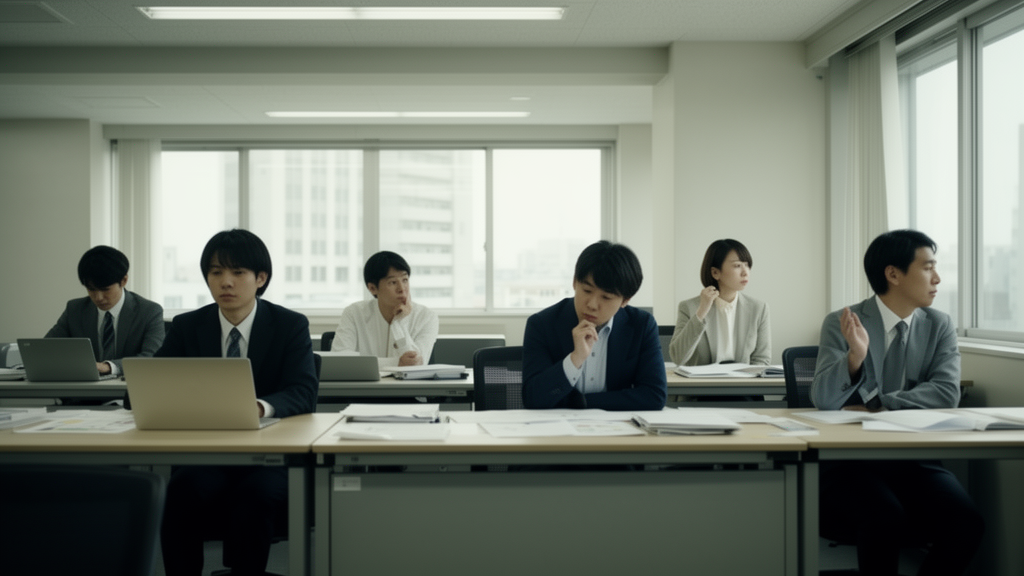
Why do employees decide to say nothing when they see problems at work? A research team at the University of Tsukuba has now built and tested the first validated Japanese version of a scale designed to measure exactly that. The new instrument, called the Japanese version of the six-factor Employee Silence Motives scale, or ESM-J, adapts a measure originally developed among employees in the United States by the researcher Brinsfield. The work, published in BMC Psychology, provides a statistical toolkit for studying why workers in Japanese organizations withhold their opinions, a phenomenon known to damage organizational decision-making, innovation, and ethical judgment.
Employee silence is not a single behavior with a single cause. People stay quiet for many different reasons: some fear retaliation, some believe speaking up is futile, some protect colleagues, and some disengage from the organization altogether. Japan presents a particularly important setting for studying these motives because its workplace culture combines collectivism with high power distance, traits that researchers suspect may make silence easier and more frequent. Until now, however, no Japanese version of the six-factor silence motives model had been validated, leaving Japanese organizations and scientists without a reliable way to measure the phenomenon.
The study involved employees aged 22 to 64 years working in Japanese companies. The primary validation sample, referred to as Sample B, contained 503 participants whose data were used for the main analyses. A separate independent sample, Sample A, was recruited for test-retest reliability testing, with 797 participants at the first measurement and 664 completing a second survey approximately two weeks later. The researchers translated and adapted the original scale and then subjected it to a battery of psychometric tests, including confirmatory factor analysis, convergent validity checks, reliability estimation, and discriminant validity testing.
Confirmatory factor analysis compares how well different theoretical structures fit the same data. The team tested models containing one through six factors and found that the six-factor structure from the original scale demonstrated the best fit, with a Comparative Fit Index of 0.907, a Tucker-Lewis Index of 0.896, a Root Mean Square Error of Approximation of 0.068 with a confidence interval of 0.064 to 0.073, and a Standardized Root Mean Square Residual of 0.062. These indices suggest that the six distinct silence motives identified among American employees also exist as separable constructs among Japanese workers, supporting the idea that silence motives share structural features common across cultures.
Reliability and convergent validity results met accepted statistical thresholds. Internal consistency of the six-factor model ranged from 0.77 to 0.89 for both McDonald’s omega and Cronbach’s alpha, exceeding the minimum acceptable value of 0.70. Composite reliability ranged from 0.77 to 0.89, and average variance extracted ranged from 0.53 to 0.62, supporting convergent validity for all six factors. Discriminant validity was tested using the heterotrait-monotrait ratio, and all 15 factor pairs met the criterion of less than 0.90, with values ranging from 0.49 to 0.89, indicating that each silence motive is statistically distinguishable from the others.
The researchers also examined how the silence motives relate to other workplace variables. Psychological safety showed significant negative correlations with all silence factors, with correlation coefficients ranging from -0.22 to -0.45. Voice behavior and leader-member exchange, a measure of the quality of the relationship between employee and supervisor, showed significant negative correlations with five factors, excluding deviant silence. Deviant silence, the motive associated with disengagement from the organization, was not significantly associated with either variable, suggesting it operates differently from the other motives in the Japanese context.
Additional analyses tested measurement invariance across gender using multigroup confirmatory factor analysis. The results did not reject invariance at the configural, metric, and scalar levels, meaning the scale appears to function similarly for men and women. However, the female subsample was small, containing only 99 participants, and the researchers describe these findings as preliminary. Test-retest reliability using the independent sample yielded intraclass correlation coefficients ranging from 0.52 to 0.64, classified as fair to good, over an interval of approximately two weeks.
Item response theory analyses using the graded response model provided further evidence of the scale’s statistical quality. All 29 items exhibited high discrimination parameters, ranging from 1.69 to 3.45, meaning each item effectively distinguishes between respondents with different levels of each silence motive. Marginal reliability ranged from 0.82 to 0.91, indicating strong measurement precision across the response range. These results suggest the scale can be used with confidence in research settings where precise measurement of individual differences in silence motives is required.
The findings also carry substantive implications beyond measurement. The results suggest that defensive silence may occupy a central position in the associative structure among silence motives in Japan, hinting that fear-based reasons for staying quiet could be especially important in Japanese organizations. The study provides initial evidence of the validity and reliability of the ESM-J primarily within a single sample, and the researchers note that cross-validation in independent and more representative samples is needed before broader application can be recommended. Still, the scale represents a promising measure of employee silence in Japanese organizations and a step toward understanding why workers around the world choose to keep their mouths shut.
Subject of Research: Development and validation of a Japanese version of the six-factor Employee Silence Motives scale (ESM-J)
Article Title: Development and validation of a Japanese version of the six-factor Employee Silence Motives scale (ESM-J)
Article References: Kamibaba, S., Ozaki, K., & Tatsumoto, H. (2026). Development and validation of a Japanese version of the six-factor Employee Silence Motives scale (ESM-J). BMC Psychology. https://doi.org/10.1186/s40359-026-05517-y
Image Credits: AI Generated
DOI: 10.1186/s40359-026-05517-y
Keywords: employee silence, psychometrics, organizational psychology, Japan, scale validation, Development, validation, Japanese, version, six-factor, Employee, Silence
Cite Scienmag News
Glenn Wilkins. (October 17, 2026). Japanese Employees Keep Silent for Six Distinct Reasons, New Scale Reveals. Scienmag. https://scienmag.com/japanese-employees-keep-silent-for-six-distinct-reasons-new-scale-reveals/
Glenn Wilkins. "Japanese Employees Keep Silent for Six Distinct Reasons, New Scale Reveals." Scienmag, 17 October 2026, https://scienmag.com/japanese-employees-keep-silent-for-six-distinct-reasons-new-scale-reveals/. Accessed 17 October 2026.
Glenn Wilkins. "Japanese Employees Keep Silent for Six Distinct Reasons, New Scale Reveals." Scienmag. October 17, 2026. https://scienmag.com/japanese-employees-keep-silent-for-six-distinct-reasons-new-scale-reveals/


