


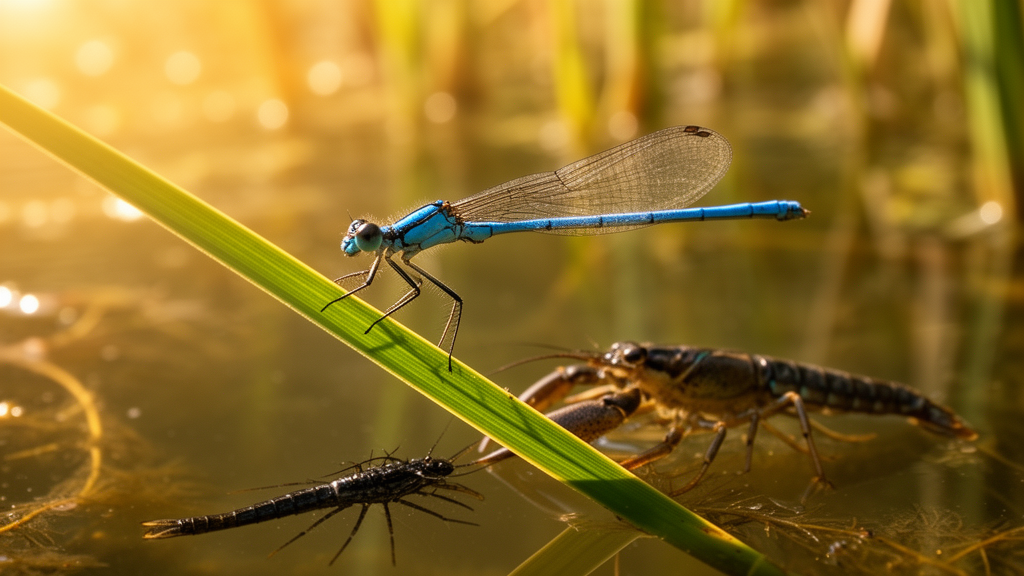
In the shallow ponds of southern Poland, a quiet chemical arms race is underway. Damselfly larvae drifting through the water are constantly bathed in molecular signals released by the predators around them, and how they react to those signals can mean the difference between life and death. A new study published in NeoBiota reveals that these reactions are far more complicated than scientists once assumed: the effects of a native predator and an invasive alien predator on damselfly fitness are not fixed properties of predator novelty, but are reshaped by warming temperatures and the shrinking seasonal deadlines imposed by changing day length.
The research team, working with the blue-tailed damselfly Ischnura elegans, conducted two complementary experiments to test how larvae respond to chemical cues from two crayfish species: the native noble crayfish (Astacus astacus) and the invasive alien spinycheek crayfish (Faxonius limosus), which arrived in central Europe in the late nineteenth century and has since become the most prevalent crayfish in EU countries. The larvae occupy a mid-level trophic position in freshwater food webs, preying on aquatic invertebrates while serving as food for fish and larger invertebrates, making them ideal sentinels for studying how predator-prey dynamics shift under environmental change.
At the heart of the study lies the naïve prey hypothesis, a framework that categorizes how native prey fail to deal with novel invaders. Level 1 naïveté describes prey that cannot recognize a new predator’s cues at all; Level 2 describes prey that recognize the predator but mount an inappropriate defense; and Level 3 describes prey that respond correctly but are simply outmatched. The researchers predicted that damselfly larvae, lacking shared evolutionary history with the spinycheek crayfish, would show mismatched or ineffective antipredator responses compared with those elicited by the familiar noble crayfish. What they found broadly supported this prediction but revealed that predator novelty alone does not determine the outcome.
In the first experiment, the team crossed two temperature treatments with three predator cue treatments. The ambient temperature of 22 degrees Celsius mimicked current conditions at the collection site, while the warming treatment of 26 degrees Celsius simulated the predicted temperature increase by 2100 under the IPCC SSP5-8.5 scenario. Egg clutches from wild-caught females were subdivided equally across all treatment combinations in a balanced split-clutch design, ensuring that genetic and maternal variation was evenly distributed. Larvae were then divided into short-term exposure groups, which received predator cues for five days at the final larval instar, and long-term exposure groups, which received cues throughout the final instar until adult emergence, allowing the researchers to assess carry-over effects across metamorphosis.
The results were striking. Following short-term exposure, damselfly larvae distinguished between the two crayfish species in their phenoloxidase activity, a key enzyme in insect immune defense, and in their boldness, measured as the time taken to resume movement after a simulated predator attack. Under ambient temperature, larvae exposed to invasive spinycheek crayfish cues showed the highest immune activity and reduced boldness, but these predator-specific differences weakened substantially under warming. The researchers suggest that elevated energetic demands at higher temperatures may constrain the ability of larvae to maintain costly, predator-specific antipredator responses.
Following long-term exposure, the picture shifted again. Survival to emergence was lower under invasive spinycheek crayfish cues than under native noble crayfish cues, indicating that prolonged exposure to the novel predator carried demographic consequences. Meanwhile, growth rate responses depended on the interaction between predator identity and temperature: under warming, growth was lower following exposure to native noble crayfish cues than in the control, with the invasive treatment intermediate. This pattern suggests that warming does not simply amplify predator effects but reshapes how investment is distributed among growth, behavior, and physiology in a trait-specific manner.
The second experiment replaced temperature with photoperiod, imposing different seasonal time constraints on developing larvae. Larvae collected in June experienced spring photoperiods, while those collected in August experienced summer photoperiods, with all individuals in the late group undergoing wintering before reaching the target stage. The late photoperiod increased predator-specific differentiation in growth rate and boldness, primarily through stronger responses to native noble crayfish cues. Under the early photoperiod, larvae exposed to invasive cues were less bold than those exposed to native cues, but under the late photoperiod, this pattern reversed, with native crayfish cues producing the strongest reduction in boldness. Feeding rate also increased under the late photoperiod only in the invasive crayfish treatment, demonstrating that seasonal context can change both the magnitude and direction of predator-specific responses.
Sex differences added another layer of complexity. Females exposed to invasive spinycheek crayfish cues showed reduced boldness compared with females in control and native treatments, whereas males exposed to native noble crayfish cues were less bold than control males. Warming increased feeding rate in females but not in males, likely reflecting sex-specific energetic requirements, with females needing greater resource acquisition to support growth and subsequent reproduction. These findings underscore that predator-induced plasticity is not uniform across individuals but emerges from interactions among predator identity, abiotic conditions, and life-history strategy.
The study also revealed that developmental history matters profoundly. Larvae that subsequently underwent wintering had substantially lower growth rates before entering the final instar than those that developed directly, and previous wintering affected later traits, particularly growth rate and fat content following long-term predator exposure. Among directly developing individuals exposed to seasonal temperature decline, growth rate increased with temperature at entry into the final instar, consistent with the general framework of seasonal regulation in temperate odonates. The researchers emphasize that such developmental pathways must be accounted for when interpreting treatment effects in organisms with complex life cycles.
Perhaps the most important takeaway is that abiotic conditions can weaken, strengthen, or otherwise modify predator-specific plasticity rather than uniformly constraining its expression. Warming weakened predator-specific differentiation in immune function and boldness, while photoperiod changed the pattern of predator-specific responses in growth and behavior. As biological invasions accelerate under climate change, these findings suggest that predicting prey responses to novel predators requires understanding not just who the predator is, but what the environment is doing to both predator and prey. The damselflies of southern Poland, it turns out, are telling a story about ecological futures that extends far beyond their ponds.
Subject of Research: Ecology of biological invasions and predator-prey interactions under climate change
Article Title: Warming and photoperiod differentially mediate native and invasive alien predator effects on damselfly fitness traits
Article References: Amer, N. R., Golab, M. J., Stoks, R., Wos, G., & Sniegula, S. (2026). Warming and photoperiod differentially mediate native and invasive alien predator effects on damselfly fitness traits. NeoBiota, 109, 217-245. https://doi.org/10.3897/neobiota.109.200244
Image Credits: AI Generated
DOI: 10.3897/neobiota.109.200244
Keywords: biological invasions, climate warming, photoperiod, damselfly, predator-prey interactions, phenotypic plasticity, naive prey hypothesis, crayfish, Warming, differentially, mediate, native
Cite Scienmag News
Patricia Pace. (October 17, 2026). Warming and Seasonal Deadlines Reshape How Damselflies Respond to Native and Invasive Predators. Scienmag. https://scienmag.com/warming-and-seasonal-deadlines-reshape-how-damselflies-respond-to-native-and-invasive-predators/
Patricia Pace. "Warming and Seasonal Deadlines Reshape How Damselflies Respond to Native and Invasive Predators." Scienmag, 17 October 2026, https://scienmag.com/warming-and-seasonal-deadlines-reshape-how-damselflies-respond-to-native-and-invasive-predators/. Accessed 17 October 2026.
Patricia Pace. "Warming and Seasonal Deadlines Reshape How Damselflies Respond to Native and Invasive Predators." Scienmag. October 17, 2026. https://scienmag.com/warming-and-seasonal-deadlines-reshape-how-damselflies-respond-to-native-and-invasive-predators/


