


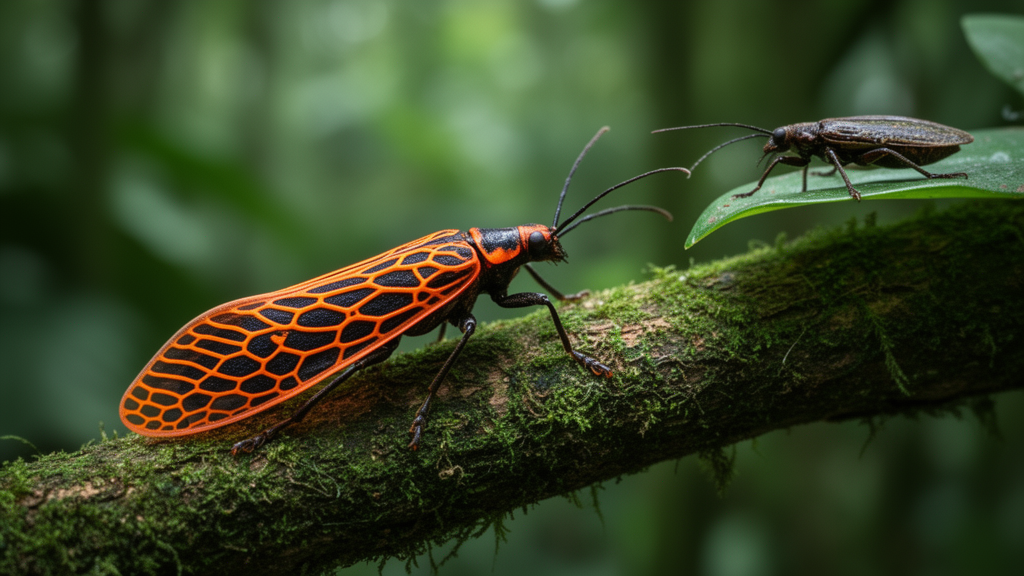
Deep in the forests of the Russian Far East, the Himalayas and North America lives a small group of crimson beetles so elusive that one species is known from a single specimen and another from just three. Now, a comprehensive review published in the Deutsche Entomologische Zeitschrift has pulled back the curtain on Punicealis, a little-studied genus of net-winged beetles, offering the first complete photographic atlas, re-description and identification key for all six of its recognised species. The work, led by entomologist Sergey Kazantsev of the Insect Centre in Moscow, represents a major step forward for a lineage that has puzzled taxonomists for more than three decades.
Net-winged beetles belong to the family Lycidae, a group famous for their soft, flattened bodies and elaborate wing patterns that mimic the veins of leaves. Within this family, the subfamily Erotinae and the tribe Dictyopterini contain some of the most strikingly coloured members, often advertising toxicity through bright red or orange warning hues. The genus Punicealis was established in 1990 by Kazantsev as a subgenus of the larger genus Dictyoptera, with five species initially assigned to it: three from the Far East of Russia and Japan, and two from North America. A sixth species from the Himalayas was added in 1993, and by 2004, following a morphology-based phylogenetic analysis of the tribe, Punicealis had been elevated to full genus status.
What makes Punicealis immediately recognisable among its relatives is a combination of two features that set it apart from the closely related Dictyoptera. First, the elytra, the hardened forewings that cover the flight wings, carry a uniform covering of fine pubescence, meaning the tiny hairs are distributed evenly across both the raised ribs and the sunken cells between them. In Dictyoptera, by contrast, the pubescence is confined only to the elytral ribs, leaving the cell floors bare. Second, and even more conspicuously, the hind trochanters, small leg segments connecting the femur to the coxa, are dramatically elongated and pointed at their tips, especially in males. In Dictyoptera, these segments retain a regular, unremarkable shape.
The new review re-describes the genus in full, drawing on specimens held in museum collections across Russia, Germany and the United States. Using a MSP-1 zoom stereoscopic dissecting microscope with a magnification range of 8 to 80 times, the author examined diagnostic characters across the head, pronotum, elytra, legs and copulatory organs. Photographs were captured with a Canon EOS 6D camera fitted with a Canon MP-E 65 mm lens, and images were stacked using Zerene Stacker software to achieve sharp focus throughout each specimen. For examination of the delicate genital structures, beetles were relaxed in water and their detached abdomens were treated in 10 percent potassium hydroxide for up to 12 hours at room temperature, then preserved in microvials of glycerine.
The results reveal a genus of remarkable morphological consistency despite considerable geographic separation between its members. Males are generally red above, with the pronotum, scutellum and abdomen often darkened at the disc. The head is transverse, with small eyes separated by a distance noticeably greater than the eye diameter. The antennae are moderately long, reaching over the mid-elytra, and are filiform except for the second and third segments, which are conical and widen distally. The pronotum is transverse and usually convex anteriorly, with acute posterior angles and blunt anterior ones, and carries a rhomboidal median cell with slightly concave posterior sides. The elytra are long, slightly widening distally, and bear four complete longitudinal costae with double rows of small regular sub-rectangular cells in the interstices.
The male copulatory organ, or aedeagus, is elongate and oval in dorsoventral view, with a straight, relatively narrow median lobe that curves slightly at its distal end in lateral view. The parameres, paired lateral structures flanking the median lobe, are slightly shorter than the lobe itself, open ventrally, and fused dorsally at their base, each bearing a prominent inwardly directed tooth. The phallobase is elongate and oval, without a median suture. Females are more robust than males, with relatively broader pronota and elytra, somewhat stouter and shorter antennae, and less elongated hind trochanters. The external female genitalia, studied here for the first time in four of the six species, feature elongate styli, elongate parallel-sided coxites and long narrow valvifers, with the valvifers loosely connected distally to an elongate bullet-shaped sternite 10.
Perhaps the most significant contribution of the review is the first-ever identification key to all six Punicealis species, allowing researchers to distinguish them without dissection. The North American species, P. hamata and P. munda, both have uniformly red pronota, while the four Asian species, P. martensi, P. medvedevi, P. miranda and P. barovskii, all display bicolorous pronota with red margins and infuscated discs. P. hamata is the largest species at 10 to 15 millimetres in length, with elongated and acute apices on the male hind trochanters and a narrow phallobase roughly 2.4 times longer than wide. P. munda, by contrast, is small, not exceeding 6 millimetres, with rounded male hind trochanter apices and a broader phallobase approximately 1.4 times longer than wide.
Among the Asian species, P. martensi is distinguished by an almost straight anterior pronotal margin and a noticeably stouter second elytral costa in its distal two-thirds. P. medvedevi has a more elongate body, with male elytra four times longer than wide at the humeri, and its aedeagal parameres bear a rounded inner tooth positioned in their middle rather than near the apex. P. miranda and P. barovskii are more robust, with male elytra roughly three times longer than wide at the humeri, but P. miranda has a roundish median pronotal cell and stouter elytral costae, while P. barovskii retains a rhomboidal cell and weaker costae, along with distally pointed middle trochanters.
The biogeographic pattern of Punicealis is unusual among net-winged beetles. One cluster of species occupies the Far East of Asia, with an additional location in the Himalayas of Nepal, while two other species are found in North America, one in the north-west from Alaska to Washington and Idaho, and the other in the east from Pennsylvania and southern Illinois to Georgia and Louisiana. This Holarctic distribution resembles that of other erotine genera such as Dictyoptera, Erotides and Lopheros, though in those groups the Palaearctic range extends much further west, reaching the Atlantic coast. In Punicealis, the Asian patch remains confined to the eastern margin of the continent.
Despite the new insights, much about Punicealis remains unknown. The larvae have never been described, and little is understood about the biology of most species. Molecular data suggest that the initial separation of the Punicealis clade occurred early in the divergence of the dictyopterine lineages, meaning that even seemingly minor morphological differences among its members may reflect independent development over millions of years. The author notes that further studies, particularly molecular analyses, may eventually reveal whether some of the observed morphological peculiarities support the recognition of distinct lineages within the genus, much as recent work led to the erection of the genus Gomezzuritus from within Benibotarus. For now, this review provides the essential morphological foundation upon which such future discoveries will be built.
Subject of Research: Taxonomic review of the net-winged beetle genus Punicealis
Article Title: A review of the dictyopterine net-winged beetle genus Punicealis Kazantsev, 1990 ( Coleoptera , Lycidae , Erotinae )
Article References: Kazantsev, S. V. (2026). A review of the dictyopterine net-winged beetle genus Punicealis Kazantsev, 1990 (Coleoptera, Lycidae, Erotinae). Deutsche Entomologische Zeitschrift, 73(1), 37-47. https://doi.org/10.3897/dez.73.183029
Image Credits: AI Generated
Keywords: Punicealis, Lycidae, net-winged beetles, taxonomy, Coleoptera, Erotinae, Dictyopterini, entomology, review, dictyopterine, net-winged, beetle
Cite Scienmag News
Drew Townsend. (October 17, 2026). Rare net-winged beetles get a full makeover in landmark genus review. Scienmag. https://scienmag.com/rare-net-winged-beetles-get-a-full-makeover-in-landmark-genus-review/
Drew Townsend. "Rare net-winged beetles get a full makeover in landmark genus review." Scienmag, 17 October 2026, https://scienmag.com/rare-net-winged-beetles-get-a-full-makeover-in-landmark-genus-review/. Accessed 17 October 2026.
Drew Townsend. "Rare net-winged beetles get a full makeover in landmark genus review." Scienmag. October 17, 2026. https://scienmag.com/rare-net-winged-beetles-get-a-full-makeover-in-landmark-genus-review/


