


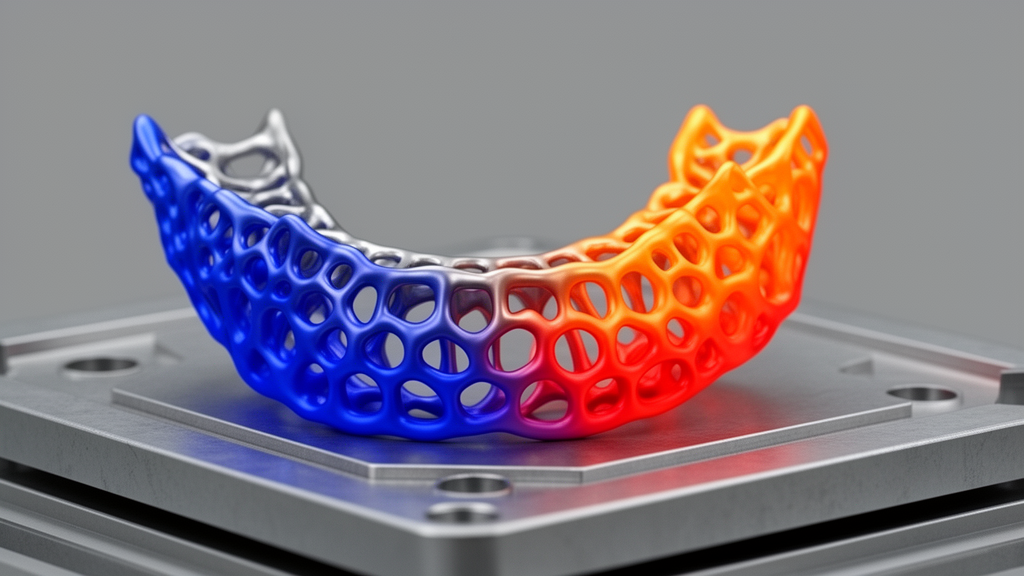
When surgeons rebuild a jaw after tumor removal or severe trauma, they increasingly turn to custom 3D-printed titanium plates shaped precisely to the patient’s anatomy. Yet a striking paradox has persisted in this high-tech field: while the outer contour of these patient-specific implants (PSIs) is tailored to the millimeter, the internal structure—the plate’s width and thickness—has traditionally been chosen by the designer based on experience and clinical observation rather than on the actual mechanical loads the implant will face. A new study published in Frontiers in Oncology introduces a computational approach that closes this gap, letting the implant’s own stress analysis dictate where it should be reinforced.
The research, led by Ankit Nayak of the University of Petroleum and Energy Studies in India together with Yu-Xiong Su and Jane Jingya Pu of the University of Hong Kong, builds on computer-assisted surgery (CAS), the current standard of care for jaw reconstruction. CAS combines three-dimensional virtual surgical planning with computer-aided design and manufacturing, and in cases of segmental mandibulectomy—the surgical removal of a portion of the lower jaw—the well-established reconstructive approach remains the vascularized free fibula flap. Patient-specific cutting guides and implants transfer the virtual plan to the operating theater, reducing freehand contouring and repeated intraoperative measurement while maintaining the planned three-dimensional position of the fibular segments relative to the residual mandible.
But geometric accuracy alone does not guarantee mechanical safety. Uniform-thickness, uniform-width plates embody two competing design risks. Plates that are overly thick have been associated with stress shielding, which may impair bone healing, increase the risk of implant exposure through overlying soft tissue, and even contribute to radiation scattering during post-operative radiotherapy. Plates that are too thin carry a higher risk of fracture, which in turn has been linked to bone non-union or mal-union in some reports. Compounding the problem, stress in a reconstruction plate accumulates disproportionately near sharp edges, notches, and screw holes—meaning a single uniform cross-section may be structurally inefficient by design.
The team’s solution is a parametric-design algorithm that feeds finite element analysis (FEA) results directly back into the geometry-generation process. Rather than uniformly reinforcing the entire plate, the algorithm selectively thickens only the regions where von Mises stress concentrations exceed a defined threshold. Crucially, the reinforcement is blended smoothly into the plate’s geometry using a cubic smoothstep taper that provides C1-continuous transitions—meaning the width changes gradually with zero slope at both boundaries. This prevents the abrupt changes in cross-section that would otherwise create new stress concentrations, the very problem the reinforcement is meant to solve.
The mathematical machinery behind the adaptation is elegant in its economy. The plate is represented as a sequence of rectangular cross-sections swept along a three-dimensional centerline guide curve, each rectangle defined in its own local orthonormal frame derived from the actual vertex coordinates. When a zone is flagged for reinforcement, the algorithm scales the width of the rectangles within that zone while holding thickness constant—a constraint that reflects the surgical requirement for a plate of known, uniform thickness that can be pre-bent intra-operatively. Scaling is performed about each section’s centroid, ensuring the plate centerline and its load path along the mandible are never displaced, and the counter-clockwise vertex ordering is preserved so the downstream surface triangulation produces a valid, non-self-intersecting mesh.
To validate the approach, the researchers performed FEA on a baseline plate simulating right molar clenching, with muscle forces adopted from published literature and the bone modeled as dense cortical bone with a Young’s modulus of 13,700 MPa. The screws were simplified as cylindrical shafts with bonded contacts, and a mesh convergence study confirmed numerical reliability—refining the mesh from 127,947 to 144,521 nodes changed the peak equivalent stress by only 0.39%. The stress-versus-arc-length profile revealed two zones where stress remained at or above a threshold of 100 MPa, roughly one-third of the baseline global maximum of 305.01 MPa: Zone 1, between screw holes 2 and 4, and Zone 2, between holes 8 and 10.
The results demonstrate the power of targeted reinforcement. Plate A, which widened only Zone 1 to 6 mm, reduced peak stress there by 36.0%—down to 195.2 MPa—and strain by 43.8%, the largest reduction observed across both design variants. Remarkably, even the unmodified Zone 2 benefited, with stress and strain falling by 12.7% and 14.3% respectively, indicating that local width adaptations help redistribute load across the entire plate. Plate B, which reinforced both zones, pushed Zone 2 stress down by 30.6% and strain by 33.3% relative to baseline, while Zone 1 strain dropped by approximately 40.6%.
One finding deserves particular attention: Plate B showed a slightly higher stress at Zone 1 than Plate A—204.64 MPa versus 195.20 MPa. The authors interpret this as a non-local mechanical trade-off rather than a design failure. Reinforcing Zone 2 alters the plate’s global deflection and curvature profile, which increases the local bending moment, and hence stress, at Zone 1. Nevertheless, Zone 1 stress in Plate B remained 32.9% lower than the baseline value, demonstrating that simultaneous multi-region adaptation can achieve favorable stress reduction at both critical locations without reintroducing baseline-level concentrations at either site.
The study also situates its approach against topology optimization, the alternative computational strategy that iteratively redistributes material within a design domain using sensitivity-based solvers. Topology-optimized implants have been reported with better fatigue performance, but they typically require repeated iterations between optimization and FEA, along with post-processing to correct numerical instabilities and satisfy manufacturing constraints. The proposed adaptive-scaling method, by contrast, recommends manufacturable, screw-hole-constrained geometry in a single FEA-driven feedback loop, offering a predictable design path at the expense of not exploiting the full unconstrained material-distribution space that topology optimization provides. The authors note that a direct benchmarking of computational cost was not performed and remains a task for future work.
The researchers are candid about the study’s limitations. The evaluation rests on a single patient-specific baseline reconstruction under a single static loading condition, with muscle forces drawn from published sources and screws idealized as bonded cylindrical shafts. No physical prototyping, mechanical testing, or fatigue analysis was conducted, even though reconstruction plates in vivo experience cyclic masticatory loading. The algorithm currently handles only single-barrel reconstruction cases and cannot accommodate branched implant structures. Importantly, the team emphasizes that automation alone will not guarantee better clinical outcomes: key design parameters remain surgeon-specific, allowing clinicians to define them according to their unique requirements—a deliberate balance between mechanical performance and surgical objectives. With the baseline plate’s peak stress of 305.01 MPa sitting well below the yield strength of 3D-printed Ti-6Al-4V titanium alloy—524.2 MPa in the lowest case of electron beam melting and up to 1035.7 MPa with selective laser melting—the approach offers a computationally efficient pathway toward implants that are not only anatomically tailored but mechanically optimized for the loads they will actually encounter.
Subject of Research: Stress-informed parametric design of patient-specific titanium implants for computer-assisted jaw reconstruction
Article Title: Stress-informed parametric shape adaptive patient-specific implant design in computer-assisted jaw reconstruction
Article References: Nayak, A., Su, Y.-X., & Pu, J. J. (2026). Stress-informed parametric shape adaptive patient-specific implant design in computer-assisted jaw reconstruction. Frontiers in Oncology, 16, Article 1966850. https://doi.org/10.3389/fonc.2026.1966850
Image Credits: AI Generated
DOI: 10.3389/fonc.2026.1966850
Keywords: patient-specific implants, mandibular reconstruction, finite element analysis, 3D printing, titanium alloy, stress adaptation, computer-assisted surgery, parametric design, von Mises stress, fibula free flap, biomechanics, additive manufacturing
Cite Scienmag News
Denise Maddox. (October 17, 2026). Stress-Feedback Algorithm Reshapes 3D-Printed Jaw Implants Where They Need It Most. Scienmag. https://scienmag.com/stress-feedback-algorithm-reshapes-3d-printed-jaw-implants-where-they-need-it-most/
Denise Maddox. "Stress-Feedback Algorithm Reshapes 3D-Printed Jaw Implants Where They Need It Most." Scienmag, 17 October 2026, https://scienmag.com/stress-feedback-algorithm-reshapes-3d-printed-jaw-implants-where-they-need-it-most/. Accessed 17 October 2026.
Denise Maddox. "Stress-Feedback Algorithm Reshapes 3D-Printed Jaw Implants Where They Need It Most." Scienmag. October 17, 2026. https://scienmag.com/stress-feedback-algorithm-reshapes-3d-printed-jaw-implants-where-they-need-it-most/


