


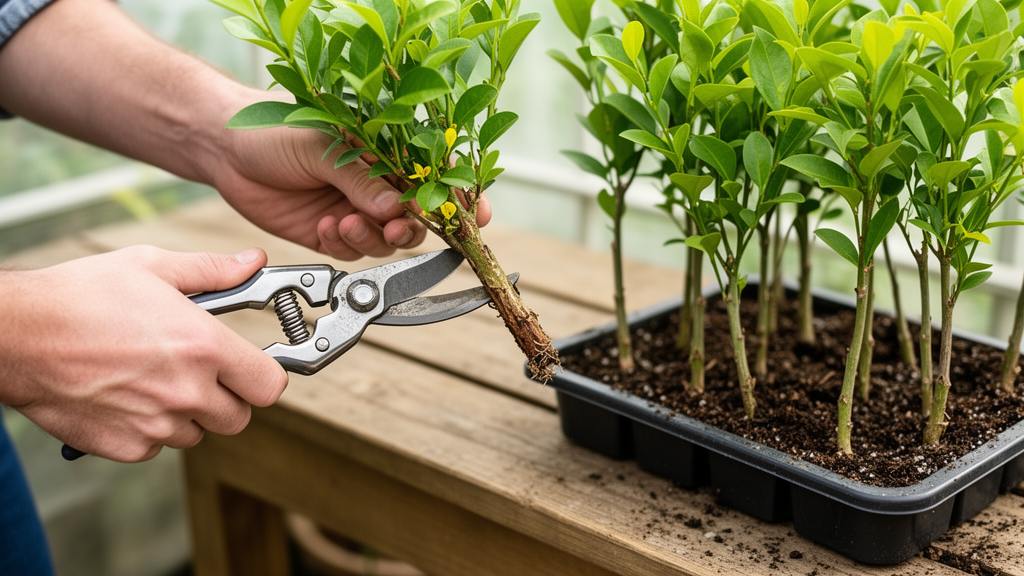
For nurseries growing fragrant tea olive and its relatives, the difference between a profitable bench of rooted cuttings and a bench of losses may come down to something as simple as how mature the stem was when it was cut. A new study from the USDA Agricultural Research Service has systematically tested how wood maturity, cultivar genetics, species identity, and auxin treatments interact to determine rooting success across three Osmanthus species, and the results challenge several assumptions that growers have long relied upon.
The research evaluated 324 cuttings from three species: Osmanthus fragrans, the fragrant tea olive prized for its intensely sweet flowers; Osmanthus heterophyllus, the holly tea olive with its spiny evergreen foliage; and Osmanthus fortunei, a hybrid combining traits of both. Cuttings were collected from plants maintained at the National Arboretum research station and propagated under controlled conditions with three levels of indole-3-butyric acid (KIBA) treatment: no auxin, 3,000 ppm, and 8,000 ppm. The cuttings were assessed after twelve weeks for survival, rooting percentage, root number, and root system size.
The most striking finding concerned wood maturity. Lignified cuttings, which had developed hardened woody tissue, dramatically outperformed semi-lignified cuttings across all species and treatments. For O. heterophyllus, the contrast was particularly pronounced: lignified cuttings achieved 90 percent survival while semi-lignified cuttings managed only 21 percent. For O. fragrans, lignified cuttings reached 58 percent survival compared with 37 percent for semi-lignified material. For O. fortunei, lignified cuttings achieved 75 percent survival against 50 percent for semi-lignified cuttings. The pattern held for rooting percentage as well, with lignified cuttings consistently producing more primary roots than their semi-lignified counterparts.
Cultivar genetics proved equally influential. Within O. fragrans, the cultivar Fodingzhu achieved 67 percent rooting while the cultivar Xiaoye averaged just 17 percent, a four-fold difference within the same species. Within O. fortunei, the cultivar Fudingzhu rooted at 75 percent while Shangyefudingzhu managed only 50 percent. Within O. heterophyllus, Goshiki rooted at 21 percent while Variegata achieved just 7 percent. These within-species differences suggest that growers cannot assume uniform propagation protocols across cultivars of the same species, and that cultivar selection may matter as much as species selection when planning production.
The auxin treatments, surprisingly, produced only modest effects. Across all species, the 8,000 ppm treatment produced significantly more primary roots than the no-auxin control, but the differences in survival and rooting percentage were small. The 3,000 ppm treatment fell between the two extremes. For growers, this means that while auxin remains useful for enhancing root system quality, it cannot compensate for poor cutting material or unfavorable genetics. The immature cuttings and difficult cultivars remained difficult regardless of auxin level.
Root system size, measured as total root area, showed the strongest response to auxin. The 8,000 ppm treatment produced root areas roughly double those of the no-auxin control across all species. Within O. fragrans, Fodingzhu produced the largest root systems while Xiaoye produced the smallest. Within O. fortunei, Fudingzhu again outperformed its counterpart. Within O. heterophyllus, Goshiki produced larger root systems than Variegata. These results indicate that auxin primarily enhances root system development rather than rooting frequency itself.
The study also revealed that species identity shaped rooting outcomes in ways that cut across maturity and cultivar effects. O. fortunei, the hybrid, showed the highest overall survival and rooting percentages, suggesting hybrid vigor may extend to vegetative propagation. O. fragrans showed intermediate performance, while O. heterophyllus proved the most difficult to root. For growers, this means that hybrid tea olives may be the easiest to propagate, while holly tea olives require the most careful attention to cutting maturity and cultivar selection.
The practical implications for nursery production are significant. The results suggest that growers should prioritize lignified cuttings whenever possible, particularly for difficult species like O. heterophyllus. They should also recognize that cultivar selection may matter as much as species selection, and that difficult cultivars may require longer bench time or more careful management. Auxin treatments remain useful for enhancing root system quality but cannot rescue poor cutting material. The findings also suggest that hybrid tea olives may be the most reliable choice for growers seeking consistent propagation results.
The research also highlights the importance of understanding the biology underlying these differences. Lignified cuttings likely contain more stored carbohydrates and developed root primordia, giving them a head start in root initiation. Cultivar differences may reflect genetic variation in endogenous auxin levels, carbohydrate storage, or root primordia development. Species differences may reflect evolutionary divergence in vegetative propagation capacity. Understanding these mechanisms could help breeders develop cultivars that are easier to propagate and help growers refine their protocols.
For the ornamental horticulture industry, which relies heavily on vegetative propagation of woody ornamentals, these findings provide a framework for improving propagation efficiency. By matching cutting maturity to species and cultivar requirements, growers can reduce losses and improve bench utilization. The results also suggest that breeders seeking to introduce new tea olive cultivars should consider propagation ease as a selection criterion alongside ornamental traits. As the industry continues to expand its offerings of fragrant tea olives and their relatives, understanding the interplay of maturity, genetics, and auxin will be essential for maintaining profitable production.
Subject of Research: Rooting success of Osmanthus stem cuttings as influenced by cutting maturity, cultivar, and auxin
Article Title: Species, cultivar, and cutting maturity drive rooting success in Osmanthus
Article References: Alexander, L. W. (2026). Species, cultivar, and cutting maturity drive rooting success in Osmanthus. Frontiers in Horticulture, 5, Article 1815981. https://doi.org/10.3389/fhort.2026.1815981
Image Credits: AI Generated
DOI: 10.3389/fhort.2026.1815981
Keywords: Osmanthus, stem cuttings, rooting success, auxin, cultivar variation, Oleaceae, Species, cultivar, cutting, maturity, drive, rooting
Cite Scienmag News
Juliet Wilcox. (October 17, 2026). Cutting Maturity and Cultivar Genetics Drive Rooting Success in Osmanthus Propagation. Scienmag. https://scienmag.com/cutting-maturity-and-cultivar-genetics-drive-rooting-success-in-osmanthus-propagation/
Juliet Wilcox. "Cutting Maturity and Cultivar Genetics Drive Rooting Success in Osmanthus Propagation." Scienmag, 17 October 2026, https://scienmag.com/cutting-maturity-and-cultivar-genetics-drive-rooting-success-in-osmanthus-propagation/. Accessed 17 October 2026.
Juliet Wilcox. "Cutting Maturity and Cultivar Genetics Drive Rooting Success in Osmanthus Propagation." Scienmag. October 17, 2026. https://scienmag.com/cutting-maturity-and-cultivar-genetics-drive-rooting-success-in-osmanthus-propagation/


