


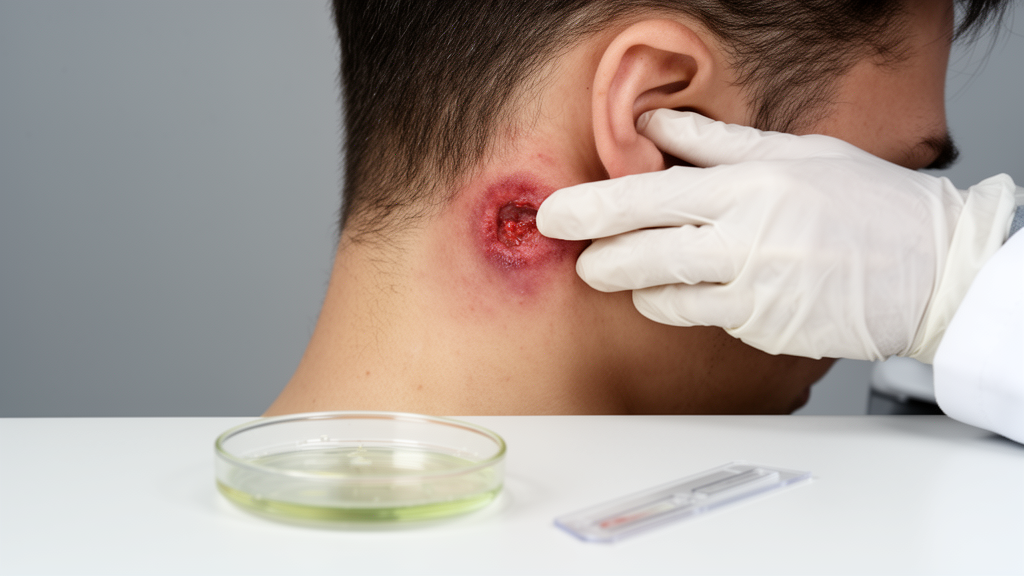
Doctors at Liaocheng People’s Hospital in Shandong Province, China, have documented the first known case of a soft-tissue abscess near the ear caused by Peptoniphilus harei, an obscure gram-positive anaerobic bacterium that rarely takes center stage in clinical microbiology. The case, published in BMC Infectious Diseases, describes a 38-year-old woman who arrived with pain and swelling beside her left ear and left the hospital with a diagnosis that required mass spectrometry, careful anaerobic culture, and a review of everything the medical literature has ever said about this unusual organism.
Peptoniphilus harei belongs to a family of microbes that most physicians will never encounter by name. It is a gram-positive anaerobic coccus, meaning it stains purple under the Gram stain, thrives in the absence of oxygen, and grows as spherical cells. These organisms normally live quietly among the diverse bacterial communities of human skin and mucosal surfaces. According to the report, P. harei invades soft tissues and causes suppurative infections, abscess-forming, pus-producing disease, when the skin or mucosal barrier is compromised. In other words, the bacterium is an opportunist: it waits for a break in the body’s defenses and then establishes a foothold in the tissue beneath.
The patient’s story began at a local hospital, where she presented with pain and swelling in the region beside her left ear, the paraauricular region. When initial evaluation suggested a collection of pus rather than a simple cellulitis, she was referred to the Liaocheng team. Upon admission, the clinicians aspirated pus from the swelling, a step that served both to relieve pressure and to obtain the specimen that would ultimately identify the culprit. The aspirated material was sent for culture, and the laboratory’s analysis identified the growing organism as P. harei using matrix-assisted laser desorption ionization-time of flight mass spectrometry, a technique known in the trade as MALDI-TOF MS.
MALDI-TOF MS has transformed clinical bacteriology over the past two decades, and this case illustrates why. The method works by firing a laser at the organism’s proteins embedded in a crystal matrix, ionizing them, and measuring the time the ions take to fly through a vacuum tube toward a detector. The resulting spectrum acts as a proteomic fingerprint that can be matched against reference databases. For anaerobic bacteria like P. harei, which are slow-growing, fastidious, and difficult to characterize by traditional biochemical tests, mass spectrometry often provides in minutes an identification that once required days of laborious manual work. The technology’s accuracy depends on the completeness of the reference library, and the successful identification in this case reflects how thoroughly these databases now cover even uncommon anaerobes.
Once the culture confirmed the identity of the organism, the clinical team moved to definitive treatment. The abscess was debrided and drained, the surgical cornerstone of managing any walled-off collection of pus, and the patient received antibiotics targeted at the recovered organism. She made a gradual recovery. This combination of source control and antimicrobial therapy remains the standard approach for soft-tissue abscesses, and the case demonstrates that infections involving unusual anaerobes respond to the same principles that govern more familiar pathogens.
To place their patient in context, the authors conducted a literature review of prior P. harei infections. The organism has previously been associated with a range of suppurative and invasive conditions at other anatomical sites, and the new report is, to the best of the authors’ knowledge, the first documented case of P. harei infection presenting as a paraauricular soft-tissue abscess. That distinction matters for clinicians working in otorhinolaryngology and head and neck surgery, because the differential diagnosis for swelling near the ear typically centers on more common entities, including parotid gland disease, odontogenic infections spreading from the teeth, and infections of overlying skin. An anaerobic coccus from the Peptoniphilus genus would rarely appear high on that list.
The diagnostic workup described in the report also highlights the layered approach modern laboratories take to anaerobic infections. Alongside culture on blood agar plates and anaerobic blood agar plates, the evaluation referenced in the case includes routine inflammatory markers such as the complete blood count, C-reactive protein, and the erythrocyte sedimentation rate, together with imaging by computed tomography when deeper extension needs to be excluded. For definitive identification, the field increasingly relies on MALDI-TOF MS and, when spectra are ambiguous, 16S rRNA gene sequencing, which reads a conserved stretch of the bacterial genome to place an organism on the tree of life. Each layer narrows the uncertainty until a precise species-level answer emerges.
Why does a single case report deserve attention? The authors argue that documenting rare presentations improves the efficiency of diagnosis and treatment. When clinicians read that P. harei can produce an abscess beside the ear, the organism enters their mental library of possibilities, and the next patient with a similar picture may be diagnosed faster. Anaerobic cultures are frequently discarded or reported as mixed flora when laboratories lack the tools or the persistence to identify every isolate, so published cases also signal to microbiology departments that these organisms are worth pursuing. The report, the team writes, enhances clinicians’ understanding of the clinical sites of infection, manifestations, diagnostic methods, and surgical and antimicrobial treatments for P. harei.
The biology of Peptoniphilus species adds further interest. These gram-positive anaerobic cocci were once lumped among the so-called Peptostreptococcus group before genomic analysis scattered them into separate genera. They are among the organisms that flourish in polymicrobial infections, where several bacterial species cooperate to overcome host defenses, and they are increasingly recognized in abscesses, diabetic foot wounds, prosthetic joint infections, and other settings where tissue oxygen levels are low. The paraauricular case fits this pattern: a barrier breach, a low-oxygen niche, and an opportunist ready to exploit it.
For the patient, the outcome was a gradual recovery after drainage and antibiotics. For the wider clinical community, the case is a reminder that the paraauricular region, like every anatomical site, can host infections caused by organisms far outside the usual suspects, and that mass spectrometry has made identifying such organisms routine rather than exceptional. The study was approved by the Clinical Research Ethics Committee of Liaocheng People’s Hospital and conducted with the patient’s written informed consent, and the article is published open access so that clinicians anywhere can add this rare presentation to their diagnostic repertoire.
Subject of Research: First documented case of a paraauricular soft-tissue abscess caused by the anaerobic bacterium Peptoniphilus harei
Article Title: Paraauricular soft-tissue abscess associated with Peptoniphilus harei: a case report and literature review
Article References: Lv, Y., Xu, J., Shi, G., Gong, L., Li, L., Song, P., & Huang, Q. (2026). Paraauricular soft-tissue abscess associated with Peptoniphilus harei: a case report and literature review. BMC Infectious Diseases. https://doi.org/10.1186/s12879-026-14659-8
Image Credits: AI Generated
DOI: 10.1186/s12879-026-14659-8
Keywords: Peptoniphilus harei, anaerobic bacterial infection, soft tissue abscess, paraauricular region, MALDI-TOF MS, case report, BMC Infectious Diseases, gram-positive anaerobic coccus, abscess drainage, antimicrobial therapy, clinical microbiology, head and neck infection
Cite Scienmag News
Morgan Morrow. (October 17, 2026). Rare Ear-Area Abscess Traced to Obscure Anaerobic Bacterium in First Documented Case. Scienmag. https://scienmag.com/rare-ear-area-abscess-traced-to-obscure-anaerobic-bacterium-in-first-documented-case/
Morgan Morrow. "Rare Ear-Area Abscess Traced to Obscure Anaerobic Bacterium in First Documented Case." Scienmag, 17 October 2026, https://scienmag.com/rare-ear-area-abscess-traced-to-obscure-anaerobic-bacterium-in-first-documented-case/. Accessed 17 October 2026.
Morgan Morrow. "Rare Ear-Area Abscess Traced to Obscure Anaerobic Bacterium in First Documented Case." Scienmag. October 17, 2026. https://scienmag.com/rare-ear-area-abscess-traced-to-obscure-anaerobic-bacterium-in-first-documented-case/


