
Friday, December 5, 2025
Science
No Result
View All Result
  • Login
  • HOME
  • SCIENCE NEWS
  • CONTACT US
  • HOME
  • SCIENCE NEWS
  • CONTACT US
No Result
View All Result
Scienmag
No Result
View All Result
Home Science News Marine

What’s quieter than a fish? A school of them

April 9, 2024
in Marine
Reading Time: 3 mins read
0
Fish swimming in quietest formation
66
SHARES
601
VIEWS
Share on FacebookShare on Twitter
ADVERTISEMENT

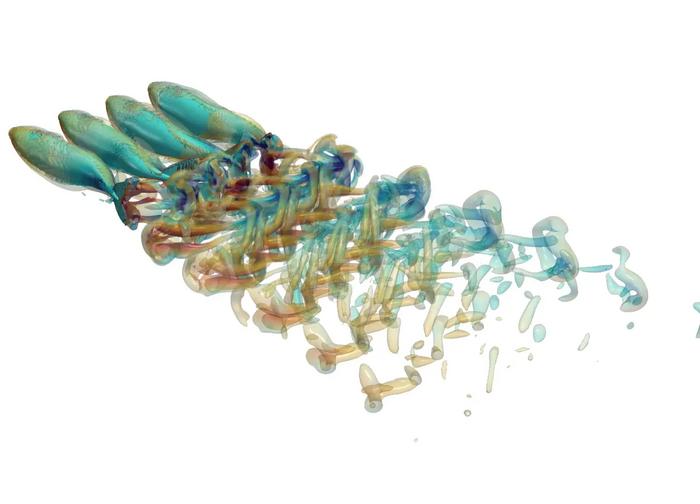
Swimming in schools makes fish surprisingly stealthy underwater, with a group able to sound like a single fish.

Fish swimming in quietest formation

Credit: Johns Hopkins University

Swimming in schools makes fish surprisingly stealthy underwater, with a group able to sound like a single fish.

The new findings by Johns Hopkins University engineers working with a high-tech simulation of schooling mackerel, offers new insight into why fish swim in schools and promise for the design and operation of much quieter submarines and autonomous undersea vehicles.

“It’s widely known that swimming in groups provides fish with added protection from predators, but we questioned whether it also contributes to reducing their noise,” said senior author Rajat Mittal. “Our results suggest that the substantial decrease in their acoustic signature when swimming in groups, compared to solo swimming, may indeed be another factor driving the formation of fish schools.”

The work is newly published in Bioinspiration & Biomimetics.

The team created a 3D model based on the common mackerel to simulate different numbers of fish swimming, changing up their formations, how close they swam to one another, and the degrees to which their movements synched. The model, which applies to many fish species, simulates one to nine mackerel being propelled forward by their tail fins.

The team found that a school of fish moving together in just the right way was stunningly effective at noise reduction: A school of seven fish sounded like a single fish.

“A predator, such as a shark, may perceive it as hearing a lone fish instead of a group,” Mittal said. “This could have significant implications for prey fish.”

The single biggest key to sound reduction, the team found, was the synchronization of the school’s tail flapping—or actually the lack thereof.

If fish moved in unison, flapping their tail fins at the same time, the sound added up and there was no reduction in total sound. But if they alternated tail flaps, the fish canceled out each other’s sound, the researchers found.

“Sound is a wave,” Mittal said. “Two waves can either add up if they are exactly in phase or they can cancel each other if they are exactly out of phase. That’s kind of what’s happening here though we’re talking about faint sounds that would barely be audible to a human.”

The tail fin movements that reduce sound also generate flow interaction between the fish that allow the fish to swim faster while using less energy, said lead author Ji Zhou, a Johns Hopkins graduate student studying mechanical engineering.

“We find that reduction in flow-generated noise does not have to come at the expense of performance,” Zhou said. “We found cases where significant reductions in noise are accompanied by noticeable increases in per capita thrust, due to the hydrodynamic interactions between the swimmers.”

The team was surprised to find that the sound reduction benefits kick in as soon as one swimming fish joins another. Noise reduction grows as more fish join a school, but the team expects the benefits to cap off at some point.

“Simply being together and swimming in any manner contributes to reducing the sound signature,” Mittal said. “No coordination between the fish is required.”

Next the team plans to add ocean turbulence into the models and create simulations that allow the fish to swim more “freely.”


Journal

Bioinspiration & Biomimetics

Share26Tweet17
Previous Post

Remote work cuts car travel and emissions, but hurts public transit ridership

Next Post

Virtue in Japan: perception differences among educational specialists and general public

Related Posts

blank
Marine

Riverine Heatwaves: A Rising Climate Threat

December 1, 2025
blank
Marine

California Beach Widths Demonstrate Resilience, Study Finds

November 17, 2025
blank
Marine

Harnessing Ocean Power for Carbon Capture: Is It Possible?

November 17, 2025
blank
Marine

Critically Endangered Penguins Face Direct Competition from Fishing Boats

November 17, 2025
blank
Marine

Drift Logs Devastating Intertidal Ecosystems: New Insights

November 15, 2025
blank
Marine

Researcher Warns: Nearly Half of Beaches to Vanish by Century’s End

November 15, 2025
Next Post
Word clouds visualizing the words that educational specialists (ESs) and the general public (GP) associate with virtue

Virtue in Japan: perception differences among educational specialists and general public

  • Mothers who receive childcare support from maternal grandparents show more parental warmth, finds NTU Singapore study

    Mothers who receive childcare support from maternal grandparents show more parental warmth, finds NTU Singapore study

    27587 shares
    Share 11032 Tweet 6895
  • University of Seville Breaks 120-Year-Old Mystery, Revises a Key Einstein Concept

    995 shares
    Share 398 Tweet 249
  • Bee body mass, pathogens and local climate influence heat tolerance

    652 shares
    Share 261 Tweet 163
  • Researchers record first-ever images and data of a shark experiencing a boat strike

    522 shares
    Share 209 Tweet 131
  • Groundbreaking Clinical Trial Reveals Lubiprostone Enhances Kidney Function

    491 shares
    Share 196 Tweet 123
Science

Embark on a thrilling journey of discovery with Scienmag.com—your ultimate source for cutting-edge breakthroughs. Immerse yourself in a world where curiosity knows no limits and tomorrow’s possibilities become today’s reality!

RECENT NEWS

  • Boosting Cancer Immunotherapy by Targeting DNA Repair
  • Addressing Dumpsite Risks: A Action Framework for LMICs
  • Evaluating eGFR Equations in Chinese Children
  • Global Guidelines for Shared Decision-Making in Valvular Heart Disease

Categories

  • Agriculture
  • Anthropology
  • Archaeology
  • Athmospheric
  • Biology
  • Blog
  • Bussines
  • Cancer
  • Chemistry
  • Climate
  • Earth Science
  • Marine
  • Mathematics
  • Medicine
  • Pediatry
  • Policy
  • Psychology & Psychiatry
  • Science Education
  • Social Science
  • Space
  • Technology and Engineering

Subscribe to Blog via Email

Success! An email was just sent to confirm your subscription. Please find the email now and click 'Confirm Follow' to start subscribing.

Join 5,191 other subscribers

© 2025 Scienmag - Science Magazine

Welcome Back!

Login to your account below

Forgotten Password?

Retrieve your password

Please enter your username or email address to reset your password.

Log In
No Result
View All Result
  • HOME
  • SCIENCE NEWS
  • CONTACT US

© 2025 Scienmag - Science Magazine