

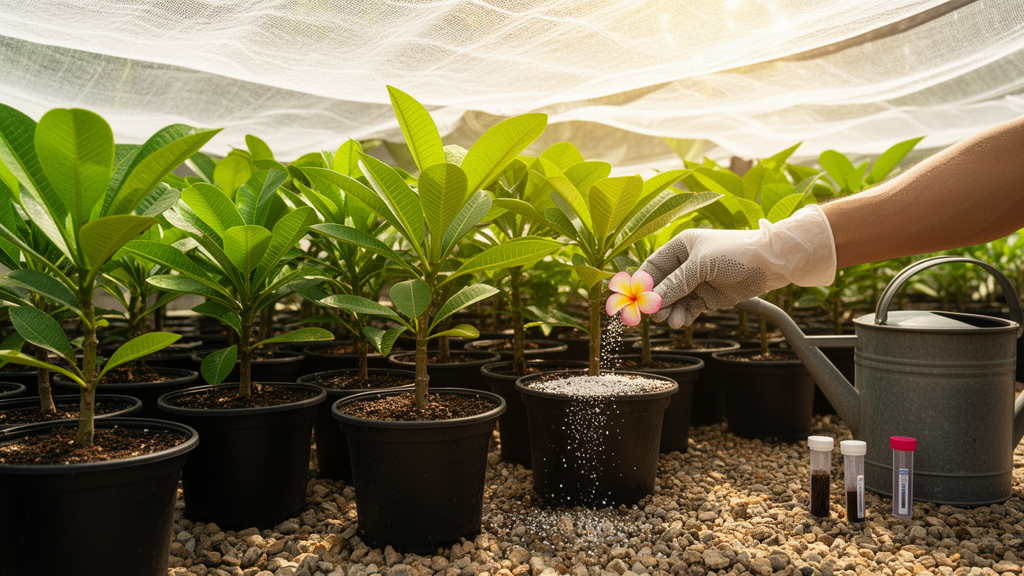
In the subtropical nurseries of southern Florida, where Plumeria rubra — the fragrant frangipani beloved of gardeners and landscapers — is grown in containers under intense sun, a new study has revealed that the interplay between light intensity and fertilizer dose plays a decisive role in shaping the plant’s growth, physiology, and nutrient dynamics. The research, conducted over 180 days, offers some of the clearest evidence yet that these two environmental factors do not act independently but interact in ways that can be harnessed to optimise nursery production.
The study, led by researchers at the University of Florida and the USDA Agricultural Research Service, set out to determine how two contrasting light environments — full sun and 50% shade — combined with five cumulative fertilizer rates, ranging from no fertilizer to 240 grams per plant, would affect the morphophysiological performance of Plumeria rubra grown in containers. The team measured plant height, leaf number, chlorophyll content, canopy vigour, and a suite of nutrient dynamics in the container substrate, including nitrate, calcium, potassium, and sodium concentrations, as well as pH and soluble salts.
The results showed that both light and fertilizer had significant effects on plant growth and physiology, but that their interaction was particularly important for chlorophyll content and canopy vigour. Under full sun, plants receiving intermediate fertilizer rates produced the greatest leaf number and canopy vigour, while under shade, the same fertilizer rates produced the highest chlorophyll content. The team also found that nutrient dynamics in the container substrate were strongly influenced by light, with nitrate and calcium concentrations increasing under full sun and pH decreasing under the same conditions.
One of the most striking findings was the non-linear response of plant growth to fertilizer dose. Plants receiving intermediate fertilizer rates produced the greatest height and leaf number, while those receiving the highest rates showed no additional benefit and, in some cases, a slight decline. This pattern, the team suggests, reflects the classic non-linear response of ornamental species to nutrient supply, where additional fertilizer beyond an optimal dose provides no benefit and may even induce salt stress in the container substrate.
The researchers also found that the interaction between light and fertilizer had important implications for nutrient use efficiency. Under full sun, plants receiving intermediate fertilizer rates showed the greatest nutrient uptake, while under shade, the same rates produced the highest chlorophyll content but lower nutrient uptake. The team suggests that this pattern reflects the trade-off between photosynthetic capacity and nutrient acquisition, where plants under high light can acquire more nutrients but may also experience greater water loss and salt stress.
The study’s findings have important implications for nursery production of Plumeria rubra and other ornamental species grown in containers under subtropical conditions. The team suggests that growers can optimise production by matching fertilizer dose to light environment, using intermediate rates under full sun and the same rates under shade to produce the greatest growth and chlorophyll content. The findings also highlight the importance of monitoring nutrient dynamics in the container substrate, where nitrate and calcium concentrations can increase under high light and pH can decrease under the same conditions.
The researchers also note that their study has some limitations. The team measured only a single growing season and did not assess flowering, which is an important trait for ornamental species. The team also did not measure nutrient uptake by the plants themselves, relying instead on nutrient dynamics in the container substrate. Future studies, the team suggests, should assess flowering and nutrient uptake by the plants to provide a more complete picture of the interplay between light and fertilizer in nursery production.
Despite these limitations, the study offers some of the clearest evidence yet that the interplay between light intensity and fertilizer dose plays a decisive role in shaping the growth, physiology, and nutrient dynamics of Plumeria rubra grown in containers under subtropical conditions. The team suggests that growers can harness this interplay to optimise production, matching fertilizer dose to light environment and monitoring nutrient dynamics in the container substrate to produce the greatest growth and chlorophyll content. The findings also highlight the importance of non-linear responses to nutrient supply, where additional fertilizer beyond an optimal dose provides no benefit and may even induce salt stress.
The study, published in Frontiers in Horticulture, is part of a growing body of research on the interplay between environmental factors and nursery production of ornamental species. The team suggests that their findings can be applied to other ornamental species grown in containers under subtropical conditions, where the interplay between light and fertilizer can be harnessed to optimise production and reduce environmental impacts. The findings also highlight the importance of monitoring nutrient dynamics in the container substrate, where nitrate and calcium concentrations can increase under high light and pH can decrease under the same conditions.
Subject of Research: Light–fertilizer interactions in Plumeria rubra nursery production
Article Title: Light–fertilizer interactions regulate morphophysiological performance and nutrient dynamics in Plumeria rubra under subtropical nursery conditions
Article References: Khoddamzadeh, A. A., Munoz-Salas, M. N., Cabrera, A., & Nageswara-Rao, M. (2026). Light–fertilizer interactions regulate morphophysiological performance and nutrient dynamics in Plumeria rubra under subtropical nursery conditions. Frontiers in Horticulture, 5, Article 1881853. https://doi.org/10.3389/fhort.2026.1881853
Image Credits: AI Generated
DOI: 10.3389/fhort.2026.1881853
Keywords: Plumeria rubra, light intensity, fertilizer dose, nursery production, ornamental species, nutrient dynamics, container substrate, subtropical conditions, chlorophyll content, canopy vigour, nitrate, calcium
Cite Scienmag News
Scienmag. (October 17, 2026). Light and Fertilizer Interactions Regulate Morphophysiological Performance and Nutrient Dynamics in Plumeria Under Subtropical Nursery Conditions. https://scienmag.com/light-and-fertilizer-interactions-regulate-morphophysiological-performance-and-nutrient-dynamics-in-plumeria-under-subtropical-nursery-conditions/
Scienmag. "Light and Fertilizer Interactions Regulate Morphophysiological Performance and Nutrient Dynamics in Plumeria Under Subtropical Nursery Conditions." Scienmag, 17 October 2026, https://scienmag.com/light-and-fertilizer-interactions-regulate-morphophysiological-performance-and-nutrient-dynamics-in-plumeria-under-subtropical-nursery-conditions/. Accessed 17 October 2026.
Scienmag. "Light and Fertilizer Interactions Regulate Morphophysiological Performance and Nutrient Dynamics in Plumeria Under Subtropical Nursery Conditions." Scienmag. October 17, 2026. https://scienmag.com/light-and-fertilizer-interactions-regulate-morphophysiological-performance-and-nutrient-dynamics-in-plumeria-under-subtropical-nursery-conditions/


