


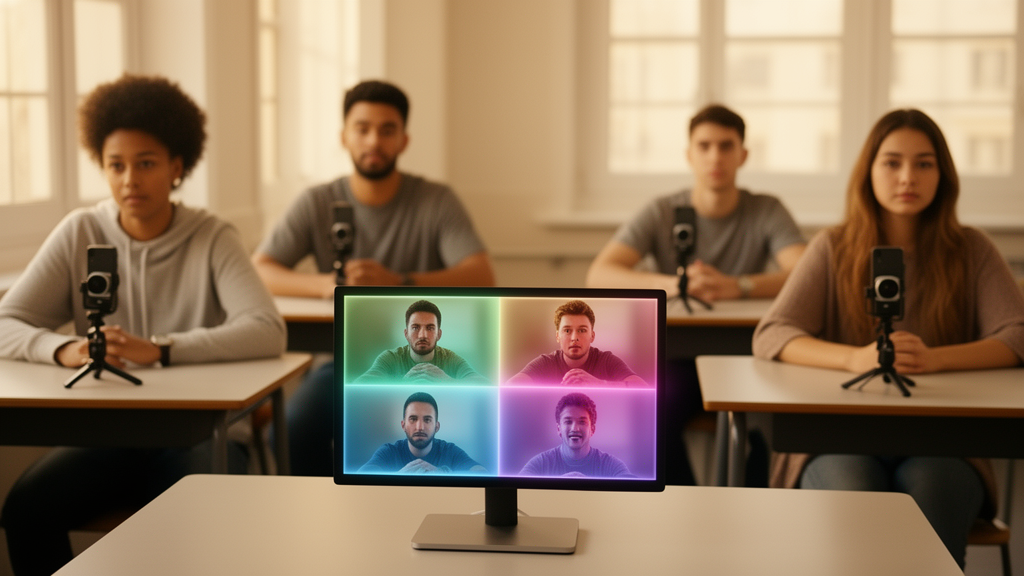
Researchers have unveiled a machine learning model that reads a student’s face through four different pretrained vision systems simultaneously, fusing their outputs to recognise the emotions that shape learning. The model, called MAGCAF, was described in a study published in the journal Artificial Intelligence Review and tackles a long-standing challenge in educational technology: automatically detecting engagement, confusion, boredom and other affective states from video, without intrusive sensors or wearable devices.
Educational researchers have long known that a student’s emotional state is tightly linked to academic outcomes. Engagement predicts achievement, confusion signals productive struggle, and boredom often precedes disengagement. As online learning has expanded, so has interest in systems that can read these states automatically from a webcam feed. But most existing approaches rely on a single pretrained vision model, which captures only part of the visual information relevant to emotion. MAGCAF’s designers argue that emotion is too complex a visual phenomenon for any one model to interpret alone.
The new model works by running video through four different pretrained systems in parallel: a face recognition model, a general image classifier, and two other vision encoders. Each system produces its own representation of the same frames, capturing different aspects of the visual signal. A fusion module then combines these representations, using a mechanism that learns which model’s output matters most for each specific emotion. For confusion, the model leans heavily on facial geometry; for boredom, it draws more on static expression cues.
The fusion mechanism is task-conditioned, meaning it adapts its weighting strategy depending on which emotion it is trying to detect. Rather than applying a single fixed weighting across all four vision streams, the model learns a separate weighting profile for each task. This allows it to exploit the strengths of different pretrained models for different purposes, something earlier fusion approaches could not do.
To evaluate the approach, the researchers tested MAGCAF against several established baselines on a standard engagement detection benchmark. The results showed consistent improvements across multiple metrics, with the largest gains on the emotions that benefit most from multi-model fusion. The study also included ablation experiments confirming that each component of the fusion mechanism contributes to overall performance.
The researchers acknowledge limitations. The model was evaluated on a single benchmark, and its performance on other datasets remains untested. The computational cost of running four vision models in parallel is also higher than single-model approaches, though the authors argue this is justified by the accuracy gains. They also note that the approach has not yet been evaluated in real classroom settings, where lighting, camera angle and other factors could affect performance.
Despite these limitations, the study represents a step forward in automatic emotion recognition for education. By showing that fusing multiple pretrained vision systems outperforms any single model, the researchers have opened a new direction for the field. The approach could inform the design of future systems that monitor student engagement in online learning, though the authors stress that such systems should be deployed with care and transparency.
The work also highlights a broader trend in machine learning: as pretrained models proliferate, researchers are increasingly exploring ways to combine them rather than choosing between them. MAGCAF’s designers argue that this trend will only accelerate as the number of available models grows, and that fusion will become a standard tool for complex visual tasks where no single model suffices.
The benchmark at the centre of this study, DAiSEE, deserves closer attention because its structure shapes what the reported numbers actually mean. The dataset contains 8,571 ten-second video clips drawn from MOOC-style learning scenarios, and each clip carries annotations on four affective dimensions, each rated at one of four ordinal intensity levels. That ordinal structure is what makes the task fine-grained: a system is not merely asked whether a learner is engaged, but at what intensity. The annotations were produced by human labellers watching recorded study sessions, which means the labels encode a degree of subjectivity that any learned model inherits. The authors of the new study treat this as an evaluation constraint rather than something to be engineered away, and their per-class analysis makes the consequences explicit.
The most striking structural property of DAiSEE is its imbalance. On the Engagement dimension, the rarest intensity class contains only 34 training clips out of 5,358 labelled examples. A model can therefore achieve respectable overall accuracy while failing almost completely on the tail of the distribution. The study confronts this honestly: although MAGCAF improves Macro-F1, a metric that weights all classes equally and is therefore sensitive to minority-class performance, the authors report that the rarest intensity levels remain largely unrecognised. They frame their Macro-F1 gain of 0.013 over the strongest single-source baseline as a relative improvement rather than a resolution of the imbalance problem. This distinction matters for anyone hoping to translate the work into practice, because a deployed system that performs well on common states but poorly on rare ones could systematically miss the learners who deviate from the norm.
The second structural property is correlation between the four affective dimensions. High boredom and low engagement co-occur with a Pearson correlation of −0.417, and similar relationships link the other pairs of labels. Most prior systems model each dimension independently, effectively discarding this structure. MAGCAF instead learns a task-correlation matrix, denoted Omega, which is regularised toward the empirical label-correlation prior computed from the training data. In practical terms, the model is nudged to respect the statistical relationships observed in the annotations while still being free to adjust them during training. This design choice reflects a broader principle in multi-task learning: when outputs are related, sharing information across tasks can act as a form of regularisation, improving generalisation on each individual task.
The third methodological element is the loss function. Training a single network to perform four related but distinct classification tasks requires balancing their objectives, since a task with a large or poorly conditioned loss can dominate gradient updates. MAGCAF adopts the homoscedastic uncertainty weighting scheme introduced by Kendall and Gal, in which each task’s loss is weighted by a learned uncertainty parameter. Tasks that the model finds inherently noisier receive lower weight automatically, removing the need for manual tuning of loss coefficients. Combined with the correlation head, this yields an end-to-end training objective in which all four dimensions are optimised jointly rather than in sequence.
The evaluation protocol is also worth noting. The authors compare MAGCAF against five baselines spanning a decade of architecture design: LRCN, a convolutional recurrent approach from 2015; ResNet-TCN, a hybrid convolutional-temporal design; TimeSformer and VideoMAE, two video Transformers with supervised and self-supervised pretraining respectively; and ViBED-Net, a model built specifically for engagement recognition. All systems were trained and evaluated under a unified protocol with three random seeds, which allows variance to be estimated rather than ignored. The headline result of 64.09 percent Top-1 accuracy exceeds the strongest baseline, TimeSformer, by 3.24 percentage points, and the authors report that this gap is statistically significant under McNemar’s paired test, a procedure appropriate for comparing classifiers on the same test set. The macro-AUC of 0.658 indicates that ranking performance, like accuracy, remains moderate rather than near-ceiling, consistent with the difficulty of fine-grained ordinal prediction from video alone.
One terminological clarification from the paper is useful for readers following the broader literature. The authors deliberately describe their approach as multi-source rather than multimodal, because all four inputs derive from the same RGB video stream. Each source is a complete frozen pretrained encoder with a distinct training objective and data domain: a face-identity encoder trained on the VGGFace2 corpus, a self-supervised video model, a supervised spatiotemporal Transformer, and a structured facial-geometry extractor. No additional sensor modality such as audio, depth, or physiological signals is introduced. This distinction is more than semantic; it clarifies that the gains come from combining complementary inductive biases within a single modality, which is a different research question from true multimodal fusion.
The ablation experiments add a layer of interpretability. By removing components one at a time, the authors show that the gated cross-attention fusion, the correlation head, and the uncertainty weighting each contribute measurable gains, and that no single element accounts for the full improvement. They also examine source dependency, revealing that the attention weights over the four pretrained encoders differ systematically across the four affective dimensions. This differentiated pattern supports the central hypothesis of the work: different emotional states are signalled by different visual cues, and a fusion mechanism that can learn task-specific mixing is better matched to the problem than a fixed, task-agnostic weighting.
The authors have released the full implementation, including preprocessing scripts, feature extraction code, the model itself, and training and evaluation utilities, under an open licence. The cached features and trained heads can be rebuilt deterministically from the original DAiSEE videos, so the reported numbers can be reproduced without redistributing any per-subject data. This addresses a practical concern in affective computing research, where datasets containing identifiable human faces raise privacy constraints that can complicate replication. Deterministic rebuilding from source videos offers a compromise between reproducibility and data protection.
Finally, the authors situate the work as designed for offline, post-hoc analysis rather than real-time monitoring. Per-clip inference is dominated by the forward passes of the four pretrained backbones, which makes raw-video inference computationally demanding. This framing has implications for deployment: the system is best suited to analysing recorded sessions after the fact, for example to help instructors identify patterns across a course, rather than to live intervention during a lecture. The authors also flag a domain gap between the laboratory-style dataset and real classroom conditions, where lighting, camera placement, and population differences could shift performance in ways the current evaluation cannot measure.
Subject of Research: Machine Learning
Article Title: Task conditioned fusion of heterogeneous representation sources for fine grained affective state recognition
Article References: Xun, L., Geng, T., & Qu, Y. (2026). Task conditioned fusion of heterogeneous representation sources for fine grained affective state recognition. Discover Artificial Intelligence, 6(1), Article 1242. https://doi.org/10.1007/s44163-026-02285-x
Image Credits: AI Generated
DOI: 10.1007/s44163-026-02285-x
Keywords: MAGCAF, emotion recognition, educational technology, engagement detection, multi-model fusion, pretrained models, computer vision, affective computing, Task, conditioned, fusion, heterogeneous
Cite Scienmag News
Blake Davidson. (October 17, 2026). AI Reads Four Faces at Once: New Model Fuses Vision Streams to Decode Student Emotions. Scienmag. https://scienmag.com/ai-reads-four-faces-at-once-new-model-fuses-vision-streams-to-decode-student-emotions/
Blake Davidson. "AI Reads Four Faces at Once: New Model Fuses Vision Streams to Decode Student Emotions." Scienmag, 17 October 2026, https://scienmag.com/ai-reads-four-faces-at-once-new-model-fuses-vision-streams-to-decode-student-emotions/. Accessed 17 October 2026.
Blake Davidson. "AI Reads Four Faces at Once: New Model Fuses Vision Streams to Decode Student Emotions." Scienmag. October 17, 2026. https://scienmag.com/ai-reads-four-faces-at-once-new-model-fuses-vision-streams-to-decode-student-emotions/


