


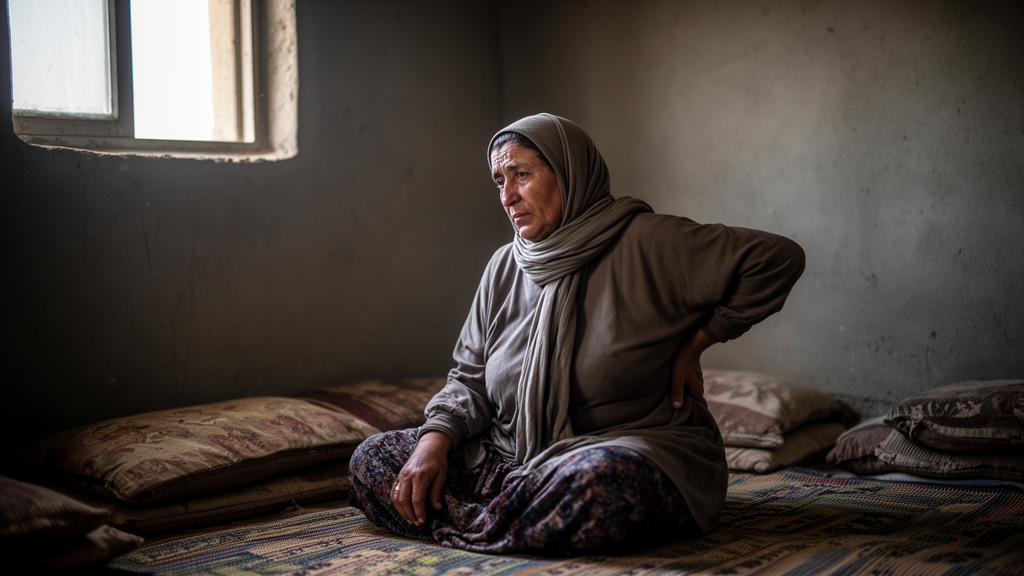
Nearly seven in ten women seeking care at a major hospital in Sana’a are living with chronic neck or lower back pain, according to one of the first detailed studies of musculoskeletal disease in Yemen since the country’s conflict began. The research, published in Frontiers in Musculoskeletal Disorders, found that 68.8 percent of 470 women examined at Al-Kuwait University Hospital carried a diagnosis of chronic spinal pain, with psychological distress, obesity and long hours of screen time each independently raising the odds of disease. The findings offer a rare quantitative glimpse of a hidden health burden in a population where war has displaced millions and stretched medical services to breaking point.
Chronic spinal pain is already recognized as one of the leading causes of disability worldwide, but reliable data from active conflict zones remain scarce. Yemen has endured more than a decade of war that has devastated infrastructure, displaced roughly 4.5 million people and left over half the population in need of humanitarian assistance. Against this backdrop, a team led by Dr. Fekri Dureab of the Health and Nutrition Society and colleagues from Yemen, Germany and Qatar set out to measure how common chronic neck and back pain really is among women attending a tertiary hospital in Sana’a, and to identify which factors drive the condition in this uniquely stressed population.
The researchers recruited 470 women aged 18 to 65 who visited the outpatient orthopedic clinic at Al-Kuwait University Hospital between January and March 2024. Each participant completed a structured questionnaire covering demographic details, lifestyle habits, ergonomic exposures and psychological wellbeing, assessed with the validated Depression, Anxiety and Stress Scale. Clinicians then performed standardized physical examinations, checking spinal range of motion, tenderness on palpation and straight leg raising, and ordered X-rays or MRI scans when clinically indicated. Chronic spinal pain was defined as persistent neck or lower back pain lasting three months or longer, in line with the Nordic Musculoskeletal Questionnaire framework.
The results were striking. Chronic spinal pain was confirmed in 68.8 percent of participants, with chronic low back pain present in 51.7 percent and chronic neck pain in 41.1 percent; some women suffered both. Radiographic findings matched the clinical picture: 47.4 percent of those imaged showed intervertebral disc degeneration, 38.5 percent had disc herniation, 23.4 percent had spinal canal stenosis and 14.9 percent showed spondylolisthesis, the slippage of one vertebra on another. More than half of the women reported that pain interfered with daily activities, and roughly a third said it disrupted their sleep.
When the team ran statistical models adjusting for age, employment and other confounders, four factors stood out as independent predictors of chronic spinal pain. Psychological distress, measured as depression, anxiety or stress on the DASS scale, roughly tripled the odds of disease (odds ratio 3.2). Obesity, defined as a body mass index of 30 or higher, more than doubled the odds (OR 2.4). Prolonged screen time, meaning more than four hours per day, raised the odds by 80 percent (OR 1.8), and heavy lifting at work or home increased them by 60 percent (OR 1.6). Physical inactivity, prolonged sitting and poor posture also showed associations in unadjusted analyses, though these did not remain significant after adjustment.
The prominence of psychological distress is perhaps the study’s most consequential finding. More than half of the participants screened positive for at least one form of psychological distress, with anxiety the most common. The authors argue that this reflects the cumulative toll of nearly a decade of war: exposure to violence, loss of income, displacement and the constant strain of caring for families in a collapsing economy. A well-documented bidirectional relationship links chronic pain and mental health, in which pain amplifies distress and distress lowers pain tolerance while heightening inflammation. In Yemen, the researchers suggest, this feedback loop may be operating at a population scale.
Obesity and sedentary behavior form the second axis of the findings. More than a third of participants were obese, and over 40 percent reported sitting for more than six hours a day. The authors attribute this partly to cultural norms that limit women’s participation in outdoor physical activity, and partly to the economic crisis, which has made gym memberships, sports facilities and even safe public spaces unattainable for many families. Prolonged screen time, driven by the spread of smartphones and the use of digital devices as a coping mechanism during conflict, adds a modern ergonomic hazard to a population already burdened by traditional risk factors.
Heavy lifting, the fourth independent predictor, highlights the physical demands placed on Yemeni women in wartime. Many participants reported carrying water, firewood or supplies for displaced relatives, tasks that have intensified as infrastructure has collapsed. The combination of heavy lifting with obesity and weak core musculature, the authors note, creates a perfect mechanical storm for spinal disc degeneration and herniation, the radiographic hallmarks seen in nearly half of the imaged participants.
The study’s limitations are acknowledged by the authors themselves. As a cross-sectional survey conducted at a single tertiary hospital, it captures women who were already seeking care and cannot establish whether the risk factors preceded the pain or vice versa. The sample also excludes women who lack access to hospital services altogether, a group that may carry an even heavier burden. Self-reported psychological and lifestyle data are subject to recall bias, and the three-month recruitment window may not capture seasonal variation in pain and activity patterns.
Even with these caveats, the researchers argue that the findings carry urgent implications for health policy in Yemen and beyond. Chronic spinal pain is a treatable condition, and the risk factors identified here, psychological distress, obesity, sedentary behavior and heavy lifting, are all modifiable. The authors call for integrated care models that combine physiotherapy, ergonomic education and mental health support, delivered through primary care networks that can reach women where they live. They also recommend community-based exercise programs adapted to cultural norms, and workplace interventions to reduce heavy lifting in households and informal economies.
More broadly, the study adds to a growing body of evidence that the health consequences of war extend far beyond injuries and infectious disease. Chronic noncommunicable conditions, from spinal pain to diabetes and hypertension, accumulate silently in displaced and impoverished populations, and their burden falls disproportionately on women who carry the double weight of caregiving and economic hardship. As the authors conclude, addressing chronic pain in Yemen will require not only clinical services but also a recognition that the musculoskeletal health of a population is inseparable from the social and psychological conditions in which it lives.
Subject of Research: Chronic spinal pain prevalence and risk factors among women in conflict-affected Yemen
Article Title: The hidden burden of cervical and low back pain among women in conflict-affected Yemen
Article References: Muafa, H. M., & Balkam, M. A. (2025). The hidden burden of cervical and low back pain among women in conflict-affected Yemen. Frontiers in Musculoskeletal Disorders, 3, Article 1673096. https://doi.org/10.3389/fmscd.2025.1673096
Image Credits: AI Generated
DOI: 10.3389/fmscd.2025.1673096
Keywords: hidden, burden, cervical, back, pain, women, conflict-affected, Yemen, scientific research
Cite Scienmag News
Daisy Hatcher. (October 17, 2026). Chronic Neck and Back Pain Affects Nearly Seven in Ten Women in Conflict-Hit Yemen, Study Finds. Scienmag. https://scienmag.com/chronic-neck-and-back-pain-affects-nearly-seven-in-ten-women-in-conflict-hit-yemen-study-finds/
Daisy Hatcher. "Chronic Neck and Back Pain Affects Nearly Seven in Ten Women in Conflict-Hit Yemen, Study Finds." Scienmag, 17 October 2026, https://scienmag.com/chronic-neck-and-back-pain-affects-nearly-seven-in-ten-women-in-conflict-hit-yemen-study-finds/. Accessed 17 October 2026.
Daisy Hatcher. "Chronic Neck and Back Pain Affects Nearly Seven in Ten Women in Conflict-Hit Yemen, Study Finds." Scienmag. October 17, 2026. https://scienmag.com/chronic-neck-and-back-pain-affects-nearly-seven-in-ten-women-in-conflict-hit-yemen-study-finds/


