


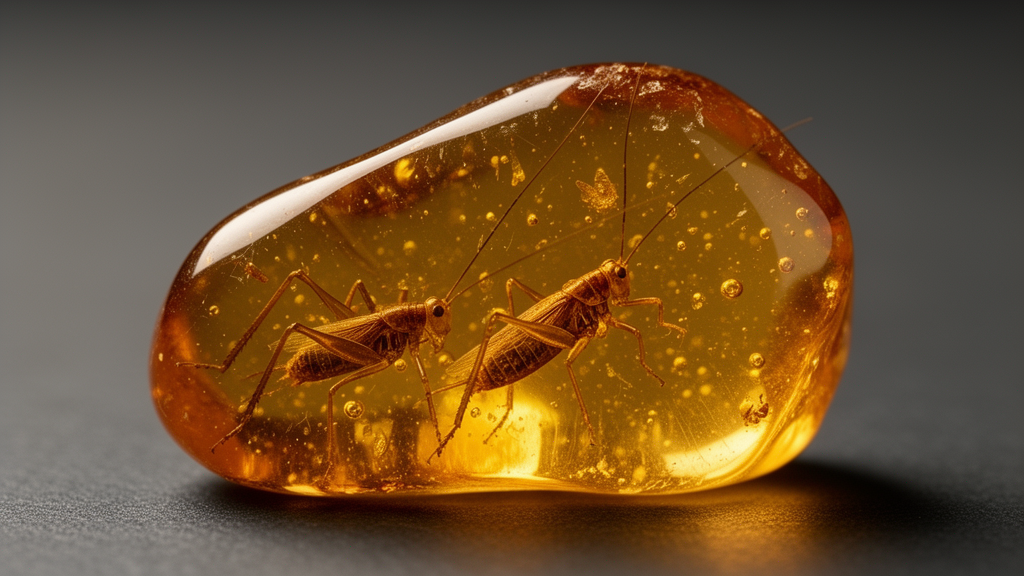
Two new species of extinct insect relatives of crickets and katydids have been described from mid-Cretaceous Burmese amber, adding to one of the richest fossil insect deposits on Earth. The specimens, both members of the family Elcanidae, an extinct lineage of Orthoptera that flourished during the Mesozoic Era, include the first species of the genus Parelcana ever found in Burmese amber and only the second known species of the genus Longioculus. With these additions, the total number of Elcanidae species known from Burmese amber rises to 23, underscoring how remarkably diverse this group was in the Cretaceous forests of what is now northern Myanmar.
The new species, Parelcana xena and Longioculus poinari, are described in the Journal of Orthoptera Research. Both specimens are housed in the collection of the Leibniz Institute for the Analysis of Biodiversity Change in Hamburg, where they were examined in detail using focus-stacking photography. The amber pieces were discovered at mining sites near Tanai village in Kachin State or Hkamti village in Sagaing Division, two nearby locations whose amber deposits differ in age by roughly 10 million years. Amber from Tanai is estimated to be 98.79 ± 0.62 million years old, while amber from Hkamti dates to approximately 110 million years ago.
Elcanidae are an extinct family of Orthoptera that appear in the fossil record throughout the Mesozoic and on every continent except Africa and Antarctica. They are characterized by a large dark area near the anterior margin of the forewing, known as the pterostigma, and an overall appearance similar to many living Ensifera, the suborder that includes crickets and katydids. Their antennae were longer than their bodies, and their ovipositors were very prominent, often shaped like the blade of a scythe or sword. A defining feature of the family is three pairs of large moveable spurs on the dorsal side of the metatibiae, which vary in shape and can be leaf-like, ensiform, spine-like, or paddle-shaped.
Since 2007, when the first Elcanidae from Burmese amber was described, a plethora of species have been found in this remarkable deposit. The amber dates back to the mid-Cretaceous, roughly 110 to 100 million years ago, and is famous for its high abundance of arthropod inclusions, among them many families of Orthoptera. The family was organized into two subfamilies in 2006: the Elcaninae and the Archelcaninae. The main point of differentiation between the two is the state of the forewing veins 1A, CuPb, and CuPaβ, which are fused in Elcaninae but not in Archelcaninae. For Elcanidae from Burmese amber, and for the entire family, the Elcaninae are more diverse than their sister taxon. So far, only four species of Archelcaninae were known from the amber, compared with fourteen species of Elcaninae. The two new species described in this study are both Archelcaninae, significantly increasing the known diversity of this rarer subfamily.
Parelcana xena stands out by its unusual morphology. The specimen consists of a well-preserved wing apparatus and parts of the thorax, including pro- and mesothoracic legs. The rest of the body appears to have dissolved. The species name derives from the ancient Greek word for strange, alluding to the unusual morphology of the type specimen’s fused forewing veins CuA and CuPaα, which are also fused to MP. This state is not known from any described Elcanidae and is likely an individual aberration rather than a defining characteristic of the species. The authors suggest that this unusual venation was probably caused by individual variation, a phenomenon that has been documented in other Elcanidae when multiple specimens of the same species could be compared.
The forewing of Parelcana xena is approximately 12.6 millimeters long. The media vein has four branches, all anterior to the stem of the radius posterior branch, which itself has six to seven branches. The anterior radius bears numerous comb-like cross veins. Two dark wing spots are present, the anterior one distinctly larger than the posterior one, measuring 1.4 millimeters and 0.84 millimeters in diameter respectively. The spots appear to be located on the hindwing, although this cannot be stated with certainty due to strong wing overlap. Among its congeners, Parelcana xena shares similarities with the type species Parelcana tenuis from the Jurassic of Germany, including six branches of the radius posterior vein and similar size. Aside from a great temporal and spatial distance of roughly 80 million years and thousands of kilometers, Parelcana tenuis differs from the new species in the morphology of the anal veins, which are more numerous in the older German species.
Longioculus poinari is a female specimen in very good condition, with only parts of the antennae and ovipositor missing. The body length is approximately 5.2 to 5.5 millimeters, and the forewing is 6.9 millimeters long. The species is named after George O. Poinar, who described the genus and its first species and made many contributions to the study of prehistoric insects found in amber. Longioculus burmensis, described in 2007, was the first Elcanidae to be described from Burmese amber and the pioneer of the many that were to follow. The new species differs from Longioculus burmensis in some aspects of the metatibial armature, notably by not having seven circular light blotches on the dorsal surface of the pronotum and by the denticles on the proximal half of the metatibia being broader and more prominent.
Based on the new specimen’s free veins 1A, CuPb, and CuPaβ, the genus Longioculus is now assigned to the subfamily Archelcaninae. The state of these veins was unknown in Longioculus burmensis, but the free condition in the new species allows the entire genus to be placed in this subfamily. The metatibial spurs of Longioculus poinari, which are not preserved in the holotype of Longioculus burmensis, are leaf-like, a feature that helps distinguish the species and provides new anatomical information about the genus. The specimen also has strongly protruding oval eyes that are much higher than wide, measuring 0.94 millimeters in height, roughly half the height of the head. The ovipositor, though broken off shortly after its base, appears to have been sword-shaped rather than scythe-like.
The amber piece containing Longioculus poinari includes several syninclusions, among them two dipterans, one belonging to Nematocera, and a well-preserved mite, along with some trichomes. The piece appears rather dark due to many particles clouding the interior, but the specimen itself is in overall good condition. The amber piece containing Parelcana xena is relatively transparent and includes tiny beetles and fragments of larger unspecified invertebrates. These syninclusions offer glimpses of the broader ecological community in which these insects lived, a Cretaceous forest teeming with arthropod life.
The authors note that political stability and the enforcement of human rights continue to be problematic in Myanmar, and they acknowledge the ethical problems surrounding amber fossils of Burmese origin. The year the amber pieces in this study were originally obtained is unknown, but the authors argue that material already present in collections should not be ignored for scientific examination. Despite these challenges, the discovery of two new Archelcaninae species from Burmese amber raises the total number of Elcanidae species from this deposit to 23, demonstrating that even well-studied fossil deposits continue to yield new insights into the diversity of life that existed during the age of dinosaurs.
Subject of Research: Paleontology
Article Title: The first species of Parelcana and the second species of Longioculus ( Orthoptera , Elcanidae ) from mid-Cretaceous Burmese amber
Article References: Schall, O.-K. O., & Husemann, M. (2026). The first species of Parelcana and the second species of Longioculus (Orthoptera, Elcanidae) from mid-Cretaceous Burmese amber. Journal of Orthoptera Research, 35(1), 77-82. https://doi.org/10.3897/jor.35.154648
Image Credits: AI Generated
Keywords: Burmese amber, Elcanidae, Orthoptera, Cretaceous, paleontology, fossil insects, new species, first, species, Parelcana, second, Longioculus
Cite Scienmag News
Gavin Prescott. (October 17, 2026). Two new extinct cricket relatives emerge from 100-million-year-old Burmese amber. Scienmag. https://scienmag.com/two-new-extinct-cricket-relatives-emerge-from-100-million-year-old-burmese-amber/
Gavin Prescott. "Two new extinct cricket relatives emerge from 100-million-year-old Burmese amber." Scienmag, 17 October 2026, https://scienmag.com/two-new-extinct-cricket-relatives-emerge-from-100-million-year-old-burmese-amber/. Accessed 17 October 2026.
Gavin Prescott. "Two new extinct cricket relatives emerge from 100-million-year-old Burmese amber." Scienmag. October 17, 2026. https://scienmag.com/two-new-extinct-cricket-relatives-emerge-from-100-million-year-old-burmese-amber/


