


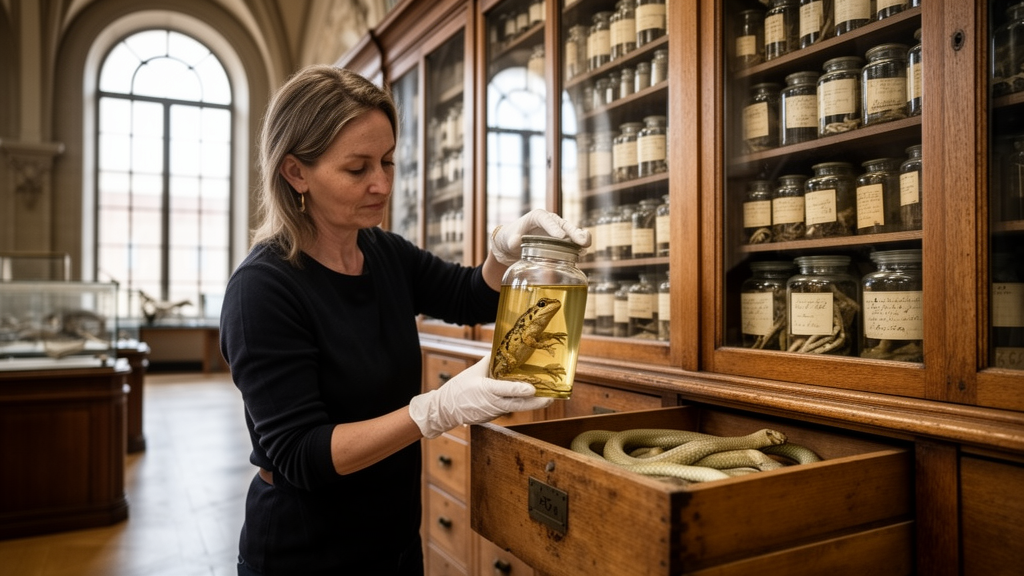
Deep inside the Zoological Museum of Hamburg, drawers and jars of preserved amphibians and reptiles have been quietly hiding scientific treasures. A newly published second addition to the herpetological type catalogue of the Zoological Museum Hamburg (ZMH), now part of the Leibniz Institute for the Analysis of Biodiversity Change, reveals 53 additional type specimens that were either newly discovered in the collection or newly described over the past two decades. The work, appearing in the journal Evolutionary Systematics, expands upon type catalogues published in 1998 and 2006 and brings the total holdings to 397 type specimens representing 176 nominal species of amphibians and reptiles.
Type specimens are the single most important objects in any natural history collection. Under the International Code of Zoological Nomenclature, the name of every animal species is permanently attached to one or more name-bearing specimens, which serve as the objective reference points for what the species actually is. When a researcher questions whether a named species is distinct, whether two names refer to the same animal, or where a species fits in the tree of life, it is the type specimen that provides the final answer. Catalogues of these specimens are therefore not dusty bookkeeping exercises but the nomenclatural backbone of biodiversity science, and every newly recognized type is a small event with consequences for taxonomy worldwide.
The Hamburg herpetological collection currently contains approximately 62,000 individual specimens in about 42,000 catalogued lots, covering frogs, salamanders, turtles, crocodiles and the entire Lepidosauria, the lineage that includes lizards and snakes. All material is now catalogued in a FileMaker Pro Advanced 18 database, a technical modernization that has made systematic searches for overlooked types far more effective than the card-based systems of earlier decades. The first type catalogue by Jakob Hallermann in 1998 recorded 113 nominal type species and 236 type specimens. A first addition in 2006 raised the tally to 137 nominal species and subspecies with 318 type specimens, including 54 holotypes, 69 syntypes, 147 paratypes, 3 lectotypes and 43 paralectotypes. The new addition now documents 52 further type specimens of 33 nominal species: 4 holotypes, 26 paratypes, 15 syntypes, 1 neotype, 4 lectotypes and 3 paralectotypes.
Among the most technically significant results are three newly designated lectotypes. When an original species description fails to fix a single holotype, the type series consists of syntypes, and nomenclatural stability can only be achieved by designating one of them as the lectotype, the objective name-bearing specimen. The authors designate lectotypes for Leptodactylus kreffti Werner, 1904, a Chilean frog currently treated as Eupsophus roseus; for Epicrates monensis Zenneck, 1898, the Mona boa of Puerto Rico, now placed in the genus Chilabothrus; and for the gecko Hemidactylus brookii haitianus Meerwarth, 1901, currently aligned with Hemidactylus angulatus. In each case the original description left the name-bearing type unfixed, and the designation follows section 74.5 of the Code, which permits lectotype designation precisely to provide an objective, stable type when none was fixed originally.
The case of Leptodactylus kreffti illustrates the detective work involved. Franz Werner described the species in 1904 using a male from the Hamburg Magellanic collecting expedition of 1892 to 1893, but the surviving female from the collection of Paul Krefft, donated to the Hamburg museum in 1898, was also part of the type series even though Werner examined it without mentioning it. Werner did not specify a holotype, so the original publication provided no objective, stable name-bearing type. The surviving syntype, ZMH A15770, a subadult female from a meadow pond at Coronel in the Bío-Bío Region of Chile, is now the lectotype, and its illustrated documentation in dorsal, lateral and ventral view gives future researchers an unambiguous reference.
The Mona boa lectotype carries its own dramatic history. The original type series contained four specimens, two adults and two juveniles, but one adult specimen formerly in Hamburg is missing and destroyed, and the lectotype itself, ZMH R20204, an adult female collected on Isla de Mona in 1891, arrived with its body nearly in two parts and a deep wound across the dorsum. Two juvenile paralectotypes from 1894 survive with the same collection data. By fixing the lectotype and restricting the type locality, the authors aim to prevent future uncertainty about the identity of this Caribbean boa, a species of real conservation relevance because Chilabothrus monensis is endemic to Mona and its immediate surroundings.
The catalogue also untangles long-standing confusions in the literature. The gecko Hemidactylus brookii haitianus was elevated to species status in the 1990s, then synonymized with H. angulatus in 2007 on the basis of little or no DNA sequence difference, with Caribbean populations most likely introduced from Africa by the slave trade. Because H. angulatus may itself be a species complex, the authors note that resurrection of H. haitianus remains possible, and the new lectotype ZMH R22378, an adult collected in Haiti in 1893, now anchors whatever name ultimately applies. Similar scrutiny applies to the Sri Lankan agamid Sitana bahiri, shown by molecular species delimitation methods in 2018 to be a junior synonym of S. ponticeriana, and to the frog Leptobrachium parvum, where ten specimens are claimed as syntypes although only five were mentioned in Boulenger’s original 1893 description, leaving the Hamburg paralectotype candidates with doubtful status.
Modern species descriptions also feature prominently in the new additions. The Hamburg collection holds paratypes of Ansonia teneritas, a slender blackwater stream toad from Gunung Hose in Sarawak, Borneo, collected in 2011; paratypes of Sumaterana dabulescens and Sumaterana montana, ranid frogs from Aceh and the Kerinci-Seblat mountains of Sumatra described in 2018; the holotype and paratype of Bronchocela rubrigularis, a red-throated agamid from the central Nicobar Islands described in 2009; and the holotypes of two newly described African house snakes, Boaedon broadleyi from the Ethiopian highlands near Addis Ababa and Boaedon subniger from the Gumbi Hills of Somaliland, which appears to be endemic to northern Somalia. These entries show that the museum is not merely a repository of historical material but an active participant in documenting biodiversity that is still being discovered.
Perhaps the most sobering section of the publication lists type specimens that were definitively deposited in Hamburg and are now lost, many of them omitted from the previous two catalogues. A large number were described by Franz Werner, the Viennese herpetologist who worked in and with the Hamburg collection between 1908 and 1924. Werner’s own words from 1917 confirm that he deliberately transferred types of new species to the Hamburg museum rather than keeping them in private possession, in accordance with his principle of not retaining types of new species privately. The lost types include flying lizards such as Draco ochropterus and Draco intermedius, the Bolivian worm lizard Leposternon pfefferi, numerous colubrid snakes including Dendrelaphis effrenis from Sri Lanka and several Dipsas species from South America, the Sri Lankan tree snake Dendroechis reticulata, now identified as the mamba Dendroaspis jamesonii, and the blind snake Typhlops steinhausi from Cameroon, destroyed in the Second World War, for which a neotype was later designated in Paris.
For working taxonomists, the practical value of this catalogue lies in its corrections as much as its discoveries. Spelling mistakes in earlier catalogues are corrected, status changes are documented, and missing specimens are recorded so that researchers no longer waste time searching for types that no longer exist. The family and genus concepts follow the Reptile Database for reptiles and Amphibian Species of the World for amphibians, keeping the catalogue aligned with current systematic consensus. Each species is listed under its originally proposed combination, with the currently accepted name and the authority for any change given below, arranged alphabetically by genus and species within each family. In an era when amphibians and reptiles are among the most threatened vertebrates on Earth, and when molecular methods are reshaping species boundaries at unprecedented speed, the careful anchoring of names to physical specimens in Hamburg ensures that the nomenclatural foundation of herpetology remains as solid as the century-old jars that hold it.
Subject of Research: Biodiversity and taxonomy
Article Title: A second addition to the herpetological type catalogue of the Zoological Museum of Hamburg (ZMH)
Article References: Hallermann, J. (2025). A second addition to the herpetological type catalogue of the Zoological Museum of Hamburg (ZMH). Evolutionary Systematics, 9(2), 271-284. https://doi.org/10.3897/evolsyst.9.175041
Image Credits: AI Generated
DOI: 10.3897/evolsyst.9.175041
Keywords: herpetology, type specimens, taxonomy, Zoological Museum Hamburg, lectotype, amphibians, reptiles, museum collections, biodiversity, nomenclature, second, addition
Cite Scienmag News
Margaret Porter. (October 17, 2026). Hamburg museum’s hidden frog and snake types reshape herpetology catalogue. Scienmag. https://scienmag.com/hamburg-museums-hidden-frog-and-snake-types-reshape-herpetology-catalogue/
Margaret Porter. "Hamburg museum’s hidden frog and snake types reshape herpetology catalogue." Scienmag, 17 October 2026, https://scienmag.com/hamburg-museums-hidden-frog-and-snake-types-reshape-herpetology-catalogue/. Accessed 17 October 2026.
Margaret Porter. "Hamburg museum’s hidden frog and snake types reshape herpetology catalogue." Scienmag. October 17, 2026. https://scienmag.com/hamburg-museums-hidden-frog-and-snake-types-reshape-herpetology-catalogue/


