


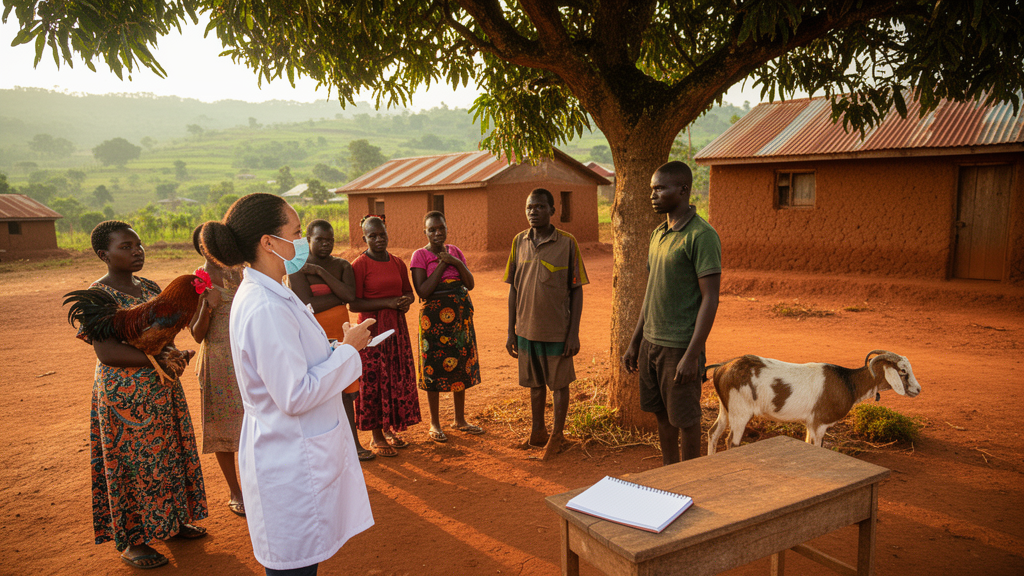
Rwanda’s health security depends on how well its communities connect human, animal, and environmental health. A new descriptive qualitative study published in BMC Public Health examined these connections at the grassroots level, revealing that fragmented systems, weak coordination, and behavioral barriers continue to constrain the country’s resilience against emerging threats like the Marburg virus. The research, led by Marie-Michelle Umulisa of Rinda Ubuzima in Kigali, offers a detailed portrait of how people in six priority districts perceive disease risks, seek healthcare, and engage with the One Health framework that Rwanda has championed as a pillar of its pandemic preparedness strategy.
The study focused on Rulindo, Kayonza, Nyanza, Rusizi, Rubavu, and Nyaruguru districts, selected to represent Rwanda’s geographic and socioeconomic diversity. Data collection took place in October 2025, using six in-depth interviews per district and two focus group discussions per district. Participants were drawn from different socioeconomic classes and occupations, rotated across districts to ensure inclusivity. In total, 143 people participated in the focus group discussions, the majority of whom were male (n=82, 57.34%) and aged between 31 and 40 years. The most common occupation among focus group participants was animal health personnel (n=19, 13.29%). Among the 36 in-depth interview participants, nearly half (n=15, 41.7%) were aged 31-40, and the most frequently reported occupation was health personnel (n=12, 33.32%).
The researchers anchored their analysis in two established behavioral frameworks: the Health Belief Model and the Social Ecological Model. The Health Belief Model posits that health-seeking behavior is shaped by perceived susceptibility to a disease, perceived severity of its consequences, perceived benefits of taking action, and perceived barriers to action, modulated by cues to action and self-efficacy. The Social Ecological Model extends this logic outward, situating individual behavior within nested layers of interpersonal relationships, community norms, institutional structures, and policy environments. Together, these models allowed the team to trace how personal perceptions interact with systemic constraints to produce the health-seeking patterns observed in the field.
Data were coded using Dedoose software, and the team conducted weekly debriefing meetings to familiarize themselves with the material as it accumulated. Using the joint display method to compare findings from in-depth interviews and focus group discussions, the researchers identified points of convergence across several themes. These included factors influencing healthcare-seeking behavior, economic constraints and the deprioritization of health interventions, perceived importance of One Health alongside weak intersectoral collaboration, community health information dissemination through multiple communication channels, myths and misinformation leading to vaccine rejection, and the persistent challenge of maintaining proper handwashing practices.
Economic constraints emerged as a dominant barrier to healthcare-seeking. Participants described how the cost of transport to health facilities, consultation fees, and the opportunity cost of missed workdays forced families to deprioritize health interventions, particularly preventive ones. When resources are scarce, immediate economic needs take precedence over future health security, a dynamic that the Health Belief Model would interpret as a perceived barrier outweighing perceived benefits. This deprioritization extends beyond individual choices to community-level resource allocation, where limited engagement of community members in planning continues to promote health insecurity, according to the study’s conclusions.
Participants recognized the conceptual importance of One Health, understanding that human health cannot be separated from animal health and environmental conditions. Yet this recognition coexisted with reports of weak intersectoral collaboration. District-level coordination between health, agriculture, and environment sectors remained fragmented, with limited accountability mechanisms. The study found that bottleneck challenges on resources and insufficient community engagement perpetuated these gaps. Community health workers and community animal health workers, who serve as frontline connectors between households and formal health systems, were identified as critical assets that require better training to listen to and engage community members effectively.
Health information reached communities through multiple channels, including radio, community meetings, and household visits by community health workers. However, the study documented how myths and misinformation circulating through these same networks led to vaccine rejection. This finding underscores a central tension in risk communication: the channels that disseminate accurate information also transmit falsehoods, and without targeted counter-messaging, misinformation can undermine even well-designed immunization campaigns. The researchers noted that training community health workers to actively listen and engage community members would enhance the effectiveness of risk communication and community engagement strategies.
Handwashing, a cornerstone of infection prevention, presented its own set of challenges. Participants reported difficulty maintaining consistent handwashing practices, citing water scarcity, lack of soap, and competing daily demands. This finding connects individual behavior to environmental determinants, illustrating precisely the kind of human-environment interface that the One Health approach is designed to address. When water infrastructure fails, infection prevention breaks down at the household level, regardless of how well people understand the science of disease transmission.
The study received ethical approval from the Rwanda National Ethics Committee and was funded by UNICEF-Rwanda through the Pandemic Fund award. The research team included investigators from Rinda Ubuzima, Rwanda Biomedical Centre, and UNICEF in Kigali. The authors conclude that their findings provide a critical foundation for identifying behavioral and systemic gaps and facilitators toward the One Health approach in Rwanda. They recommend district-level coordination and accountability, alongside enhanced training of community health workers, as priority interventions for strengthening the country’s One Health sector.
As Rwanda confronts emerging health threats, including the Marburg virus outbreaks that have highlighted the urgency of integrated surveillance and response, this study offers actionable evidence for policymakers. The convergence of behavioral insights and systemic analysis demonstrates that pandemic preparedness cannot be achieved through infrastructure alone. It requires communities that trust health systems, understand disease risks, and can act on that understanding without economic penalty. The study’s findings suggest that Rwanda’s next phase of One Health implementation must move beyond sectoral coordination to genuine community partnership, where local knowledge shapes national strategy and where the barriers that families face daily are treated as central to health security rather than peripheral to it.
Subject of Research: Community barriers, perceptions, and health-seeking behaviors within the One Health approach in Rwanda
Article Title: Community barriers, perceptions, and health-seeking behaviors within the one health approach in six priority districts of Rwanda: a descriptive qualitative study
Article References: Umulisa, M.-M., Ishema, L., Rwagasore, E., Muhirwa, P. K., Mugwaneza, O., Desie, S., Ilibagiza, D., Birungi, A., Umutoni, G., & Dine, R. D. (2026). Community barriers, perceptions, and health-seeking behaviors within the one health approach in six priority districts of Rwanda: a descriptive qualitative study. BMC Public Health. https://doi.org/10.1186/s12889-026-29896-4
Image Credits: AI Generated
DOI: 10.1186/s12889-026-29896-4
Keywords: One Health, Rwanda, outbreak preparedness, community engagement, risk communication, vaccine hesitancy, public health, qualitative research, Community, barriers, perceptions, health-seeking
Cite Scienmag News
Kristina Jarvis. (October 17, 2026). Rwanda’s One Health Gaps: Community Barriers Undermine Outbreak Preparedness. Scienmag. https://scienmag.com/rwandas-one-health-gaps-community-barriers-undermine-outbreak-preparedness/
Kristina Jarvis. "Rwanda’s One Health Gaps: Community Barriers Undermine Outbreak Preparedness." Scienmag, 17 October 2026, https://scienmag.com/rwandas-one-health-gaps-community-barriers-undermine-outbreak-preparedness/. Accessed 17 October 2026.
Kristina Jarvis. "Rwanda’s One Health Gaps: Community Barriers Undermine Outbreak Preparedness." Scienmag. October 17, 2026. https://scienmag.com/rwandas-one-health-gaps-community-barriers-undermine-outbreak-preparedness/


