


Deep in the mossy forests of Yunnan Province, China, spiders belonging to one of the world’s least understood spider families have been quietly hiding in plain sight. A new taxonomic review published in Zoosystematics and Evolution has transformed Metashinobius, a genus that until now contained only a single known species, into a three-species lineage with a newly documented female form and a biogeographic story that stretches back to the ancient supercontinent Gondwana. The findings suggest that a family of spiders long thought to be overwhelmingly South American may have far deeper roots in Asia than anyone realized.
Trechaleidae, the family to which Metashinobius belongs, is a relatively small group of spiders currently comprising 18 genera and 136 species. What makes this family so intriguing to arachnologists is its distribution: 16 genera and 132 species are restricted entirely to the Neotropical Realm, the vast expanse of tropical and subtropical habitat spanning South and Central America. In Asia, only two genera and four species had ever been recorded before this study, scattered across Japan, Tibet, and Guizhou Province in China. Such a lopsided pattern has long puzzled scientists trying to reconstruct how the family came to occupy both sides of the planet.
The genus Metashinobius itself was established only recently, in 2025, based on a single male specimen collected in Guizhou, China. Because no female had ever been described, and because the genus was known from just one individual, its status as a distinct lineage remained uncertain. The new review changes that picture dramatically. Researchers have now recorded the female of the genus for the first time and described two entirely new species from Yunnan Province: Metashinobius daweishan sp. nov., known only from a female, and Metashinobius dulongjiang sp. nov., represented by both male and female specimens. With these additions, the diagnosis and description of the genus have been substantially refined, giving taxonomists a much clearer framework for identifying future specimens.
The first new species, Metashinobius daweishan, was named after Daweishan National Nature Reserve in Pingbian County, where the holotype female was collected at an elevation of 2,000 meters in May 2024. The female measures just 6.31 millimeters in total length, with a carapace 3.53 millimeters long and 2.95 millimeters wide. Its chelicerae, the jaw-like structures spiders use to seize prey, bear three promarginal and three retromarginal teeth, a feature that helps distinguish it from the only previously known species in the genus, M. hikariae, which has three promarginal and four retromarginal teeth. The two species are also separated by roughly 600 kilometers of distance, further supporting their status as distinct lineages.
The second new species, Metashinobius dulongjiang, was collected near Hapang waterfall in Dulongjiang Town, Gongshan County, at an elevation of 1,155 meters. Both a holotype male and a paratype female were examined, allowing researchers to describe the reproductive anatomy of both sexes in detail. The male measures 5.73 millimeters in total length, while the female reaches 6.15 millimeters. What sets this species apart from its relatives is a suite of subtle but taxonomically significant differences in the copulatory organs. In the male, the ventral part of the retrolateral tibial apophysis is bent rather than straight, and the median apophysis, a sclerotized structure on the palp, has a distinct shape compared to that of M. hikariae. In the female, the septum of the epigyne is as long as it is wide, whereas in M. daweishan it is considerably wider than long.
These distinctions may sound like minor anatomical quibbles, but in spider taxonomy they are the equivalent of fingerprints. The male palp, the intromittent organ spiders use to transfer sperm, and the epigyne, the corresponding female structure, are the primary features taxonomists use to delimit species. In Metashinobius, the male palp carries a bifurcate retrolateral tibial apophysis and a large ventral tibial apophysis, features absent in the closely related genus Shinobius. The median apophysis has two arms rather than one, another key diagnostic difference. On the female side, the epigyne bears a considerably large, disc-shaped septum covering the atrium, in contrast to the small, inverted T-shaped or indistinct septum of Shinobius. Copulatory ducts are subdivided into two parts, with the anterior portion strongly sclerotized and the posterior portion only slightly so, and the spermathecae are small and clavate with stalks roughly as long as the head is wide.
Beyond the anatomical detail, the broader biogeographic implications of the study are what give it real scientific weight. The authors suggest that the current distribution pattern of Trechaleidae may imply that the family originated in Gondwana, the ancient supercontinent that included South America, Africa, India, Australia, and Antarctica, and later dispersed into Asia following the drift of the Indian subcontinent. Shinobius orientalis, the Japanese representative of the family, is thought to have invaded Japan from elsewhere, and recent discoveries on the southern slopes of the Himalayas and in Guizhou Province, China, have extended the known Asian range considerably. If Metashinobius and its relatives are indeed Gondwanan in origin, their presence in southern China would represent a remarkable chapter in the family’s evolutionary history, one that connects the spiders of Yunnan to lineages that once roamed the southern hemisphere hundreds of millions of years ago.
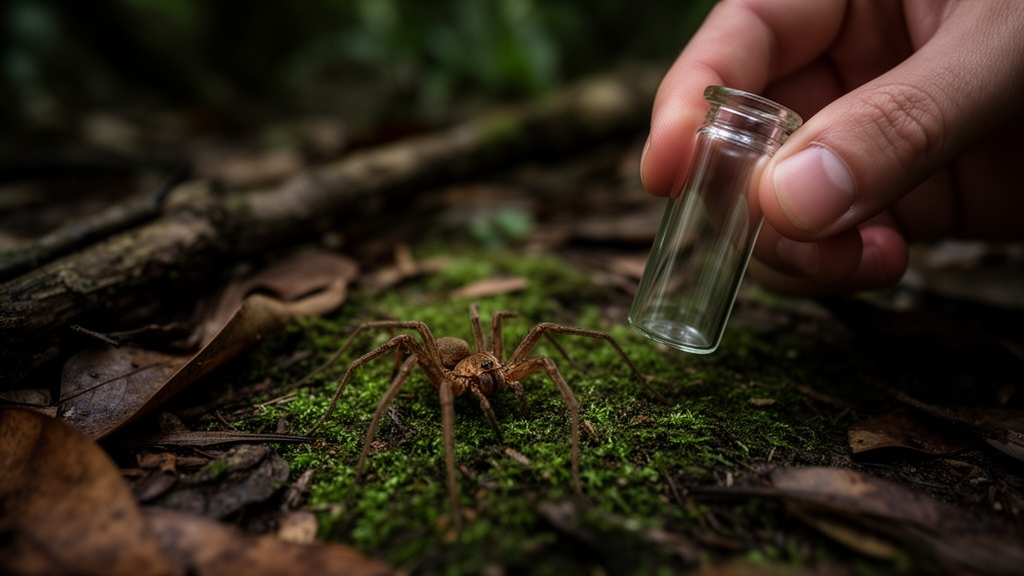
Part of the reason Asian trechaleids have remained so elusive is their highly cryptic habitat. These spiders live on moss growing on tree trunks or rock surfaces, where they construct irregular sheet webs on the moss surface. Their small size, muted coloration, and preference for vertical, mossy substrates make them extremely difficult to detect during routine surveys. The female carries the egg sac attached to her spinnerets, and after the spiderlings emerge, they remain aggregated over the egg sac for some time, a behavior that adds another layer of complexity to field observation. Such specialized habits mean that standard collecting methods, which often target ground-dwelling or foliage-dwelling spiders, are poorly suited to capturing these animals.
The specimens examined in the study were preserved in 75 percent ethanol and studied using a Leica M205A stereomicroscope equipped with a drawing tube, a Leica DFC450 camera, and LAS v. 4.6 software. Male palps and epigynes were dissected and illustrated, and epigynes were cleared by immersing them in a pancreatin solution, a technique that softens tissue to reveal internal structures without destroying them. Eye sizes were measured as maximum dorsal diameter, and leg measurements were recorded as total lengths of individual segments. All specimens are deposited in the Collection of Spiders at the School of Life Sciences, Southwest University, Chongqing, China, ensuring that future researchers can verify the findings and build upon them.
Given how cryptic these spiders are, and how recently the Asian members of the family have come to light, the authors believe it is highly likely that many more trechaleid species remain to be discovered in southern China, as well as in Southeast and South Asia. The discovery of two new species in a single province, from a genus that was monotypic only months ago, suggests that the region’s mossy forests may harbor a hidden radiation of these spiders that has gone unnoticed simply because nobody thought to look. As field surveys continue and molecular tools are applied to these animals, the true diversity of Metashinobius and its relatives may prove far greater than the current count of three species, and the Gondwanan connection may become an even more central thread in the story of how spider lineages came to inhabit the forests of Asia.
Subject of Research: A review of the Metashinobius, a genus previously considered monotypic (Araneae, Trechaleidae)
Article Title: A review of the Metashinobius , a genus previously considered monotypic ( Araneae , Trechaleidae )
Article References: Xu, Y.-Q., Wang, L.-Y., Zhang, Z.-S., & You, Y.-K. (2026). A review of the Metashinobius, a genus previously considered monotypic (Araneae, Trechaleidae). Zoosystematics and Evolution, 102(4), 885-891. https://doi.org/10.3897/zse.102.200567
Image Credits: AI Generated
Keywords: review, Metashinobius, genus, previously, considered, monotypic, Araneae, Trechaleidae, scientific research
Cite Scienmag News
Drew Townsend. (October 17, 2026). Hidden Spider Genus Reveals Two New Species and Gondwanan Origins. Scienmag. https://scienmag.com/hidden-spider-genus-reveals-two-new-species-and-gondwanan-origins/
Drew Townsend. "Hidden Spider Genus Reveals Two New Species and Gondwanan Origins." Scienmag, 17 October 2026, https://scienmag.com/hidden-spider-genus-reveals-two-new-species-and-gondwanan-origins/. Accessed 17 October 2026.
Drew Townsend. "Hidden Spider Genus Reveals Two New Species and Gondwanan Origins." Scienmag. October 17, 2026. https://scienmag.com/hidden-spider-genus-reveals-two-new-species-and-gondwanan-origins/


