


For centuries, the image of Roman engineering has been defined by two enduring ideas: that the empire’s roads ran relentlessly straight across the landscape, and that every one of them ultimately led to Rome. A new study, published in Nature Communications on 15 September, puts both assumptions to a rigorous quantitative test — and finds that neither survives contact with the data. Analysing a dataset representing almost 300,000 kilometres of Roman roads across the former empire, a multidisciplinary team from Aarhus University in Denmark, Queen Mary University of London and other European institutions has produced the most detailed quantitative picture yet of how the Roman road network was actually structured. The results reveal a system far more complex, more adaptive and more decentralised than the famous saying implies.
The research draws on Itiner-e, The Digital Atlas of Ancient Roads, a comprehensive digital reconstruction of the routes that carried people, goods and ideas across Roman territory. Rather than examining individual roads or single regions, the team applied network centrality analysis to the entire dataset. Network centrality is a method borrowed from graph theory and modern transport science that measures how important any given point is to the overall connectivity of a system. In a road network, highly central nodes are the places through which a disproportionate share of movement must pass, whether or not they are politically prominent. Applying this lens to the Roman world allowed the researchers to ask, for the first time at empire-wide scale, which places truly anchored overland mobility.
The answer was not Rome. The analysis found that the city at the heart of the empire was not the dominant hub of its land transport network. Instead, the late antique capital of Byzantium emerged as more central to empire-wide land mobility, and provincial capitals consistently ranked among the most important nodes in the system. According to Dr. Matteo Mazzamurro of Queen Mary University of London, the research reveals a sophisticated network in which provincial capitals often acted as vital crossroads, mediating regional overland communications. Crucially, he notes, these results remain robust even when the researchers account for gaps and inconsistencies in the archaeological record — a persistent challenge in any study of ancient infrastructure.
The consistently high centrality of provincial capitals and main roads carries a broader implication about how the network came to exist. If the system had been imposed from a single centre with Rome as its fixed reference point, the pattern of connectivity would look very different. The observed structure instead suggests that the development of the network involved complex, system-level decision-making, in which regional administrative centres and the practical demands of moving armies, officials, goods and information shaped priorities on the ground. The empire’s roads, in other words, were the product of layered planning rather than a single radial blueprint radiating outward from the capital.
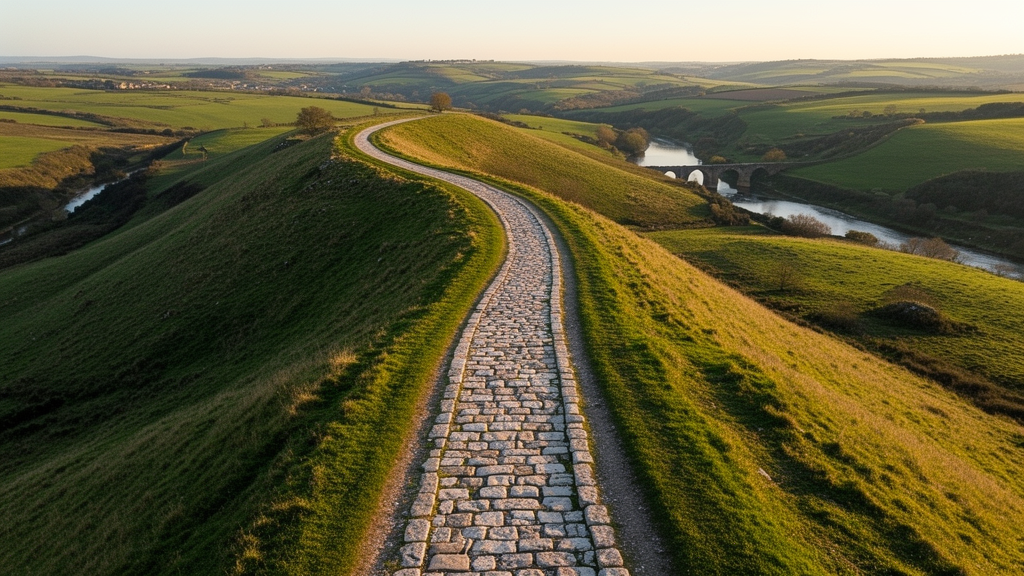
The study also dismantles the popular image of the perfectly straight Roman road. As Dr. Adam Pazout of Universitat Autònoma de Barcelona, the lead author of the study, explains, Roman engineers adapted road construction to the landscape. While they favoured straight routes where possible, the roads were generally less straight than major modern ones. Mountains, valleys, rivers and settlements all helped shape their routes. Where terrain proved difficult, Roman builders deployed an impressive engineering toolkit: terracing to carve level paths into slopes, rock cutting to punch through obstacles, retaining walls to hold back earth, and bridges to span watercourses. The result was a network that balanced the strategic value of directness against the practical constraints of geography and the needs of the communities it connected.
One of the most striking findings concerns the afterlife of this ancient infrastructure. The researchers found that the Roman road network still has a measurable relationship with modern transport infrastructure nearly 2,000 years later, though this relationship is decidedly uneven. Across the former empire as a whole, Roman and modern roads show a moderate correlation. But the strength of that relationship varies considerably from place to place, depending on local geography, the growth or decline of cities, the position of rivers and mountain passes, and shifting political and economic priorities over the centuries. In some regions, modern highways still trace corridors first engineered in antiquity; in others, the ancient routes have faded into archaeological memory while modern networks followed entirely different logic.
The significance of the study lies partly in its scale. Previous research on Roman roads has often proceeded region by region, or focused on individual characteristics such as topography, producing valuable but fragmented insights. By bringing together a highly detailed digital dataset covering the empire as a whole, the team was able to test long-standing assumptions about Roman infrastructure quantitatively at an unprecedented scale. Questions that had been debated on the basis of individual case studies — how central Rome really was, how straight the roads truly ran, which settlements mattered most for connectivity — could now be answered with consistent metrics applied across hundreds of thousands of kilometres of reconstructed routes.
The researchers are careful to acknowledge the limits of their evidence. As with any large-scale historical dataset, the underlying road network is a reconstruction based on incomplete archaeological and documentary evidence, and coverage is not uniform across all regions of the former empire. Some areas have been surveyed intensively for decades; others preserve only fragmentary traces of their ancient routes. Rather than treating the dataset as a complete record, the team accounted for this uncertainty directly in their analysis, testing whether their conclusions held when gaps and inconsistencies were taken into account. The robustness of the results under these conditions strengthens confidence that the findings reflect genuine features of the Roman network rather than artefacts of uneven preservation.
Beyond its technical achievements, the study reframes how we think about the relationship between infrastructure and society. Roman roads were far more than transport routes. They helped structure the movement of people, trade, technology and beliefs across the empire, channelling not only armies and merchants but also ideas, artistic styles and religious practices. Understanding how this network actually worked — which nodes were truly central, how routes bent to the landscape, where connectivity concentrated — offers a new way of exploring how infrastructure can shape societies over centuries and even millennia.
It also offers a sobering perspective on the present. The measurable persistence of Roman routes in modern transport corridors shows that decisions made thousands of years ago can continue to influence the landscapes we live in today, even as cities rise and fall and political priorities shift. The empire that built these roads is long gone, but the logic of connectivity it embedded in the European, North African and Near Eastern landscape endures — just not in the way the old saying would have us believe. Not all roads led to Rome. Many of them, it turns out, led to the provincial capitals and regional crossroads where the real business of moving through the ancient world actually took place, and some of them still guide the way we travel now.
Subject of Research: Quantitative network analysis of the Roman road system across the former empire
Article Title: Not all roads lead to Rome: Study challenges what we think we know about Roman roads
Article References: Not all roads lead to Rome: Study challenges what we think we know about Roman roads. (n.d.). Original publication
Image Credits: AI Generated
DOI: Not provided
Keywords: Roman roads, network centrality, Itiner-e, ancient infrastructure, Roman Empire, provincial capitals, transport networks, archaeology, Byzantium, landscape engineering, Nature Communications, digital atlas
Cite Scienmag News
Courtney Benton. (October 17, 2026). Roman roads were less straight and less Roman-centric than history suggests, massive study finds. Scienmag. https://scienmag.com/roman-roads-were-less-straight-and-less-roman-centric-than-history-suggests-massive-study-finds/
Courtney Benton. "Roman roads were less straight and less Roman-centric than history suggests, massive study finds." Scienmag, 17 October 2026, https://scienmag.com/roman-roads-were-less-straight-and-less-roman-centric-than-history-suggests-massive-study-finds/. Accessed 17 October 2026.
Courtney Benton. "Roman roads were less straight and less Roman-centric than history suggests, massive study finds." Scienmag. October 17, 2026. https://scienmag.com/roman-roads-were-less-straight-and-less-roman-centric-than-history-suggests-massive-study-finds/


