


A collaborated research team led by The Hong Kong University of Science and Technology (HKUST) and Tsinghua University has theoretically proposed a new mechanism of electrical 180° switching of Néel vector and experimentally realized it in antiferromagnetic materials with spin-splitting band structure featuring the C-paired spin-valley locking, also named as altermagnet. The team also demonstrated the material’s capability to manipulate Néel vector, paving the way for the manufacturing of ultrafast memory devices.

Credit: HKUST
A collaborated research team led by The Hong Kong University of Science and Technology (HKUST) and Tsinghua University has theoretically proposed a new mechanism of electrical 180° switching of Néel vector and experimentally realized it in antiferromagnetic materials with spin-splitting band structure featuring the C-paired spin-valley locking, also named as altermagnet. The team also demonstrated the material’s capability to manipulate Néel vector, paving the way for the manufacturing of ultrafast memory devices.
Antiferromagnetic spintronics has sparked widespread interest due to its enormous potential for creating ultra-dense and ultrafast antiferromagnetic memory that is suitable for modern high-performance information technologies. The electrical 180° switching of the Néel vector is a long-term objective for producing electrically controllable antiferromagnetic memory using opposite Néel vectors as binary “0” and “1”. However, the state-of-art antiferromagnetic switching mechanisms have long been limited for 90° or 120° switching of Néel vector, which unavoidably requires multiple writing channels that contradict ultradense integration. The study of electrical 180° switching of Néel vector makes spin-splitting antiferromagnet a new potential candidate for ultrafast memory.
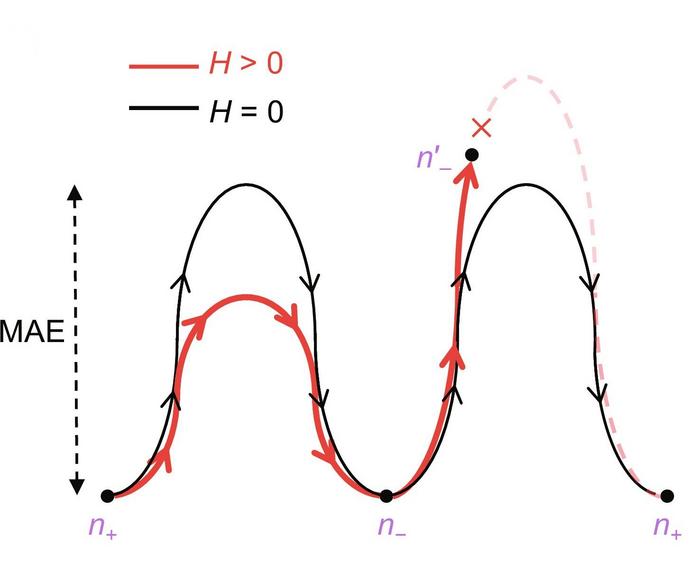
Specifically, in collinear antiferromagnet, the Néel vector n have two stable states n_+ and n_- with symmetric energy barriers. To leave an asymmetry of energy barriers, the team led by Prof. LIU Junwei, Associate Professor at the Department of Physics at HKUST proposed to exert an external magnetic field to interact with the tiny DMI-induced moment. Then, the damping-like spin-orbit torque [2] can be used to drive Néel vector n to cross the barrier from n_+ to n_- but cannot cross the opposite one (Figure 1a). As shown in Figure 1b, the atomic spin model simulation shows that n can be deterministically switched to state n_+ or n_- in 0.1 ns. Integrating the non-zero Berry curvatures on spin-splitting bands of tight-binding model, the anomalous Hall conductivities show high sensitivity to these two states n_+ and n_-, shown in Figure 1c.
In experiments led by Prof. PAN Feng and Prof. SONG Cheng, from the School of Materials Science and Engineering at Tsinghua University, the good cyclic performance of fabricated antiferromagnetic Mn5Si3 thin film is shown in Figure 1d, which means the current-driven 180° switching of Néel vector is robust and sustainable.
In fact, the team had presented a new theory as C-paired spin-valley locking (SVL) a few years ago in the scientific journal Nature Communications, indicating a new way to induce the magnetization in antiferromagnet and laying the foundation of switching of Néel Vector. Compared to this conventional T-paired SVL materials, the C-paired SVL materials create the spin-splitting bands by the strong exchange coupling between itinerant electrons and local magnetic moments instead of SOC. Furthermore, the spin-splitting valleys are paired with opposite spin directions by preserved crystal symmetry rather than time-reversal symmetry, as shown in Figure 2. In practice, a strain / charge current can be exerted to slightly break or affect the crystal symmetry and therefore induce a net magnetization / noncollinear spin current.
Based on the theoretical and experimental study of electrical 180° switching and readout of the Néel vector in Mn5Si3, electrical-controllable AFM memory devices are available with High efficiency and high reproducibility. This basic work achieved the information transformation between charge and spin degrees of freedom in antiferromagnet, paving way for the rapid development of spintronics in electronics industry. With its potential application as a storage device, such as in a computer hard drive, the material presents notable benefits including enhanced read and write speeds, as well as increased storage density.
In the future, Prof. Liu hopes that the team will explore more switching mechanisms and the underlying physics, and try to search for more suitable material platforms with higher efficiency.
The study was recently published in the scientific journal Science Advances, the corresponding authors were Prof. Pan Feng and Prof. Song Cheng at Tsinghua University, and Prof. Liu Junwei at HKUST, and the first authors were postgraduate students HAN Lei and FU Xizhi at Tsinghua University and HKUST respectively.
Journal
Science Advances
Subject of Research
Not applicable
Article Title
Electrical 180° switching of Néel vector in spin-splitting antiferromagnet
Article Publication Date
29-Jan-2024
Cite Scienmag News
Denise Maddox. (April 9, 2024). HKUST and Tsinghua researchers develop mechanism of electrical 180° switching of Néel vector. Scienmag. https://scienmag.com/hkust-and-tsinghua-researchers-develop-mechanism-of-electrical-180-switching-of-neel-vector/
Denise Maddox. "HKUST and Tsinghua researchers develop mechanism of electrical 180° switching of Néel vector." Scienmag, 9 April 2024, https://scienmag.com/hkust-and-tsinghua-researchers-develop-mechanism-of-electrical-180-switching-of-neel-vector/. Accessed 5 September 2026.
Denise Maddox. "HKUST and Tsinghua researchers develop mechanism of electrical 180° switching of Néel vector." Scienmag. April 9, 2024. https://scienmag.com/hkust-and-tsinghua-researchers-develop-mechanism-of-electrical-180-switching-of-neel-vector/

