


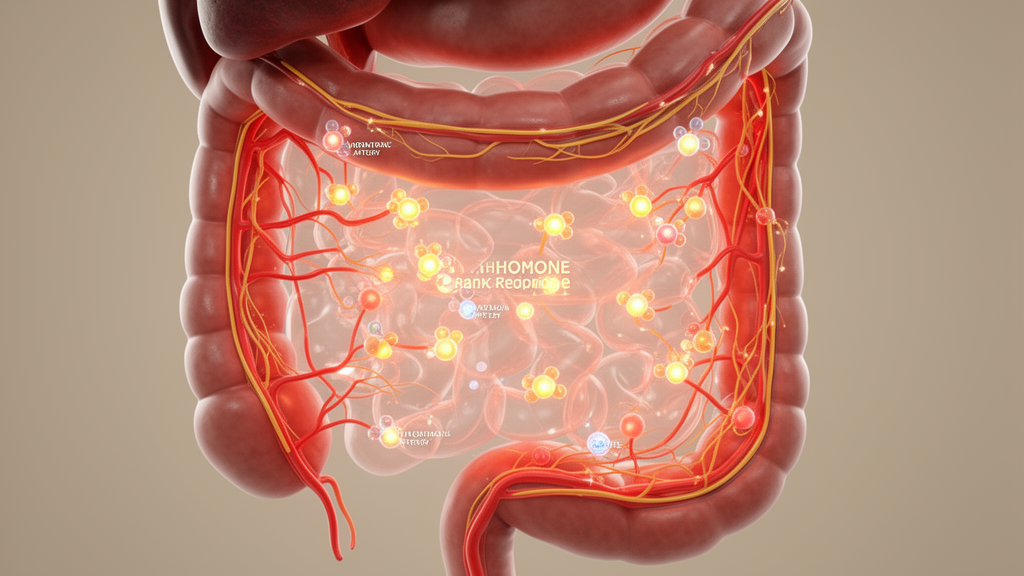
Glucagon-like peptide 2, better known as GLP-2, has long been celebrated as the gastrointestinal system’s own growth serum. Secreted naturally by the gut, this peptide hormone drives intestinal expansion by thickening the mucosal lining, deepening the crypts, and lengthening the villi that absorb nutrients. In cattle and other livestock, exogenous GLP-2 administration has been shown to dramatically increase small intestinal mass, a response mediated through downstream activation of insulin-like growth factor 1 and epidermal growth factor signaling, which in turn stimulate the Wnt/β-catenin and PI3K/Akt pathways responsible for cellular proliferation and differentiation. But growing an intestine is an energetically expensive business, and the increased metabolic demand must be met by a corresponding surge in blood supply. Previous work has demonstrated that GLP-2 administration increases superior mesenteric arterial blood flow and decreases vascular resistance in both ruminant and nonruminant species, yet the precise neurovascular mechanisms driving these hemodynamic changes have remained stubbornly opaque, particularly in cattle.
Now, a team of researchers at the University of Kentucky and the USDA-ARS Forage-Animal Production Research Unit has taken a major step toward unraveling this mystery. In a study published in Physiological Reports, the investigators used an ex vivo myography-based approach to directly examine how GLP-2 influences vasorelaxation mechanisms in isolated bovine mesenteric arteries and veins. To their knowledge, this is the first study to apply such techniques to ruminant vasculature in the context of GLP-2 signaling, and the results challenge several assumptions about how this gut hormone regulates mesenteric blood flow.
The research team synthesized GLP-2 based on the native bovine amino acid sequence and administered it subcutaneously to ten Angus × Holstein steers at a dose of 50 micrograms per kilogram of body weight every 12 hours for 48 hours. A control group received bovine serum albumin as a vehicle. The 48-hour treatment window was deliberately chosen because prior studies had shown that intestinal growth responses begin after this period, that acute exposure produces greater increases in superior mesenteric arterial blood flow than chronic exposure, and that plasma GLP-2 concentrations do not differ between acute and chronic dosing regimens. Following the final injection, the steers were slaughtered and jejunal mesenteric arteries and veins were carefully isolated from the gastrointestinal tract, sliced into cross-sections, and mounted onto luminal pins in multi-myograph chambers filled with oxygenated Krebs-Henseleit buffer at physiological temperature and pH.
Once mounted, the vessel segments were pre-contracted with endothelin-1, a potent vasoconstrictor, and then challenged with increasing concentrations of GLP-2, vasoactive intestinal peptide (VIP), serotonin (5-HT), and acetylcholine (ACh). The researchers recorded isometric changes in tension and normalized responses as a percentage of the maximum endothelin-1-induced contraction, allowing them to quantify vasorelaxation dose-response curves and calculate 50% effective concentration (EC50) values for each agonist. In parallel, they used quantitative PCR to measure mRNA expression of genes associated with receptor-mediated vasorelaxation, including the GLP-2 receptor (GLP2R), muscarinic receptor 3 (CHRM3), serotonergic receptors 4 and 7 (HTR4 and HTR7), nitric oxide synthase 3 (NOS3), vascular endothelial growth factor A (VEGFA), and VIP receptors 1 and 2 (VIPR1 and VIPR2).
The findings were striking in what they revealed and, perhaps more importantly, in what they did not. Exogenous GLP-2 administration did not alter vascular dimensions of either the mesenteric artery or vein, suggesting that the hemodynamic effects of GLP-2 are functional rather than structural, at least over the acute 48-hour exposure period. More surprisingly, increasing concentrations of GLP-2 applied directly to the isolated vessels produced minimal vasorelaxation, despite the fact that GLP2R mRNA was detectable in both mesenteric arteries and veins. This result indicates that GLP-2 does not directly induce vasorelaxation through activation of GLP2R on vascular smooth muscle or endothelial cell membranes, supporting the hypothesis that GLP-2-mediated increases in mesenteric blood flow occur through indirect neuroendocrine intermediates rather than direct receptor activation within vascular tissue.
This interpretation aligns with previous work demonstrating that the GLP-2 receptor is predominantly localized to enteric neurons and enteroendocrine cells rather than vascular cells. In pigs, the GLP-2 receptor has been shown to be co-expressed with VIP-containing and serotonin-containing enteric neurons, suggesting that downstream neurotransmitter signaling may be the true mediator of GLP-2’s vascular effects. In mice, GLP-2 administration increased serum serotonin concentrations, potentially secondary to increased small intestinal growth and proliferation. However, recent work in rats demonstrated that GLP-2-induced increases in mesenteric blood flow occurred independently of both nitric oxide and VIP signaling pathways, indicating the presence of alternative, still-undefined mediators. The current study in cattle adds a critical ruminant perspective to this species-dependent picture.
Among the enteric neurotransmitters tested, VIP emerged as the most potent vasodilator in the bovine mesenteric circulation. Dose-dependent vasorelaxation responses to VIP were observed in both the mesenteric artery and vein, with maximal relaxation reaching approximately 55% in the artery and 40% in the vein. The potency of VIP exceeded that of acetylcholine by roughly 132-fold in the artery and by more than 50,000-fold in the vein, confirming the extraordinary vasodilatory capacity of this neuropeptide within the mesenteric vasculature. Notably, VIPR1 mRNA was not detected in either vessel type, whereas VIPR2 expression was confirmed in both, suggesting that VIP-mediated vascular relaxation in bovine mesenteric vessels is likely mediated through VIPR2 activation on vascular smooth muscle cells, independent of nitric oxide signaling.
Serotonin, by contrast, displayed a more complex and nuanced profile. Increasing concentrations of 5-HT progressively reduced vasorelaxation in the mesenteric vein, with minimal relaxation at the highest doses tested, suggesting a greater contribution of contractile influences at elevated serotonin concentrations. This biphasic behavior likely reflects simultaneous activation of vasodilatory and vasoconstrictive serotonergic receptor subtypes, particularly HTR2A, which is abundantly expressed in mesenteric arteries and mediates contraction. The lack of significant vasorelaxation in response to 5-HT corresponds with the absence of changes in serotonergic receptor mRNA expression following GLP-2 treatment, indicating that serotonergic pathways are unlikely to be primary mediators of GLP-2-associated mesenteric vasodilation in cattle.
Acetylcholine, however, told a different story. In the mesenteric artery, the researchers observed a significant interaction between in vivo GLP-2 treatment and ex vivo ACh concentration, with vessels from GLP-2-treated steers exhibiting greater vasorelaxation at the highest ACh doses compared with controls. This finding suggests that GLP-2 may enhance endothelial responsiveness to cholinergic stimulation, potentially through the canonical CHRM3-mediated pathway that increases intracellular calcium and activates endothelial nitric oxide synthase. Although CHRM3 mRNA expression was not significantly altered, numerical increases in GLP-2-treated arteries provide a plausible mechanistic basis for the enhanced ACh responsiveness observed ex vivo. Intriguingly, the researchers also detected greater NOS3 mRNA expression in the mesenteric vein from GLP-2-treated steers, a novel finding in cattle that may point to a role for nitric oxide in regulating venous tone.
Collectively, these results paint a picture of GLP-2 as a hormone that regulates mesenteric blood flow through indirect, multifactorial mechanisms rather than direct vascular receptor activation. The enhanced acetylcholine-mediated vasorelaxation in the mesenteric artery and the increased NOS3 expression in the mesenteric vein suggest that cholinergic signaling pathways may represent a previously unrecognized contributor to GLP-2-associated mesenteric vasoregulation in cattle. This is particularly interesting given that recent work in mice found GLP-2-induced increases in mesenteric blood flow to be independent of both nitric oxide and VIP signaling, although cholinergic pathways were not evaluated in that study. The current findings in cattle thus open an entirely new avenue of investigation into how this intestinotrophic hormone coordinates the hemodynamic support required for intestinal growth, and they underscore the importance of species-dependent neurovascular signaling in the regulation of splanchnic circulation.
Subject of Research: Mechanisms of GLP-2-mediated enteric neurotransmitter vasorelaxation in bovine mesenteric vessels
Article Title: Influence of exogenous glucagon‐like peptide 2 on mechanisms of enteric neurotransmitter‐mediated vasorelaxation in the isolated bovine mesenteric artery and vein
Article References: David, G. S. S., Maples, E. C., Klotz, J. L., & Trotta, R. J. (2026). Influence of exogenous glucagon‐like peptide 2 on mechanisms of enteric neurotransmitter‐mediated vasorelaxation in the isolated bovine mesenteric artery and vein. Physiological Reports, 14(19), Article e71134. https://doi.org/10.14814/phy2.71134
Image Credits: AI Generated
DOI: 10.14814/phy2.71134
Keywords: GLP-2, mesenteric artery, vasorelaxation, enteric neurotransmitters, cattle physiology, myography, Influence, exogenous, glucagon, like, peptide, mechanisms
Cite Scienmag News
William Thompson. (October 17, 2026). Gut hormone GLP-2 reshapes cattle mesenteric blood flow through cholinergic vascular signaling. Scienmag. https://scienmag.com/gut-hormone-glp-2-reshapes-cattle-mesenteric-blood-flow-through-cholinergic-vascular-signaling/
William Thompson. "Gut hormone GLP-2 reshapes cattle mesenteric blood flow through cholinergic vascular signaling." Scienmag, 17 October 2026, https://scienmag.com/gut-hormone-glp-2-reshapes-cattle-mesenteric-blood-flow-through-cholinergic-vascular-signaling/. Accessed 17 October 2026.
William Thompson. "Gut hormone GLP-2 reshapes cattle mesenteric blood flow through cholinergic vascular signaling." Scienmag. October 17, 2026. https://scienmag.com/gut-hormone-glp-2-reshapes-cattle-mesenteric-blood-flow-through-cholinergic-vascular-signaling/


