


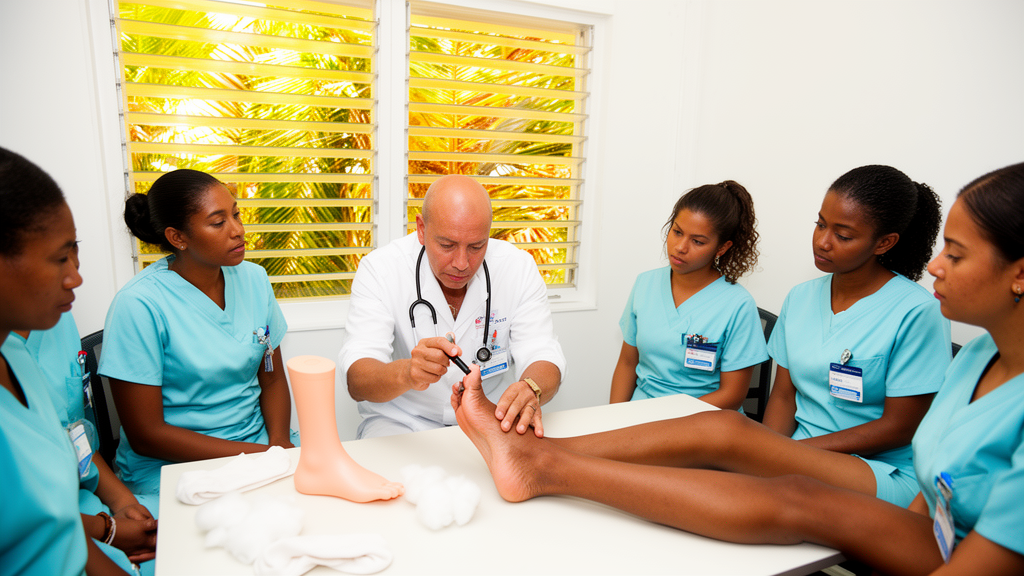
On the Caribbean island of Barbados, diabetes has quietly become one of the most pressing threats to public health, and its most feared complication is often the one patients notice last: the diabetic foot. Diabetic foot disease, which ranges from nerve damage and poor circulation to ulceration, infection and ultimately amputation, is a leading cause of disability and reduced quality of life among people living with diabetes. Yet until now, Barbados has had no structured continuing education programme to teach healthcare practitioners how to prevent, detect and manage this devastating condition. A new study published in BMC Medical Education has mapped exactly what Barbadian healthcare professionals need to learn, and built a curriculum designed specifically for the island’s cultural and clinical reality.
The research, led by Laura Lovell and Natalie Greaves of The University of the West Indies in Barbados, together with Nachiappan Chockalingam of The University of Staffordshire and Nina Davies of The University of Staffordshire and Leeds Community Healthcare NHS Trust in the United Kingdom, set out to answer a deceptively simple question: what do healthcare practitioners in Barbados actually know about the diabetic foot, and what do they feel they are missing? The stakes are high. Globally, gaps in the education of healthcare professionals regarding diabetes and diabetic foot disease have been well established, with many practitioners receiving diabetes-related education only during basic medical training and little or nothing thereafter. In Barbados, a small island developing state where the incidence of diabetes continues to climb, that gap has never been formally addressed.
To understand the problem from the inside, the team turned to qualitative research methods. Between June 2023 and February 2024, they conducted nine focus groups with healthcare professionals and non-governmental stakeholders drawn from both public and private healthcare settings across Barbados. The analysis was grounded in an interpretivist philosophical paradigm with constructivist theory, meaning the researchers treated knowledge as something built through experience and dialogue rather than simply measured with questionnaires. Thematic analysis was used to organise what participants said into meaningful patterns, a technique that allows researchers to identify recurring ideas, tensions and aspirations within large volumes of conversational data.
Three major themes emerged from the analysis, and together they tell a striking story about the state of diabetic foot care in Barbados. The first theme, which the researchers called The Gaps, encapsulated the shortfalls in healthcare practitioners’ knowledge that acted as barriers to good diabetes care. The second theme, The Discord, captured a tension that will be familiar to clinicians across much of the world: the friction between evidence-based medicine and alternative medicine, known locally as bush medicine. The third theme, The Vision, reflected the felt need of how diabetic foot education for healthcare practitioners should actually be offered, from the perspective of the potential users themselves. Rather than designing a curriculum in isolation, the researchers let the people who would deliver and receive the training shape its form.
What makes this study technically interesting is how it converted qualitative findings into a rigorous educational framework. The organising themes from the focus groups were mapped against the guidance of the International Working Group on the Diabetic Foot, the global reference body for diabetic foot management. This mapping exercise allowed the team to identify minimum competencies, the specific skills and knowledge areas that any credible diabetic foot curriculum must cover. In total, the resulting programme supports eleven minimum competencies, ensuring that the curriculum is anchored to internationally accepted standards rather than local opinion alone.
The curriculum that emerged from this process is called BDFS-LEARN, and its architecture reflects decades of research into how adults actually learn. Its constructs are aligned to Adult Learning Theory, which holds that adult learners engage best when material is relevant to their daily practice and builds on their existing experience, and to Bloom’s Taxonomy, the classic hierarchy that moves learners from basic recall of facts through application to higher-order analysis and evaluation. Expert validation informed the final content, meaning that specialists in diabetic foot care reviewed and refined the modules before they were finalised. The result is a curriculum that is theoretically grounded, clinically validated and locally informed, a combination that educational researchers rarely achieve in a single programme.
Delivery is deliberately hybrid, a design choice with particular relevance for resource-limited settings. The programme consists of a 90-minute self-guided online component followed by a four-hour in-person workshop for skill refinement. The online portion includes eight modules, allowing practitioners to absorb foundational knowledge at their own pace and on their own schedules, which matters enormously for busy clinicians juggling clinics, ward rounds and family commitments. The in-person module then provides the hands-on practice that foot care demands, from assessing pulses and sensation to grading ulcerations and planning referrals. Together, the eight online modules and one in-person module create a learning experience that is culturally appropriate, acceptable and accessible for the Barbadian context.
The cultural dimension is not a decorative afterthought; it is central to the study’s contribution. The Discord theme revealed that any Barbadian diabetic foot education programme must reckon with bush medicine, the traditional remedies that many patients and even some practitioners turn to alongside or instead of conventional treatment. A curriculum that ignores this reality risks being dismissed as irrelevant, while one that engages with it thoughtfully can build bridges between evidence-based practice and the beliefs patients bring to the clinic. By surfacing this tension through focus groups rather than pretending it does not exist, the researchers have built a programme that meets Barbadian healthcare practitioners where they actually stand.
The implications reach well beyond one island. Barbados is classified as a small island developing state, a category that encompasses many territories facing similar combinations of rising diabetes prevalence, limited specialist resources and small healthcare workforces. The researchers argue that the BDFS-LEARN curriculum has potential relevance to other resource-limited settings, offering a template for how other nations might map their own education needs and build culturally grounded programmes. The methodology itself, from the interpretivist focus groups to the mapping against International Working Group on the Diabetic Foot guidance, is a transferable blueprint that education planners anywhere could adapt.
For patients, the ultimate promise is earlier detection and better prevention of the ulcers and amputations that make diabetic foot disease so feared. For practitioners, it is the first structured pathway to continuous medical education in diabetic foot care that their healthcare system has ever offered. And for the global medical education community, the study demonstrates that rigorous, theory-driven curriculum design can emerge from nine focus groups on a small Caribbean island and still meet international standards. The study received no external funding, and the authors declare no competing interests, with ethical approval obtained from the University of the West Indies and Ministry of Health and Wellness of Barbados Ethics Committee in accordance with the Declaration of Helsinki. As diabetes rates continue to climb worldwide, this Barbadian experiment may prove to be a model worth watching.
Subject of Research: Medical Education
Article Title: Continuous medical education for the diabetic foot adapted for a Caribbean context
Article References: Lovell, L., Chockalingam, N., Davies, N., & Greaves, N. (2026). Continuous medical education for the diabetic foot adapted for a Caribbean context. BMC Medical Education. https://doi.org/10.1186/s12909-026-10423-3
Image Credits: AI Generated
DOI: 10.1186/s12909-026-10423-3
Keywords: diabetic foot, Barbados, continuing medical education, BDFS-LEARN, medical education, Caribbean, diabetes, curriculum design, Continuous, medical, education, diabetic
Cite Scienmag News
Courtney Benton. (October 17, 2026). Diabetic Foot Training Gets a Caribbean Makeover. Scienmag. https://scienmag.com/diabetic-foot-training-gets-a-caribbean-makeover/
Courtney Benton. "Diabetic Foot Training Gets a Caribbean Makeover." Scienmag, 17 October 2026, https://scienmag.com/diabetic-foot-training-gets-a-caribbean-makeover/. Accessed 17 October 2026.
Courtney Benton. "Diabetic Foot Training Gets a Caribbean Makeover." Scienmag. October 17, 2026. https://scienmag.com/diabetic-foot-training-gets-a-caribbean-makeover/


