


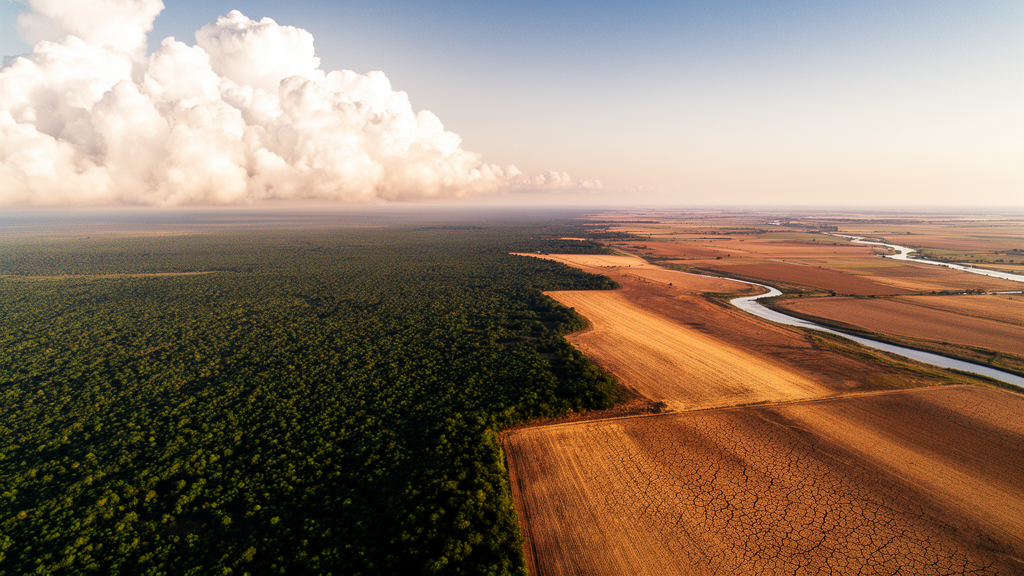
When a forest is cut down or a field is irrigated, the local consequences are easy to picture. Bare ground absorbs more sunlight and grows hotter, while wet soil cools the air as water evaporates, the same physics that makes sweating work. For decades, climate scientists have assumed that these intuitive, largely non-radiative mechanisms must also shape the global temperature response to land-surface change. A new study in Nature Communications turns that assumption on its head, showing that at planetary scale the climate impact of altering the land surface is overwhelmingly radiative, driven by shifts in planetary albedo and the clouds that govern it.
The research, led by Philipp de Vrese of the Max Planck Institute for Meteorology together with Victor Brovkin, Moritz Günther, Sarah M. Kang, Thomas Raddatz, Wim Thiery and Yi Yao, addresses one of the most stubborn gaps in climate accounting. Land-use and land-cover change is the only major anthropogenic climate driver whose hydrological contribution is not fully quantified in the assessments of the Intergovernmental Panel on Climate Change. The reason is technical but consequential: changes in surface hydrology, whether from agricultural irrigation, deforestation or afforestation, alter the partitioning of energy between latent and sensible heat, and these non-radiative effects are thought to rival the radiative effects of surface albedo changes in magnitude. If they do, the standard radiative forcing framework, which underpins how climate drivers from carbon dioxide to aerosols are compared, would break down for land-surface change.
The key insight behind the new work is a difference in how surface properties shape regional and global climate. Changes in surface albedo modify Earth’s heat content directly, because they change the amount of solar radiation the planet absorbs at the top of the atmosphere. Changes in surface hydrology, by contrast, merely redistribute the available energy between evaporation and direct heating of the air. Without a direct effect on the planet’s overall energy budget, the spatially integrated climate impact of hydrological change must arise through indirect mechanisms whose temperature effects need not align with the local response. The team set out to test whether these indirect pathways ultimately even out, leaving a radiative signature that scales linearly with planetary albedo.
To do so, the researchers ran idealized simulations with the Max Planck Institute’s Earth system model, MPI-ESM, in which they perturbed either surface albedo or water availability across three extensive latitudinal bands: the tropics between 10 degrees south and 10 degrees north, the subtropics between 15 and 35 degrees north, and the mid-latitudes between 40 and 60 degrees north. The perturbations were deliberately severe. Surface albedo was increased by 0.15, comparable to a dramatic brightening of the land, while water availability was boosted by maintaining the thin skin reservoir of water on the surface at 80 percent of its maximum capacity, effectively eliminating moisture constraints on evaporation. Each simulation ran for 50 years under pre-industrial greenhouse gas concentrations, starting from an equilibrium control experiment, so that the climate response could be isolated cleanly from internal variability.
The analysis of the surface energy balance revealed a striking pattern. Locally, the two perturbation types behaved as expected: albedo increases cooled the surface by reducing absorbed shortwave radiation, while hydrological perturbations produced their strongest local cooling through enhanced evaporation. But when the team examined the zonally averaged fluxes, the picture changed fundamentally. The increase in latent heat flux from added evaporation was offset by opposing shifts in the sensible heat flux, because evaporative cooling lowers the surface temperature while condensational heating higher in the atmosphere warms the air, jointly reducing the surface-atmosphere temperature gradient that drives turbulent exchange. Where turbulent fluxes did increase, the resulting energy deficit at the surface was compensated by enhanced atmospheric counterradiation. In every simulation, the only surface energy-balance component consistently linked to the cooling was a decrease in net surface shortwave radiation, a purely radiative process.
The mechanism connecting hydrological change to shortwave radiation turned out to be clouds. The atmosphere has a finite water-holding capacity, so when evapotranspiration rises, precipitation must rise to match it, increasing cloudiness. This effect is amplified by the reduction in the sensible heat flux, which cools the atmosphere and raises relative humidity, further promoting cloud formation through enhanced lower-troposphere stability. The resulting clouds, particularly optically thick low-altitude clouds, reflect additional sunlight back to space. For albedo increases, the cloud response is more nuanced: cooling lowers saturation vapor pressure, drying the atmosphere and reducing shortwave absorption by water vapor, which increases surface insolation, while the spatially varying cloud response can either amplify or diminish the change in surface brightness. In both cases, however, the decisive shifts in the surface energy balance are radiative, mediated by cloud radiative forcing.
The global temperature response confirmed the hypothesis with remarkable precision. Observations and reanalysis data place the slope between top-of-atmosphere outgoing longwave radiation and surface temperature, the so-called lw-TOARSTR, at between 1.9 and 2.2 watts per square meter per kelvin. In the simulations, none of the clear-sky TOARSTRs deviated from this range by more than 10 percent, and there was no systematic difference between albedo and hydrological perturbations or between perturbations applied in different latitudes. The all-sky shortwave TOARSTR averaged 2.5 watts per square meter per kelvin, implying a surface temperature response of roughly 0.4 kelvin per watt per square meter change in top-of-atmosphere net shortwave radiation. In other words, the spatially integrated biophysical climate impact of land-surface change scales approximately linearly with the resulting shift in planetary albedo, regardless of whether the perturbation is radiative or hydrological in origin.
Notably, while non-radiative effects strongly influence local temperatures, their net contribution to the global-mean signal proved negligible. The simulations also showed that remote effects are largely independent of the perturbation type, arising mainly through changes in meridional heat transport. Except for the tropical albedo case, all perturbations cooled the boreal region, the Arctic Ocean and the North Atlantic, while most northern-hemisphere perturbations warmed the southern border of the Sahel and South Asia through a southward shift of the Intertropical Convergence Zone. A distinctive warming pattern along North America’s west coast stemmed from changes in the intensity and position of the Aleutian Low. Even the tropical albedo experiment, in which the initial brightening triggered an extreme decline in precipitation across the Amazon and Congo basins, reducing tree cover and cloud cover so that more shortwave radiation was ultimately absorbed, produced global TOARSTRs consistent with the other experiments, suggesting that synergistic effects between simultaneous surface changes are of minor importance for the global temperature response.
Because the global response depends chiefly on regional cloud-cover characteristics, the team built a simplified estimation scheme based on local shifts in surface brightness and evapotranspiration combined with region-specific sensitivity parameters derived from low-altitude cloud statistics. Applied to their own simulations, including combined brightness and hydrological perturbations and changes in surface roughness, as well as to multi-model experiments from the Land-Use and Irrigation Model Intercomparison Projects, the scheme reproduced the simulated responses with high agreement. Temperature estimates deviated from the simulated values by less than a third of the latter, and the agreement was even better for combined perturbations, since the biases partly offset each other. The approach also captured roughness changes well, indicating that, like hydrological change, roughness acts primarily through shifts in the Bowen ratio and cloudiness.
The findings offer straightforward answers to longstanding questions. They show that the radiative forcing framework can be extended to all aspects of land-surface change if the rapid cloud response is treated as a radiative forcing rather than a climate feedback, as is already done for cloud adjustments to aerosols. Such treatment could also resolve the apparent difference between climate sensitivity to land-use change and to atmospheric carbon dioxide. Perhaps most strikingly, the results explain why agricultural irrigation has profound local impacts yet only a minor influence on global mean temperature: irrigated areas are predominantly located in arid regions, where local evaporative cooling may be strongest but the cloud sensitivity to changes in evapotranspiration is comparatively low. Applying the same amount of water in the boreal region, with weaker evaporative cooling but substantially higher cloud sensitivity, would induce a global cooling several times larger. The authors note that terrestrial water management therefore offers some potential as a climate-mitigation tool, though they caution that their investigation relies on a single Earth system model, and the sensitivity parameters describing cloud effects are highly model-dependent, with inter-model variability in cloud feedback remaining a key source of uncertainty. The general shifts in the surface energy balance, however, agree well with those produced by other models, and the TOARSTRs are consistent with observation-based estimates, suggesting the applicability of the key findings is neither limited to the model used nor to the idealized scenarios investigated.
Subject of Research: Global climate impact of land-surface change driven by radiative effects
Article Title: Global climate impact of land-surface change driven by radiative effects
Article References: de Vrese, P., Brovkin, V., Günther, M., Kang, S. M., Raddatz, T., Thiery, W., & Yao, Y. (2026). Global climate impact of land-surface change driven by radiative effects. Nature Communications, 17(1), Article 10454. https://doi.org/10.1038/s41467-026-77834-0
Image Credits: AI Generated
DOI: 10.1038/s41467-026-77834-0
Keywords: Global, climate, impact, land-surface, change, driven, radiative, effects, scientific research
Cite Scienmag News
Violet Maxwell. (October 17, 2026). Clouds, not evaporation, decide how land change shifts global climate. Scienmag. https://scienmag.com/clouds-not-evaporation-decide-how-land-change-shifts-global-climate/
Violet Maxwell. "Clouds, not evaporation, decide how land change shifts global climate." Scienmag, 17 October 2026, https://scienmag.com/clouds-not-evaporation-decide-how-land-change-shifts-global-climate/. Accessed 17 October 2026.
Violet Maxwell. "Clouds, not evaporation, decide how land change shifts global climate." Scienmag. October 17, 2026. https://scienmag.com/clouds-not-evaporation-decide-how-land-change-shifts-global-climate/


