


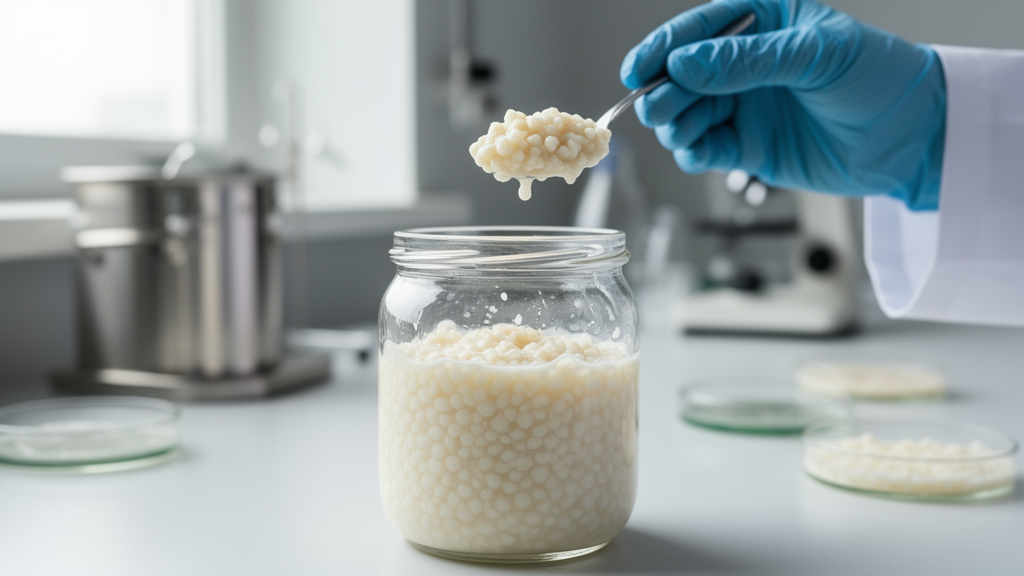
For roughly 3,000 years, humans have consumed milk kefir, a fermented drink shaped by a symbiotic consortium of bacteria and yeasts. Now, a review published in Frontiers in Drug Discovery argues that this ancient beverage is far more than a probiotic curiosity: it is a natural factory of antimicrobial compounds that could help address the growing crisis of antibiotic resistance. Silvia Tenorio-Salgado and Alejandra Sánchez-Canché of the Tecnológico Nacional de México, together with Ernesto Perez-Rueda of the Universidad Nacional Autónoma de México, systematically cataloged the bioactive molecules produced by kefir’s microbiome and the molecular mechanisms by which they kill or disable dangerous pathogens such as Salmonella typhimurium, Pseudomonas aeruginosa, and Listeria monocytogenes.
The kefir grain itself is a remarkable biological structure. It harbors more than 50 distinct microbial species, dominated by lactic acid bacteria including Lactobacillus helveticus, Lactobacillus kefiranofaciens, and Lactococcus lactis, alongside acetic acid bacteria, Bifidobacterium species, and yeasts such as Kluyveromyces marxianus, Candida, and Kazachstania. A large-scale analysis of 64 kefir grains from 25 countries revealed a strikingly consistent pattern: each grain is dominated by representatives of L. helveticus, L. kefiranofaciens subsp. kefiranofaciens, or L. lactis subsp. lactis or cremoris. This bacterial and eukaryotic heterogeneity is not incidental; the relative abundances of bacteria and yeasts directly influence the production of bioactive compounds. In water kefir, for example, coculture between L. kefiranofaciens and Saccharomyces cerevisiae enhances the synthesis of kefiran, a polysaccharide with documented antimicrobial activity.
The review’s central thesis is that kefir’s antimicrobial power derives from synergy, not from any single molecule. During fermentation, the microbial community hydrolyzes milk macromolecules, transforming them into metabolites with functional activity. Cell envelope proteinases of Lactobacillus catalyze the first step of casein hydrolysis, lactic acid bacteria consume lactose and drive the pH steadily downward, and acid-induced cleavage of the protein matrix releases bioactive peptides. On average, approximately 700 metabolites have been identified after fermentation. The resulting cocktail includes organic acids, bacteriocins, bioactive peptides, and exopolysaccharides, which act not only as individual molecules but as a complex combination of metabolic products that modify the environment and disrupt pathogen cell membranes or promote pores into bacterial cell walls.
Bacteriocins are among the most extensively characterized weapons in kefir’s arsenal. These ribosomally synthesized bacterial peptides, produced mainly by lactic acid bacteria such as Lactobacillus plantarum and Lactococcus species, range from less than 5 kilodaltons to more than 30 kilodaltons in molecular weight. Many exhibit extensively post-translationally modified structures encoded on complex gene clusters, whereas others have simple linear structures. Studies have demonstrated their activity against Klebsiella pneumoniae, Clostridioides difficile, methicillin-resistant Staphylococcus aureus, L. monocytogenes, P. aeruginosa, Salmonella enteritidis, Escherichia coli, Bacillus cereus, Enterococcus faecalis, and Cronobacter sakazakii. Metagenomic analyses of kefir grain samples have identified genes associated with bacteriocin synthesis, including helveticin and zoocin, and a bacteriocin designated ST8KF has been characterized from a kefir isolate of L. plantarum.
The molecular logic of bacteriocin action exploits a fundamental asymmetry between attacker and target. Both Gram-negative and Gram-positive bacteria present negatively charged surfaces, owing to the anionic lipopolysaccharide-rich outer membrane of the former and the negatively charged teichoic acids decorating the peptidoglycan of the latter. Bacteriocins with positive charge and hydrophobic domains bind electrostatically to these surfaces and insert into the membrane, forming pores that cause rapid cell death. Nisin, produced by L. lactis, employs a dual mechanism: it binds lipid II, a key component of peptidoglycan biosynthesis, disrupting the cell wall while simultaneously preventing peptidoglycan synthesis. Lactocin 27, from L. helveticus, inhibits protein synthesis without affecting DNA or RNA synthesis or ATP levels, and lactococcin 972 blocks septum biosynthesis rather than forming pores in the cytoplasmic membrane.
Kefiran, the signature exopolysaccharide of kefir, is a water-soluble branched glucogalactan composed of equal proportions of D-glucose and D-galactose, mainly produced by L. kefiranofaciens. Agar diffusion methods reveal its activity against Candida albicans and multiple bacteria, with the highest potency observed against Streptococcus pyogenes, while bacterial viability assays confirm bactericidal effects on P. aeruginosa, E. coli, S. aureus, and S. typhimurium. Using supported bilayer lipid membrane models, researchers showed that kefiran concentrations between 11.4 and 22.7 micromoles per liter induce membrane defects through penetration and pore formation, acting like a detergent. The proposed mechanism involves hydrogen bonding between the carbohydrate and the phosphate head group of the phospholipid, following a carpet-like model of interaction. Kefiran also protects intestinal epithelial cells by preventing Bacillus cereus-induced necrosis, F-actin disorganization, and microvilli effacement in Caco-2 cells, and has demonstrated potential against S. aureus in wound infections in a rat model.
Antimicrobial peptides represent another rich vein. Typically ranging between 6 and 50 residues, these small peptides destroy a wide range of microorganisms. Purification of 46 peptides from a Turkish milk kefir cultured with bovine milk, using reversed-phase high-performance liquid chromatography, showed that 13 achieved 100 percent inhibition against E. coli, K. pneumoniae, and P. aeruginosa. In a Brazilian kefir cultured with sheep’s milk, researchers identified 1,942 peptides using MALDI-TOF, of which 13 exhibited antimicrobial activity against P. aeruginosa, B. cereus, and B. subtilis, while ultra-high-performance liquid chromatography coupled with mass spectrometry revealed 257 peptides, 230 unique to kefir grains, sixteen previously described as bioactive. Critically, antimicrobial peptides have a significantly lower incidence of resistance compared with conventional antibiotics because they employ a multi-target mechanism, primarily the physical disruption of the bacterial membrane, in contrast to the single-target mechanism of traditional antibiotics.
Organic acids complete the picture. Lactic acid, the predominant end-product of lactose metabolism, decreases the milk pH from approximately 6.7 to less than 4.6, causing casein coagulation and inhibiting pathogen growth. Cell-free kefir supernatants contained lactic acid concentrations ranging from 83.59 to 229.92 millimolar and showed antagonistic effects on Salmonella arizonae and S. typhimurium. The antimicrobial mechanism of the undissociated form is elegant: the lipid bilayer is permeable to lipophilic acetic and lactic acids, which diffuse into the relatively alkaline cytoplasm, dissociate, and produce protons and anions. When protons exceed the buffering capacity, they are transported out through membrane-bound proton pumps, depleting energy reserves. The resulting lowering of intracellular pH denatures proteins and destabilizes structural and functional components of the cell. Lactic acid also potentiates other antibacterial molecules by disrupting the outer membrane of Gram-negative bacteria, making it permeable to metabolites that are too lipophilic or too large to penetrate otherwise, and sensitizing Gram-negative bacteria to bacteriocins such as nisin.
The kefir microbiota also possesses genetic potential to produce nonribosomal peptides and polyketides, secondary metabolites synthesized outside the ribosome by nonribosomal peptide synthetases and polyketide synthases. Bioinformatic prediction of biosynthetic gene clusters in metagenomic analyses of two Mexican kefir grain samples identified plipastatin, fengycin, and bacillaene, and detected contigs involved in exporting polyketides in Texas kefir metagenomes. In a Bacillus velezensis strain isolated from milk kefir, 55 percent of the genome was predicted to encode nonribosomal peptides, 36 percent polyketides, and 9 percent hybrids, with expression of genes for iturin, bacilysin, and mycosubtilin corroborated by RT-PCR, although experimental validation of their functional roles remains necessary.
The authors conclude that kefir grains represent an important source of antimicrobial compounds with biotechnological potential, but they caution that substantial heterogeneity in kefir preparation, dosage, intervention duration, study populations, and outcome measures limits interpretation of current findings. Larger, well-designed clinical trials with standardized kefir interventions, detailed reporting of microbial composition and viable counts, consistent dosing, longer interventions, and double-blind designs with matched sensory controls are needed to better define kefir’s efficacy in specific populations and health conditions. Nevertheless, the convergence of evidence from in vitro assays, lipid membrane models, metagenomics, and animal studies suggests that this ancient fermented drink may hold practical answers to one of modern medicine’s most urgent questions: where to find new antimicrobial molecules that pathogens have never encountered before.
Subject of Research: Minireview Kefir as a source of antimicrobial compounds against bacterial pathogens
Article Title: Minireview Kefir as a source of antimicrobial compounds against bacterial pathogens
Article References: Tenorio-Salgado, S., Sánchez-Canché, A., & Perez-Rueda, E. (2026). Minireview Kefir as a source of antimicrobial compounds against bacterial pathogens. Frontiers in Drug Discovery, 6, Article 1856085. https://doi.org/10.3389/fddsv.2026.1856085
Image Credits: AI Generated
DOI: 10.3389/fddsv.2026.1856085
Keywords: Minireview, Kefir, source, antimicrobial, compounds, against, bacterial, pathogens, scientific research
Cite Scienmag News
Morgan Morrow. (October 17, 2026). Kefir’s 3,000-Year-Old Microbial Consortium Yields a New Arsenal Against Bacterial Pathogens. Scienmag. https://scienmag.com/kefirs-3000-year-old-microbial-consortium-yields-a-new-arsenal-against-bacterial-pathogens/
Morgan Morrow. "Kefir’s 3,000-Year-Old Microbial Consortium Yields a New Arsenal Against Bacterial Pathogens." Scienmag, 17 October 2026, https://scienmag.com/kefirs-3000-year-old-microbial-consortium-yields-a-new-arsenal-against-bacterial-pathogens/. Accessed 17 October 2026.
Morgan Morrow. "Kefir’s 3,000-Year-Old Microbial Consortium Yields a New Arsenal Against Bacterial Pathogens." Scienmag. October 17, 2026. https://scienmag.com/kefirs-3000-year-old-microbial-consortium-yields-a-new-arsenal-against-bacterial-pathogens/


