


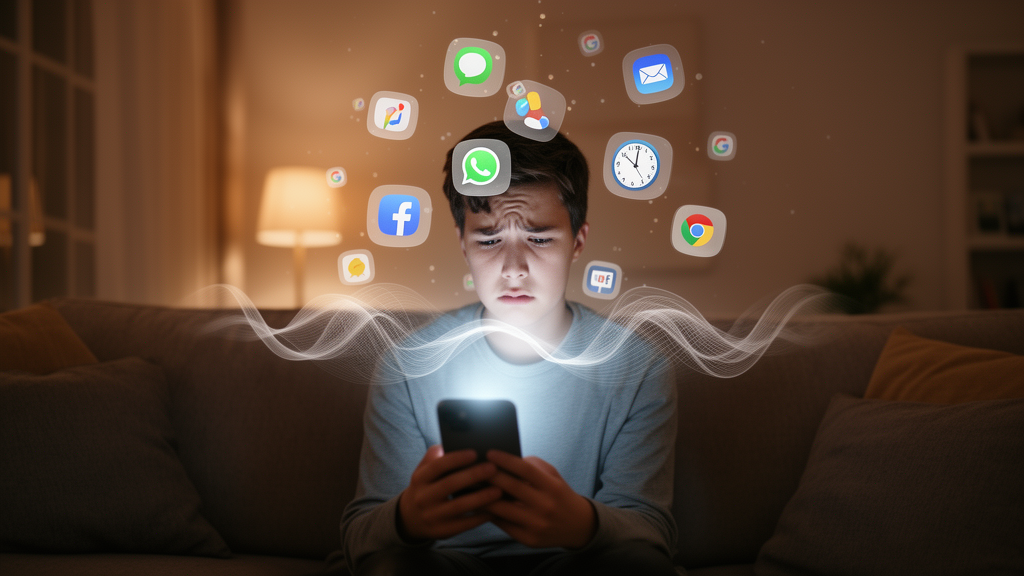
The most revealing record of a person’s daily stress may not be a questionnaire or a wearable sensor, but the quiet trail of routine actions performed on a smartphone: opening a messenger to chat, typing a search query, tapping through a payment screen. Researchers at the Korea Advanced Institute of Science and Technology (KAIST) have now developed a technology that reads these repeated behaviors and uses them to identify whether a person is experiencing stress on a given day. The work, led by Professor Uichin Lee of the Department of AI Computing, introduces a framework called SHIRBT-MMF, which automatically identifies recurring smartphone behaviors and analyzes factors such as the duration and frequency of each behavior and patterns of text input to determine daily stress status.
The core insight of the research is a deliberate shift in what gets measured. Previous smartphone-based stress studies have concentrated on indicators such as total screen time, the number of times apps are launched, the timing and frequency of use by app category, and typing behavior. Those metrics are easy to collect, but they carry a structural weakness: whenever the apps a person uses change, or when an app’s interface is redesigned, the underlying data change as well. A stress-detection model trained on one set of apps can therefore lose stability over long periods, precisely the timescale over which mental health monitoring is most valuable. Longitudinal reliability, the ability of a model to mean the same thing in month six as it did in week one, has been a persistent challenge for the field.
The KAIST team’s answer was to stop asking which app a person is using and instead ask what the person is doing. Even if a user abandons KakaoTalk for LINE or WhatsApp, the activity itself remains messenger chatting. The analysis is anchored to the purpose of the behavior rather than the name of the app. The researchers formalized this idea as Smartphone Human Interaction Routine Behavior Tasks, abbreviated SHIRBTs: repeated, purposeful units of smartphone interaction that persist across different applications and interface updates. Because these behavioral units are defined at the level of human intent, they are far less fragile than app-level usage counts.
Identifying these routines automatically required a two-stage technical pipeline. First, the team developed a technique called Multi-Level Sequential Pattern Mining, or ML-SPM, which scans screen-transition sequences recorded across multiple days and extracts recurring patterns of navigation. These patterns capture the characteristic ways a person moves through screens when performing a familiar task. Second, the system uses a large language model to assign human-readable labels to the mined patterns, producing categories such as messenger chatting, web browsing, financial payment, and reading or writing email. The labeling step matters because it converts raw interaction traces into behavioral units that both the model and a human observer can understand, an important property for any technology that aspires to transparency in mental health applications.
The classification of these behaviors proved highly reliable. In evaluations testing whether the same behavior could be consistently recognized across different email clients, web browsers, and messenger apps, the system achieved an accuracy of more than 95 percent. That consistency across app families is the technical foundation on which the rest of the study rests: if the behavioral labels are stable, then models built on them should inherit that stability even as individual applications come and go from a user’s phone.
Privacy considerations shaped the design from the outset. The system does not store the actual text or message content entered by users. It records only behavioral information: whether text was entered, how often it was entered, and how screens transitioned during use. Information about message recipients or call partners is likewise obscured through hashing, a process that converts the original identifiers into values that do not directly reveal them. This means the framework can characterize the rhythm and shape of a person’s digital day without ever reading a message or learning who a person communicated with, a distinction that matters for any technology intended to touch on sensitive mental state data.
To test whether the framework could actually detect stress, the team analyzed real-life data from 26 university students and office workers in their 20s and 30s, all Android users. Among the participants for whom both daily self-reported stress assessments and smartphone records were available, 16 short-term participants contributed an average of 30.5 days of data each, while 10 long-term participants contributed an average of 105.1 days. Anchored to the participants’ daily self-assessments, the researchers built personalized artificial intelligence models that distinguished between days with stress and days without. In total, 29 distinct types of repeated behaviors were identified across the group, with each individual routinely repeating an average of about seven of them.
The results showed a consistent advantage for behavior-level analysis over app-level analysis. The best-performing personalized models achieved an average accuracy of 75.9 percent for short-term participants and 73.8 percent for long-term participants, meaning the system was correct roughly three times out of four about whether a given day was a stressed day. Those figures exceeded the conventional approach, which fed app usage data into the same AI technique, by 5.5 and 3.5 percentage points respectively. Notably, performance did not depend on observing every behavior: with the same personalized model, using only two behaviors, messenger chatting and financial payment, or even messenger chatting alone, produced higher average classification accuracy than the conventional method. In the long-term data, the indicators derived from repeated behaviors also changed less over time and maintained a more stable structure than those used in the conventional approach, confirming the central design hypothesis that behavioral routines outlast the apps that host them.
The practical implications extend in two directions. In this experiment, the researchers deliberately collected a broad range of smartphone usage records so that their method could be compared fairly with conventional approaches. In future deployments, once an individual’s repeated behaviors have been identified, data collection and analysis could be focused on just those relevant behaviors, reducing the burden of continuous logging. The study also suggests a path toward digital mental health monitoring that is both interpretable and durable: because the system classifies stress using labeled human behaviors rather than opaque app statistics, it is easier to understand which behaviors drove a given classification, and the model remains relatively stable even when a user’s app environment changes. Professor Uichin Lee framed the vision this way: the smartphone should be viewed not simply as a device for measuring usage time, but as a space in everyday life where an individual’s communication, information seeking, and financial activities are repeatedly carried out. Converting complex smartphone records into human-understandable behavioral units, he noted, provides a foundation for more reliable long-term mental health tracking.
The researchers are careful about the limits of the findings. The study demonstrated associations between behavior and stress, not a causal relationship showing that any particular behavior causes or reduces stress; the models detect a state, they do not explain it. The participant pool, drawn from Android users in their 20s and 30s, also leaves open questions about generalizability, and the team plans to expand the research to broader age groups, occupations, and smartphone environments while verifying long-term stability at larger scales. The study, with Hansoo Lee as first author, Professor Uichin Lee as corresponding author, and Taehyeon Park, Youngji Koh, and Professor Jae-Gil Lee of the School of Computing as co-authors, was published in December 2025 in the international journal Proceedings of the ACM on Interactive, Mobile, Wearable and Ubiquitous Technologies, and is scheduled to be presented at ACM UbiComp/ISWC 2026 in Shanghai, China, from October 13 to 15, 2026. The work was supported by the Institute of Information and Communications Technology Planning and Evaluation through its ICT Convergence Digital Inclusion Technology Development project and by the National Research Foundation of Korea’s Sejong Fellowship project, funded by the Ministry of Science and ICT. If the approach proves durable across wider populations, the routine taps, searches, and payments that fill an ordinary day could become a continuous, privacy-conscious window into mental well-being, no additional hardware or questionnaires required.
Subject of Research: Detection of daily stress from repeated smartphone interaction behaviors using behavior-task mining and personalized AI models
Article Title: KAIST reads “stress” from smartphone chatting, searching, and payment habits
Article References: KAIST reads “stress” from smartphone chatting, searching, and payment habits. (n.d.). Original publication
Image Credits: AI Generated
DOI: Not provided
Keywords: KAIST, stress detection, smartphone behavior, digital mental health, machine learning, behavior mining, large language model, UbiComp, privacy, mobile computing, personalized AI, passive sensing
Cite Scienmag News
Glenn Wilkins. (October 17, 2026). Your Phone Knows When You Are Stressed: KAIST Turns Everyday App Habits Into a Mental Health Signal. Scienmag. https://scienmag.com/your-phone-knows-when-you-are-stressed-kaist-turns-everyday-app-habits-into-a-mental-health-signal/
Glenn Wilkins. "Your Phone Knows When You Are Stressed: KAIST Turns Everyday App Habits Into a Mental Health Signal." Scienmag, 17 October 2026, https://scienmag.com/your-phone-knows-when-you-are-stressed-kaist-turns-everyday-app-habits-into-a-mental-health-signal/. Accessed 17 October 2026.
Glenn Wilkins. "Your Phone Knows When You Are Stressed: KAIST Turns Everyday App Habits Into a Mental Health Signal." Scienmag. October 17, 2026. https://scienmag.com/your-phone-knows-when-you-are-stressed-kaist-turns-everyday-app-habits-into-a-mental-health-signal/


