


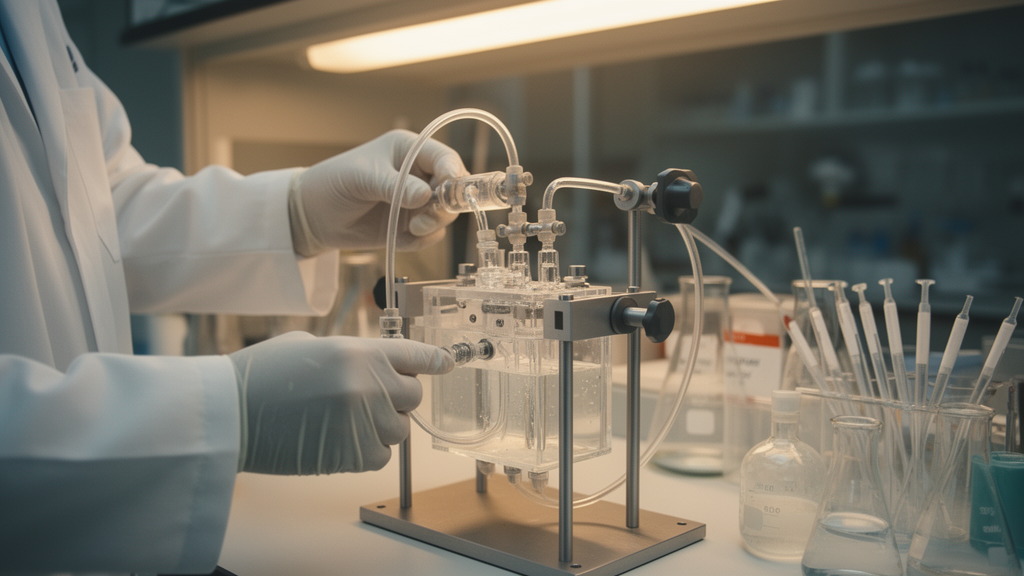
For decades, pharmaceutical scientists have relied on a single, deceptively simple measurement to decide whether a pill will do its job: the dissolution test. Drop a tablet into a warmed buffer, stir it with a rotating paddle, and watch how quickly the active ingredient dissolves. The problem is that dissolution tells only half the story. A drug can dissolve beautifully in a beaker and still fail to cross the membranes of the human gut, never reaching the bloodstream in useful amounts. A team of researchers at Rīga Stradiņš University in Latvia has now built and tested a system that closes this gap, wiring a standard pharmacopoeial dissolution apparatus directly to an Ussing chamber, a classic device for measuring how molecules pass through membranes. Their feasibility study, published in the Journal of Pharmacy and Pharmaceutical Sciences, used the anti-inflammatory drug naproxen as a test case and demonstrated that dissolution and permeation can, in principle, be measured simultaneously in one continuous flow.
The motivation behind the work lies in a quiet revolution in the drug pipeline. Under the Biopharmaceutical Classification System, and its more modern cousin the Developability Classification System, orally administered drugs are sorted into four classes according to how soluble they are in gastrointestinal fluids and how easily they permeate intestinal membranes. In earlier eras, most new medicines fell into classes I and III, compounds with no real solubility problems. Today, the majority of new drug candidates are poorly soluble molecules belonging to classes II and IV, often the products of combinatorial chemistry and high-throughput screening that favour potent, lipophilic targets. For these compounds, a dissolution profile alone is a poor predictor of what happens in a patient, because the rate-limiting step may not be how fast the tablet breaks apart but how fast the dissolved molecules squeeze through the lipid barriers of the intestinal wall.
Commercial dissolution-permeation systems do exist, and they have become valuable tools for formulation screening. Yet the Latvian team, led by Andrejs Sitovs and Valentyn Mohylyuk, identified three persistent shortcomings. The acceptor compartments of commercially available systems that include compendial dissolution testing hold no more than 50 millilitres, a volume that quickly saturates when a poorly soluble drug finally dissolves and needs somewhere to go. None of the existing platforms is compatible with ex vivo membranes, such as excised segments of animal or human intestine, which would allow active and facilitated transport mechanisms to be studied. And the dissolution step in most devices is not the standardised, pharmacopoeial kind that regulators around the world already recognise. The researchers’ answer was to bolt a CHM1 Ussing chamber onto a compendial USP2 dissolution apparatus, connecting the two with silicone tubing and a six-channel peristaltic pump in a closed circulation loop.
The engineering of the setup is elegantly straightforward. Two one-litre USP2 vessels ran side by side at 37 degrees Celsius with paddles spinning at 50 revolutions per minute. One vessel held the donor medium, a phosphate buffer at pH 6.8 that mimics the small intestinal lumen, where the tablet dissolved. The other held the acceptor medium, a phosphate buffer at pH 7.4, representing the blood side of the intestinal barrier. Medium was pumped from the donor vessel, roughly one centimetre below its surface, through the Ussing chamber, where it contacted a membrane mounted over a 1.13 square centimetre aperture, and then dripped passively back into the donor vessel from a height of about one centimetre. The acceptor vessel circulated through the opposite side of the chamber. Each tube ran one metre in length, and adhesive tape over the dissolution apparatus apertures kept evaporative losses to between 0.3 and 1.3 percent of the total volume over the course of an experiment.
The membrane at the heart of the chamber was an artificial lipid barrier modelled on the parallel artificial membrane permeability assay, better known in the field as PAMPA. The researchers spread 18.4 microlitres of soy L-α-phosphatidylcholine dissolved in dodecane, a mixture abbreviated LiDo, across one of two supporting filter membranes: a hydrophobic polyvinylidene fluoride membrane with 0.45 micrometre pores and a thickness of 125 micrometres, or a polycarbonate membrane with 0.20 micrometre pores and a thickness of only 10 micrometres. They tested LiDo concentrations of 5 and 10 percent by weight, deliberately lower than the 20 percent used in conventional PAMPA, because previous work had shown that increasing lecithin concentration in dodecane tends to slow naproxen permeation. Scanning electron microscopy confirmed clear differences in pore size and structure between the two filter materials, differences that would later prove consequential.
Naproxen itself was chosen with care. The drug, administered here as Nalgesin 550 milligram tablets containing naproxen sodium equivalent to 500 milligrams of naproxen, is a BCS class II compound: poorly soluble in acidic fluids but highly soluble at near-neutral pH, and transported across intestinal membranes purely by passive diffusion. That last property matters, because an artificial lipid membrane can only model passive transport. At the pH values of the small intestine, between 6.8 and 7.4, more than 99 percent of naproxen exists in its ionised, water-soluble form, according to the Henderson-Hasselbalch relationship. The researchers confirmed that proper sink conditions were maintained, with sink indices of 7.2 in the donor medium and 2.9 in the acceptor medium, meaning the buffers could hold far more dissolved drug than the experiments actually delivered. The tablets released more than half their payload within ten minutes and essentially the entire dose within thirty.
The permeability numbers that emerged were striking, and humbling. Across the 0.45 micrometre PVDF membrane, the apparent permeability coefficient of naproxen was 0.91 plus or minus 0.35 times ten to the minus eight centimetres per second with 5 percent LiDo, and 0.75 plus or minus 0.23 times ten to the minus eight with 10 percent LiDo, a difference that statistical analysis found not significant. The thinner polycarbonate membrane, however, roughly doubled the measured permeability, yielding 1.99 plus or minus 0.57 times ten to the minus eight centimetres per second at 5 percent LiDo. A control experiment in which donor and acceptor media were identical, both at pH 6.8, produced a similar value of 0.95 times ten to the minus eight, suggesting the pH gradient was not the dominant factor. Every one of these figures was approximately one hundred times lower than permeability values reported in the literature for naproxen, whether from artificial membrane-Ussing models, which report 19.55 times ten to the minus six centimetres per second, or from PAMPA experiments, which report around 4.2 times ten to the minus six.
The authors attribute this hundredfold gap primarily to the composition of their acceptor medium. Other studies routinely add chemical scavengers that mimic serum proteins, binding permeated drug and pulling the equilibrium forward, thereby inflating the apparent flux. The Latvian system used plain phosphate buffer with no such additives, so the acceptor side offered no extra thermodynamic incentive beyond the pH gradient. Membrane architecture likely played a supporting role: although the PVDF pores are on average 2.25 times larger than those of the polycarbonate filter, they appear structurally more complex under the microscope, which may affect how the lipid solution coats and distributes across the surface. The polycarbonate membrane is also twelve times thinner, shortening the diffusional path. Notably, electron microscopy showed the PVDF membrane used here matched the one in the commercial MicroFLUX system, meaning the discrepancy with published values cannot be blamed on a defective filter.
What the study delivers, then, is not a perfected predictive model but a validated platform with unusual flexibility. Because the permeation module is a standard Ussing chamber, the same rig can accept ex vivo tissue mounts, opening the door to dissolution-permeation experiments that capture active and facilitated transport, something no artificial membrane can do. The one-litre vessels provide large and adjustable acceptor volumes that poorly soluble compounds demand, and the dissolution step remains fully compendial, which matters for regulatory conversations. The researchers frame the potential payoff in broad terms: better bioavailability for oral formulations, fewer failed clinical trials, lower therapeutic doses, less unabsorbed drug excreted into the environment, and reduced financial risk across the development pipeline.
The work, funded through the European Union Recovery and Resilience Facility under a Latvian scientist grant for innovative biopharmaceutical evaluation of hard-to-develop oral medicines, is explicitly a feasibility study, and the authors are candid about its limits. The artificial membrane setup simulates passive transport only, and the permeability coefficients it generates are not yet calibrated against in vivo data. But the direction of travel is clear. If the methodology is adequately improved, as the team puts it, the humble dissolution paddle and the century-old Ussing chamber, working in tandem, could give formulation scientists a far more honest preview of how a new medicine will behave inside the human body, long before a single volunteer swallows the first tablet.
Subject of Research: A compendial dissolution-permeation system combining a USP2 dissolution apparatus with an Ussing chamber for biopharmaceutical evaluation of poorly soluble drugs
Article Title: Dissolution-permeation approach for biopharmaceutical evaluation: a feasibility study using naproxen
Article References: Sitovs, A., Gurkina, K., Petersone, L., & Mohylyuk, V. (2026). Dissolution-permeation approach for biopharmaceutical evaluation: a feasibility study using naproxen. Journal of Pharmacy & Pharmaceutical Sciences, 29, Article 16570. https://doi.org/10.3389/jpps.2026.16570
Image Credits: AI Generated
Keywords: dissolution-permeation, Ussing chamber, naproxen, BCS class II, biopharmaceutics, PAMPA, drug permeability, oral drug absorption, pharmaceutical analysis, LiDo membrane, sink conditions, in vitro testing
Cite Scienmag News
Ophelia Keating. (October 17, 2026). Scientists Couple a Classic Dissolution Test to an Ussing Chamber to Predict Drug Absorption. Scienmag. https://scienmag.com/scientists-couple-a-classic-dissolution-test-to-an-ussing-chamber-to-predict-drug-absorption/
Ophelia Keating. "Scientists Couple a Classic Dissolution Test to an Ussing Chamber to Predict Drug Absorption." Scienmag, 17 October 2026, https://scienmag.com/scientists-couple-a-classic-dissolution-test-to-an-ussing-chamber-to-predict-drug-absorption/. Accessed 17 October 2026.
Ophelia Keating. "Scientists Couple a Classic Dissolution Test to an Ussing Chamber to Predict Drug Absorption." Scienmag. October 17, 2026. https://scienmag.com/scientists-couple-a-classic-dissolution-test-to-an-ussing-chamber-to-predict-drug-absorption/


