


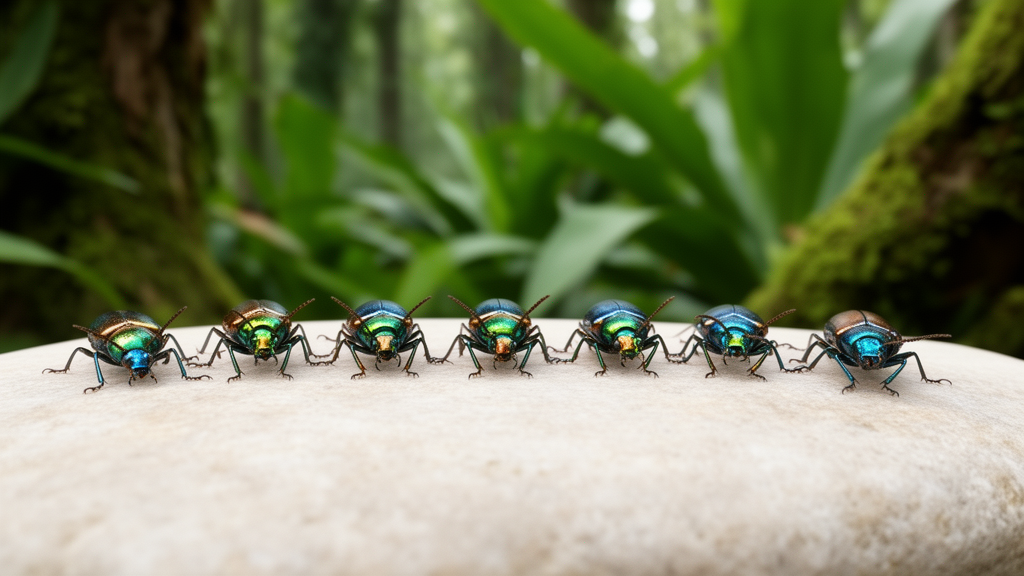
Deep in the mountain forests of Myanmar, a team of entomologists has identified seven previously unknown species of small scarab beetles, offering a rare glimpse into one of Asia’s least explored insect faunas. The discovery, published in the Deutsche Entomologische Zeitschrift, adds new members to the Sericini, a tribe of leaf-chafing scarab beetles known for their fuzzy bodies and intricate male genitalia. The new species belong to four genera: Lasioserica, Amiserica, Neoserica, and Gynaecoserica, each described with detailed images of their habitus and male genital structures. The findings also include new country records for several other species, expanding the known ranges of genera Serica, Lasioserica, Amiserica, and Gynaecoserica within Myanmar.
The research stems from a remarkable long-term effort by Harald Schillhammer, retired beetle curator of the Natural History Museum Vienna, who began surveying Myanmar’s beetle diversity in 1998 after participating in a Smithsonian-led arthropod training and inventory course. Over two decades, between 1998 and 2018, Schillhammer carried out 17 expeditions across various protected areas, some of which remain difficult or impossible for ordinary tourists to reach. Working partly in cooperation with the Nature and Wildlife Conservation Division of the Myanmar Forest Department and later with a travel agency supporting conservation projects, he assembled a collection that has now yielded these seven new taxa. The material was studied at the invitation of Matthias Seidel, curator of the beetle collection at the Natural History Museum Vienna.
Myanmar stands out as one of the most undersampled regions in South-East continental Asia for Sericini beetles, despite historical samples studied in part by Brenske in 1899, Moser in 1915 and 1920, and Arrow in 1946. Those early works were the only comprehensive taxonomic treatments of Myanmar’s Sericini fauna. Compared with other Indochinese countries, very few collectors were able to operate in Myanmar during the past century, leaving vast gaps in knowledge. The new study, led by researchers including the senior author who has extensively revised these genera across the region, provides an update to previous taxonomic revisions based on the newly available material.
Among the new species, Lasioserica kanpetlet sp. nov. was collected in Chin State’s Natmataung National Park near Kanpetlet at approximately 1,700 meters elevation. The species displays an intermediate morphology between Serica, Neoserica, and Lasioserica, with four lamellae in the male antennal club distinguishing it from Serica, which has three. Its apically flattened phallobase resembles species of Serica, while the serrated metatibia is shared with Neoserica and Lasioserica, a character the authors note is quite homoplastic. The serrated anterior margin of the metafemur, however, is present only in Lasioserica. The holotype measures 5.5 millimeters in body length with a brown dorsal surface densely covered in fine yellow setae and a few larger white scale-like setae on the elytra.
Amiserica curvifemorata sp. nov., also from Natmataung National Park, is named for its strongly curved meso- and metafemora, derived from the Latin words curvus and femoratus. The species is very similar to A. flavolucida and A. similissima but differs by longer and narrower legs, larger eyes, a longer antennal club, and the shape of the aedeagus, whose parameres are sharply pointed at the apex and evenly curved in dorsal view. The holotype is light brown with yellowish elytra bearing numerous irregular dark spots. A female paratype shows slightly smaller eyes and a shorter antennal club composed of three lamellae, as long as the remaining antennomeres combined.
Amiserica mogok sp. nov. was collected on Mt. Loisau above Shwe Thar Yar village in Shan State at 1,280 meters, using a canopy trap. It is very similar to A. nokrekensis and A. hunliana but differs by more pronounced paired ventral lobes of the phallobase, separated from the basal portion by a distinct sinuation, and by narrower parameres with more sharply extended apices. The body is dark brown with numerous irregular yellow spots on the pronotum and elytra, and the species measures 5.6 millimeters in length.
Neoserica schillhammeri sp. nov., named after its collector Harald Schillhammer, is the largest of the new species at 13.1 millimeters in body length. It was collected on the west slope of Taung Mae near Panlin village in Mogok Township at approximately 1,870 meters, again using a canopy trap. Externally similar to N. allolaotica, it differs in the general shape of the male genitalia: the dorsal lobe of the left paramere is reduced to a robust convexity, much shorter than the ventral lobe, while the right paramere is long and narrow with a longer basal lobe that is bent distally, tubular, and sharply pointed toward the apex. The species has small eyes with a diameter-to-interocular-width ratio of 0.55 and a six-antennomere antennal club.
Neoserica minshia sp. nov. was collected at Danashan at 2,800 meters, though the authors note the type locality could not be precisely localized. It is rather similar in aedeagus shape to N. myanmarensis but differs by a shorter and straight ventral process of the phallobase, convexly rounded rather than sharply pointed at the apex, and by a left paramere that is apically more enlarged with a deeply emarginate distal margin. Both species differ from other taxa of the N. vulpes group by dense erect dorsal pilosity. The body is dark brown with a yellow ventral surface and antenna, measuring 8.8 millimeters in length.
Gynaecoserica loisau sp. nov. and G. shwetharyar sp. nov., both from Mt. Loisau in Shan State, are among the smallest of the new species at 4.6 and 4.5 millimeters respectively. G. loisau differs from G. feresimplex by larger eyes, a slightly longer antennal club, and aedeagus shape, with distinctly wider parameres and a longer, straight, sharply pointed left apical process of the phallobase. G. shwetharyar differs from the externally very similar G. compacta by the shape of the aedeagus, with the phallobase slightly more widened on the left side, a dorsoventrally flattened right apical apophysis, and parameres that are slightly shorter and slightly curved externally rather than bluntly widened mesally. Both species were collected using canopy traps, and G. shwetharyar is known from a male holotype and a female paratype.
Beyond the seven new species, the study reports significant new records for Myanmar’s Sericini fauna. Amiserica michaeli, Lasioserica meghalayana, Lasioserica victoriana, Serica lepidula, Serica chinhillensis, and Gynaecoserica jelineki were all newly documented from Myanmar or nearby regions. Notably, Lasioserica victoriana was previously known only from its type locality on Mt. Victoria in the Chin Hills from a single specimen collected in 1938, making the new records from Natmataung National Park particularly valuable. Gynaecoserica ottoi was recorded from Laos with 26 males and 18 females from Attapu and a single male from Khammouan province, expanding its known distribution. The distribution data are made available on GBIF under the project New Sericini from Myanmar, and the study underscores how much remains to be discovered in one of Asia’s least surveyed beetle faunas.
Subject of Research: Taxonomy and biogeography of Sericini scarab beetles in Myanmar
Article Title: New Sericini from Myanmar ( Coleoptera , Scarabaeidae , Sericinae )
Article References: Botjes, L., & Ahrens, D. (2026). New Sericini from Myanmar (Coleoptera, Scarabaeidae, Sericinae). Deutsche Entomologische Zeitschrift, 73(1), 115-128. https://doi.org/10.3897/dez.73.186799
Image Credits: AI Generated
Keywords: Sericini, Scarabaeidae, Myanmar, new species, taxonomy, entomology, Coleoptera, Sericinae, scientific research
Cite Scienmag News
Margaret Porter. (October 17, 2026). Seven New Beetle Species Unveiled from Myanmar’s Hidden Forests. Scienmag. https://scienmag.com/seven-new-beetle-species-unveiled-from-myanmars-hidden-forests/
Margaret Porter. "Seven New Beetle Species Unveiled from Myanmar’s Hidden Forests." Scienmag, 17 October 2026, https://scienmag.com/seven-new-beetle-species-unveiled-from-myanmars-hidden-forests/. Accessed 17 October 2026.
Margaret Porter. "Seven New Beetle Species Unveiled from Myanmar’s Hidden Forests." Scienmag. October 17, 2026. https://scienmag.com/seven-new-beetle-species-unveiled-from-myanmars-hidden-forests/


