


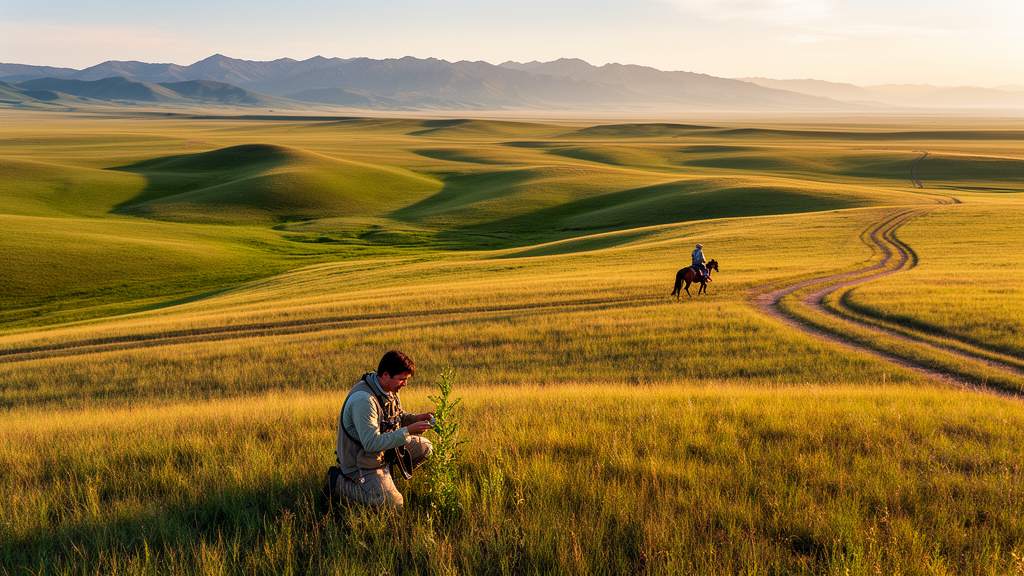
Asia’s grasslands are among the most extensive and ecologically significant ecosystems on Earth, stretching from the world’s largest continuous steppes in Mongolia and China to alpine meadows in the Himalayas, tropical savannas in Southeast Asia, and thorn-cushion grasslands in the mountains of the Middle East. Yet a new editorial in the journal Vegetation Classification and Survey reveals a startling truth: despite their vast ecological, climatic, and cultural importance, these grasslands remain dramatically underrepresented in global vegetation classification efforts. The editorial, which introduces the Special Collection “Grasslands of Asia,” exposes critical gaps in how the continent’s grassland ecosystems are documented, classified, and ultimately protected.
The numbers tell a sobering story. According to the editorial’s synthesis of current data across 48 Asian countries, only two countries have established comprehensive phytosociological classification systems for their grasslands, and just one has fully adopted the International Vegetation Classification (IVC)/EcoVeg approach. Twenty-five countries rely on partial classifications, ten employ only informal local plot-based methods, twenty-two depend on coarse non-plot-based systems, and eleven have no grassland typology whatsoever. This methodological fragmentation stands in stark contrast to the continent’s ecological significance—Asia hosts over 60% of the global human population, contributes nearly 40% of global carbon emissions, and contains ten of the world’s top 35 biodiversity hotspots.
Asia’s grasslands are extraordinarily diverse, shaped by the continent’s participation in all major biomes and three biogeographic realms. Natural grasslands include temperate steppes, arctic-alpine grasslands, and tropical savannas, while azonal types driven by edaphic conditions rather than climate—such as saline grasslands, coastal dunes, riparian meadows, and wet grasslands—are widespread across the continent. Semi-natural and anthropogenic grasslands, formed by grazing, mowing, burning, or agricultural abandonment, add further complexity. This ecological variability supports rich biodiversity, including numerous endemic species and glacial relicts, and provides critical ecosystem services such as carbon sequestration and soil stabilization. Acting as “green barriers” and “water towers,” these grasslands are indispensable for Asia’s ecological security.
Despite this importance, these ecosystems face escalating threats from multiple directions. Overgrazing, agricultural expansion, rapid land-use changes, and climate change impose both long-term and short-term pressures. Habitat fragmentation, open-pit mining, eutrophication, afforestation, and infrastructure development exacerbate biodiversity losses. Socio-political shifts—including rural depopulation leading to grassland abandonment and restrictions on traditional pastoral practices—further intensify these pressures. Without standardized classification frameworks, researchers and policymakers lack the typological foundation needed to integrate ecological data across scales, develop ecosystem-specific management strategies, and prioritize conservation actions effectively.
The editorial traces its origins to the inaugural Asian Grassland Conference in 2022, a virtual event organized by the Eurasian Dry Grassland Group (EDGG) with support from the International Association for Vegetation Science (IAVS). Delegates identified the urgent need for collaborative approaches to grassland ecology, vegetation, and conservation across the continent. As a byproduct of the conference, workshops were organized on vegetation typologies in Asia and on the foundation of an IAVS Regional Section in Asia. This regional section was established in 2022 to promote vegetation ecology activities across the continent, and the Special Collection “Grasslands of Asia” represents its first special feature in an international journal—a joint enterprise between the EDGG and the Asian Regional Section.
Although the call for contributions was open to all classification approaches from all parts of Asia, the Special Collection ultimately comprises only seven articles from just four countries in West and Middle Asia. Four regions of Asia—Central Asia, South Asia, North Asia, and Southeast Asia—are entirely unrepresented, and many countries within the two included regions are also missing. Nevertheless, these seven contributions significantly advance the understanding of grassland typologies in their respective regions, ranging from detailed phytosociological analyses based on vegetation plots to broader investigations of grassland ecology and floristics.
In West Asia, Vynokurov and colleagues delivered the first syntaxonomic, plot-based classification of Armenia’s dry grasslands and thorn-cushion communities, proposing a potential new vegetation class distinct from the Euro-Siberian Festuco-Brometea and Anatolian Astragalo-Brometea. Based on 111 vegetation plots sampled during the 13th EDGG Field Workshop and supplemented with 487 plots from surrounding countries, the study classified Armenian plots into 12 vegetation clusters, describing three new orders, four alliances, and six associations. With a mean vascular plant richness of 46.8 species per 10 square meters—well above the Palaearctic dry grassland average of 33.7—the study highlights the unique biodiversity of Armenian grasslands.
Talebi and colleagues presented a pioneering syntaxonomic classification of vegetation along the southern slopes of Mt. Damavand, the highest summit in the Middle East at 5,610 meters, covering a 3,000-meter elevational gradient. The researchers distinguished six orders, nine alliances, and 18 association-level communities, many newly described. Noroozi and colleagues investigated the Dena Mountains, the highest peaks in the Zagros range, finding 242 taxa endemic to the Iranian Plateau and describing two new associations from scree habitats. Yaselyani and colleagues focused on the plant diversity of subalpine and alpine zones in the Central Zagros, where almost 20% of 308 listed species are endemic to Iran. In Middle Asia, Nowak and colleagues proposed a new vegetation class for pistachio woodlands across Tajikistan and Iran, while Świerszcz and colleagues explored graminoid distributions across open vegetation types in Tajikistan and Kyrgyzstan and classified subalpine forb steppes in the Pamir-Alai Mountains, proposing yet another new vegetation class.
The editorial identifies several barriers behind Asia’s classification gaps, including the continent’s immense geographic, ecological, and cultural diversity, alongside socio-political and economic challenges such as uneven research capacities, economic disparities, geopolitical tensions, language barriers, and restrictive visa policies. In regions like South and Southeast Asia, studies often remain fragmented and dominated by agricultural or forestry perspectives rather than typological classification. In North Asia, notable progress has been made through Russia’s national vegetation classification programme, with a three-volume prodromus documenting at least 250 grassland associations scheduled for publication beginning in 2025. In China, the China Vegetation Classification System represents a hierarchical framework integrating physiognomy, floristic composition, ecological attributes, and dynamic processes, though formal nomenclature remains descriptively presented rather than standardized.
Moving forward, the editorial calls for coordinated efforts at local, regional, and continental scales to develop a unified, continent-wide vegetation classification framework. Successful regional prototypes such as the Vegetation of Middle Asia database—encompassing over 5,800 relevés—and the Vegetation Database of Iran demonstrate how systematic data collection can serve as a foundation for comprehensive resources. Experiences from other continents, including Europe’s European Vegetation Archive, North America’s VegBank, and Australia’s TERN-AEKOS archive, show the substantial benefits of collaborative databases. The Asian Regional Section of the IAVS, with 117 members from 29 countries including 17 Asian nations, is uniquely positioned to facilitate this transition through workshops, field studies, and conferences. Strengthening vegetation classification frameworks and regional databases will bridge existing methodological gaps and provide critical support for conservation planning, sustainable management, and biodiversity research across Asia’s grassland ecosystems.
Subject of Research: Ecology
Article Title: Advancing vegetation classification of grassland ecosystems across Asia: current status and way forward
Article References: Naqinezhad, A., Biurrun, I., Chepinoga, V., Dengler, J., & Nowak, A. (2025). Advancing vegetation classification of grassland ecosystems across Asia: current status and way forward. Vegetation Classification and Survey, 6, 79-97. https://doi.org/10.3897/vcs.151773
Image Credits: AI Generated
DOI: 10.3897/VCS.151773
Keywords: grasslands, vegetation classification, biodiversity, Asia, conservation, phytosociology, Advancing, vegetation, classification, grassland, ecosystems, across
Cite Scienmag News
Margaret Porter. (October 17, 2026). Asia’s Grasslands Get a Classification Wake-Up Call. Scienmag. https://scienmag.com/asias-grasslands-get-a-classification-wake-up-call/
Margaret Porter. "Asia’s Grasslands Get a Classification Wake-Up Call." Scienmag, 17 October 2026, https://scienmag.com/asias-grasslands-get-a-classification-wake-up-call/. Accessed 17 October 2026.
Margaret Porter. "Asia’s Grasslands Get a Classification Wake-Up Call." Scienmag. October 17, 2026. https://scienmag.com/asias-grasslands-get-a-classification-wake-up-call/


