


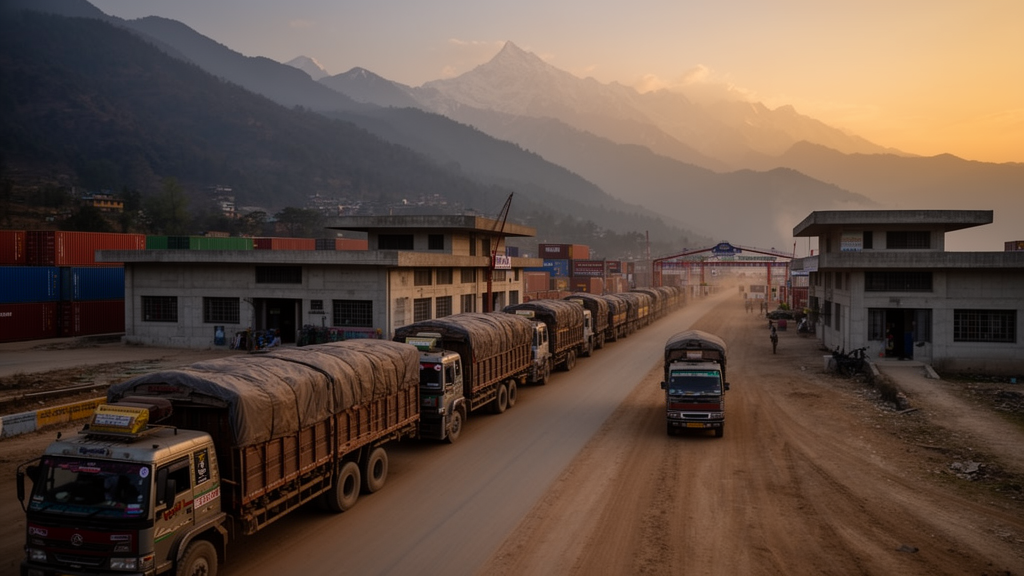
Nepal is buying roughly ten times more from the world than it sells back to it, and a new comprehensive review argues that this imbalance is quietly reshaping nearly every dimension of the country’s economic life, from the size of its national income to the price of cooking fuel in Kathmandu’s markets. The review, published in the journal Innovations in Agriculture, assembles two decades of trade statistics to show how a landlocked Himalayan economy of about thirty million people has become structurally dependent on imports of diesel, machinery, metals, and consumer goods, while its export portfolio remains narrow, volatile, and concentrated on a handful of agricultural commodities and manufactured items. The numbers are stark: in the fiscal year 2022/23, Nepal exported commodities worth 157.14 billion Nepalese rupees, roughly 1.18 billion US dollars, while importing goods worth 1611.73 billion rupees, about 12.08 billion dollars, producing an import-to-export ratio of 10.26. A year later, the picture had barely improved, with imports accounting for 91.2 percent of total trade and exports just 8.8 percent, according to figures from Nepal Rastra Bank.
The review traces how Nepal arrived at this position. Until 1951, the country’s international trade was confined almost entirely to Tibet and India. After opening to the world, Nepal built trade relationships with Japan, the United States, Germany, Malaysia, Singapore, Thailand, Kuwait, France, Bangladesh, and Spain, and joined the World Trade Organization as well as becoming a founding member of the South Asian Free Trade Agreement. Yet membership in trade blocs, the review notes, has not translated into a business environment that encourages producers and exporters to exploit the opportunities those agreements provide. Trade’s contribution to Nepal’s GDP reached 49.4 percent by 2022, a remarkable figure for a small economy, but one dominated by the import side of the ledger. India remains Nepal’s largest trading partner, followed by China, and together the top eleven partners accounted for approximately 90 percent of total foreign trade in the fiscal year 2022/23.
The export trend over the past decade reveals both a peak and a warning. Export value climbed from 91.36 billion rupees in the fiscal year 2013/14 to a high of 200.03 billion rupees in 2021/22, before falling sharply to 157.14 billion rupees in 2022/23. The composition of those exports is telling. Refined palm oil, the top export in 2022/23, saw its share of total exports decline from 20.53 percent to 13.05 percent, while refined soybean oil collapsed from 24.06 percent to just 5.39 percent, a dramatic drop that removed two of Nepal’s largest export earners in a single year. Synthetic yarn rose to 7.77 percent of exports, woolen carpets climbed to 7.32 percent, large cardamom, a high-priority agricultural commodity in both the Nepal Trade Integration Strategy 2023 and the Trade Policy 2015, secured fifth position at 5.27 percent, and readymade garments, iron sheets, fruit juice, jute fabric, and woven cloth rounded out the top ten. The review emphasizes that this concentration on a few products makes Nepal’s export earnings acutely vulnerable to global demand and price fluctuations.
Imports tell the mirror story. Import value rose from 722.77 billion rupees in the fiscal year 2013/14 to a peak of 1920.45 billion rupees in 2021/22, then eased to 1611.73 billion rupees in 2022/23 as the country tightened its external accounts. Diesel remained the single most imported item, with an import share of 9.54 percent in 2022/23, up from 8.76 percent the previous year, underscoring how deeply Nepal’s transport and energy systems depend on imported fossil fuel. Crude palm oil, by contrast, fell to tenth place with a share of 1.61 percent. The heavy import bill for fuel, metals, and crude oil products, the review argues, reflects structural limitations of the domestic economy: Nepal simply lacks the production capacity to meet its own needs for capital goods, energy, and increasingly, consumer electronics and vehicles.
The trading partner data for the fiscal year 2022/23 show a broad downturn across nearly all of Nepal’s major partners. Total trade with the top eleven countries fell 17.0 percent, from 1917.8 billion rupees to 1591.5 billion rupees, and overall trade declined 16.6 percent. Trade with India, the dominant partner, dropped 16.3 percent to 1134.5 billion rupees; trade with China fell 15.4 percent to 231.5 billion rupees. The steepest declines came from further afield: the United States saw a 42.7 percent drop, Argentina 37.3 percent, the United Arab Emirates 31.2 percent, and Australia 21.2 percent. Only Malaysia, up 32.6 percent, and Qatar, which recorded an extraordinary 300 percent increase from 3.4 billion to 13.4 billion rupees, bucked the trend, suggesting to the review’s authors that new relationships in the Gulf and Southeast Asia could offer room for expansion even as traditional partners contract.
Why does the deficit persist? The review identifies a cluster of interlocking causes, beginning with geography. Nepal is landlocked between China to the north and India to the south, east, and west, and has no direct access to seaports. Goods must transit through neighboring countries, incurring extra tariffs, fees, and extended transport times that make Nepalese exports less competitive and imports more expensive, while perishable goods face heightened degradation risk. Layered on top of this are limited export diversification, heavy dependency on imports of petroleum, machinery, vehicles, and electronics, and chronically inadequate infrastructure: underdeveloped road, rail, and air networks, mountainous terrain that complicates construction and maintenance, frequent landslide disruptions, and a lack of adequate storage and warehousing that leads to high spoilage of agricultural exports. Insufficient promotion and advertisement compounds the problem. Products of genuine global distinction, such as pashmina shawls, handicrafts, and organic tea, fail to gain international recognition because many Nepalese businesses lack the expertise and resources to use digital marketing tools, search engine optimization, and e-commerce platforms, and Nepalese products often lack the strong brand identities needed to compete against well-branded international rivals.
Political instability and uncertainty form another pillar of the deficit. Frequent changes in government have produced shifts in trade and economic policies that make long-term planning difficult, while bureaucratic inefficiency and corruption complicate trade processes, causing delays and increased costs. Instability deters the foreign direct investment needed to build export-oriented industries, and social unrest and strikes disrupt production, damaging the reliability and reputation of Nepalese suppliers. Low productivity and lack of competitiveness further undermine export capacity: many industries rely on outdated, traditional production methods, suffer inconsistent supplies of quality raw materials, and employ workforces whose skills are mismatched to industry needs, driven by inadequate infrastructure and energy shortages that inflate production costs. Remittances, which have become a primary source of national income often exceeding export revenues, enhance purchasing power and drive consumption of both essential and luxury goods such as jewelry, cars, and electronics, pushing imports higher while creating a dependency that prioritizes immediate consumption over long-term investment. Exchange rate volatility adds the final layer of fragility, as a depreciating rupee raises import costs, complicates exporters’ pricing strategies, and deters the foreign investment that seeks currency stability.
The macroeconomic consequences flow directly from Keynesian national income accounting, in which national income equals government expenditure plus consumption plus investment plus the trade balance, exports minus imports. When imports consistently exceed exports, the resulting currency outflow reduces GDP growth, stifles domestic industries that cannot compete with cheaper foreign goods, and forces increased borrowing and reliance on foreign aid to finance the gap, diverting funds from domestic development toward debt service. The review documents how inflationary pressure builds as currency depreciation raises the cost of imported commodities, spilling over into domestically produced goods whose inputs are imported, with sectors reliant on fuel and machinery particularly exposed. Employment suffers through displacement of indigenous industry: as consumers choose less expensive imported items, domestic firms shed jobs, and demand falls in supporting sectors such as manufacturing, transportation, and logistics. Persistent deficits also restrict the government’s ability to invest in infrastructure, education, and healthcare, eroding social welfare and quality of life.
The proposed solutions center on export diversification as the critical strategy. The review calls for developing high-potential sectors such as tourism, information technology, hydropower, and organic farming; improving the quality and value addition of exported goods, for instance by processing agricultural products into higher-value items; expanding market access through proactive trade diplomacy and new agreements beyond traditional partners; and supporting small and medium enterprises with access to finance, technical assistance, and market information. Substantial investments in transportation networks, energy infrastructure, and telecommunications would reduce production and logistics costs, while education and training programs aligned with export-oriented industries would enhance productivity. Promoting a national brand emphasizing quality, sustainability, and cultural uniqueness, and leveraging digital marketing platforms, could attract international buyers, and compliance with international quality standards would smooth access to foreign markets. Sound monetary policies and a stable economic environment are deemed crucial for mitigating exchange rate volatility and inflation, while political stability and a conducive business environment are prerequisites for long-term growth. The review concludes that effective utilization of remittances through productive investments, rather than consumption, and reduced dependency on external aid are pivotal for sustainable development, and that through coordinated efforts across sectors Nepal can work toward reducing its trade deficit, enhancing economic stability, and achieving sustainable growth.
Subject of Research: Agricultural trade deficit and its impact on Nepalese economy: A comprehensive review
Article Title: Agricultural trade deficit and its impact on Nepalese economy: A comprehensive review
Article References: Adhikari, A., Ghimire, S., & Khatiwada, P. (2024). Agricultural trade deficit and its impact on Nepalese economy: A comprehensive review. Innovations in Agriculture, 7, 1-11. https://doi.org/10.3897/ia.2024.132033
Image Credits: AI Generated
Keywords: Agricultural, trade, deficit, impact, Nepalese, economy, comprehensive, review, scientific research
Cite Scienmag News
Alan Morgan. (October 17, 2026). Nepal’s imports dwarf exports tenfold, review finds economy at risk. Scienmag. https://scienmag.com/nepals-imports-dwarf-exports-tenfold-review-finds-economy-at-risk/
Alan Morgan. "Nepal’s imports dwarf exports tenfold, review finds economy at risk." Scienmag, 17 October 2026, https://scienmag.com/nepals-imports-dwarf-exports-tenfold-review-finds-economy-at-risk/. Accessed 17 October 2026.
Alan Morgan. "Nepal’s imports dwarf exports tenfold, review finds economy at risk." Scienmag. October 17, 2026. https://scienmag.com/nepals-imports-dwarf-exports-tenfold-review-finds-economy-at-risk/


