


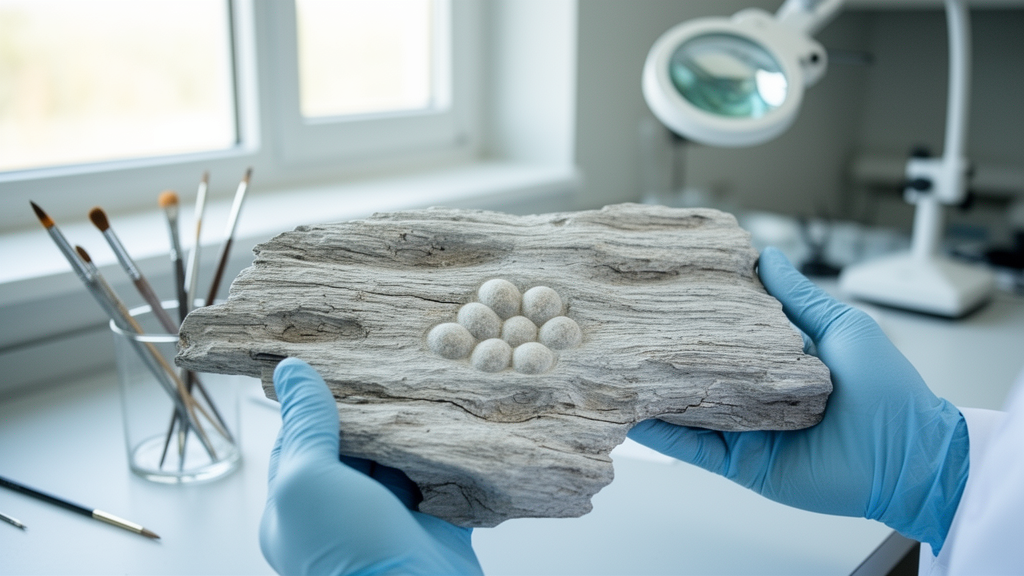
A small piece of fossilized driftwood from a clay pit in Franconia, Germany, has yielded one of the most puzzling invertebrate egg clusters ever recovered from the Jurassic. The specimen, described in the journal Zitteliana, comes from the Late Pliensbachian Amaltheenton Formation exposed south of Buttenheim, roughly eight kilometers southeast of Bamberg. Enclosed within the wood is a crescent-shaped patch of densely packed, pyritized egg capsules arranged in a striking honeycomb-like pattern. The regular geometry, the small size of the individual capsules, and their position inside a narrow slit of woody matter set this find apart from every other egg cluster known from the same marine deposits, prompting the researchers to suggest an unexpected origin: the eggs may have been laid on land by an unknown insect before the driftwood floated out to sea.
The Buttenheim clay pit, operated by the LIAPOR Company Altendorf, exposes about 35 meters of dark clay belonging to the Amaltheenton Formation, overlain by the Posidonia Shale of Toarcian age. The section is punctuated by four thin reworking horizons that record brief phases of high water energy during sea level low stands, when currents winnowed fine grains and enriched reworked calcareous concretions. Between these horizons, condensed fossil-rich intervals formed during sea level highs, when reduced sedimentation rates and faunal immigration from the Tethyan Ocean in the south produced mass occurrences of ammonites. The stratigraphy is anchored by ammonite zones: the boundary between the Gibbosus subzone of the Margaritatus zone and the Apyrenum subzone of the Spinatum zone is marked by a pyrite-bed containing large specimens of Amaltheus margaritatus, while the Bollernbank at the top of the Pliensbachian represents a sedimentary gap of about 150,000 years.
It is within these marine clays that several clusters of circular fossil egg capsules have been found over the years, scattered irregularly across various substrates including calcareous nodules, mollusk shells, ammonite shells, and sunken driftwood. Marine gastropods have been presumed as the producers, spawning their eggs directly on the seafloor. The fossil record of such non-vertebrate eggs spans nearly all geological ages, from Ediacaran structures interpreted as resting zygotes within egg cases, through Cambrian eggs containing identifiable embryos of metazoans, to the phosphatized Cambrian embryo Markuelia, interpreted as a stem-priapulid worm. Rare fossils even show eggs in combination with their putative producers, as demonstrated for the bradoriid arthropod Kunmingella from the Lower Cambrian, and some fossilized egg layers indicate parental brood care, such as Silurian ostracods and Carboniferous spinicaudatan and syncarid crustaceans.
The first report of pyritized presumed molluscan spawn from Buttenheim described loosely arranged clusters of about 40 flattened egg capsules attached to the surface of a calcareous nodule measuring 75 by 32 millimeters, occupying an area of roughly 300 square millimeters. The researchers discussed the gastropod Hayamia reticulata, found in the same outcrop, as a possible originator, drawing comparisons with similar Lower Jurassic finds from Poland and Early Cretaceous material from Daghestan, as well as with modern spawns of neritimorph gastropods. A second specimen figured more than 100 irregularly arranged circular egg capsules of about one millimeter in diameter fixed at the navel of a large ammonite shell of Pseudamaltheus engelhardti, covering about 900 square millimeters. Further finds included a couple of nine three-dimensionally preserved pyritized egg capsules on the shell of the ammonite Pleuroceras spinatum, their slightly wrinkled surfaces indicating taphonomic shrinkage, and a belemnite phragmocone of Passaloteuthis bearing imprints of a cluster of circular egg capsules along a 35-millimeter-long stripe.
Hitherto unpublished specimens add to this inventory. One pyritized, 88-millimeter-long piece of driftwood carries about 16 scattered circular egg capsules of roughly 0.9 millimeters in diameter, partly shrunk and partly hemispherical with smooth surfaces, each bearing a small central pore of about 0.25 millimeters in breadth. Another cluster of pyritized egg capsules, about 0.5 millimeters in diameter, was found attached to the inside of a tiny, three-millimeter-long pectinid bivalve fragment among sieve residues of micropaleontological samples. A third specimen, from a small creek near Bayreuth, revealed adhesive rings of scattered egg capsules of only 0.36 millimeters in diameter inside a Pleuroceras body chamber. Taken together, the dimensions of presumed gastropod egg capsules from Late Pliensbachian marine sediments range between 0.35 and 1.5 millimeters. Their shape is primarily hemispherical, with or without a visible central pore, and they are always arranged scatteredly, touching each other only occasionally and never forming regular geometrical patterns.
The new driftwood specimen breaks this mold in three decisive ways. The about 80 by 30 millimeter wood fragment is preserved partly as black, glittering jet coal and partly pyritized, exhibiting excellent cellular structures. Enclosed within the wood is a crescent-shaped area of 8 by 2.5 millimeters containing a cluster of densely, nearly seamlessly packed pyritized egg capsules of 0.4 to 0.5 millimeters in diameter. The reniform to polygonal capsules lie with their basal sides upward, tracing the fibrous wood structure. At one end of the spawn area, 13 capsules are broken out, and their molds reveal smooth convex upper sides, each bearing a circular central opening of 90 micrometers in width. The fine wood fibers preserved on the bases of the eggs prove that they were laid on a flat wood surface, probably within a torn deadwood break, in a process comparable to bioimmuration, whereby the original substrate is cast in the fossilizing material.
The position of the egg cluster seemingly enclosed within the wood posed a taphonomic puzzle. The wood surface and the attached egg cluster are covered by a thin massive pyrite layer bridging a distance of one to 1.5 millimeters to the next layer of woody matter. The researchers interpret this as evidence that the break was probably wider during egg-laying and was afterward reduced by taphonomic processes, meaning the upper side of the spawn did not originally have direct contact with wood material, as shown by its smooth surfaces lacking any casted wood structure. Deposition of the egg capsules on the driftwood could have happened on land, during marine drifting, or after the wood sank to the seafloor. Oviposition within a small deadwood break by marine gastropods would be very unusual, because all hitherto known egg clusters of this kind were laid on open surfaces such as mollusk shells, or in larger cavities such as ammonite body chambers.
The regular honeycomb-like pattern of the cluster points toward a different class of producers. Regular patterns of epiphytic oviposition are well known and widely distributed among fossil and modern insects, particularly roaches and many butterflies. Roaches, order Blattodea, are among the oldest insect orders, known since the Carboniferous, while the radiation of Lepidoptera began during the Late Triassic. The oldest exophytic oviposition of insect eggs on plants was described from Carboniferous Cordaites leaves, where individual circular eggs of nearly half a millimeter in diameter, between 388 and 482 micrometers, formed curved arcs of net-like, densely packed clusters, attributed to insects with short abdomens and ovipositors such as roaches. Some extant Lepidopterans produce monolayered, crescent-sized egg clusters similar in egg size and cluster shape to the Buttenheim fossil, for example the fall armyworm Spodoptera frugiperda. By contrast, egg depositions of pulmonate gastropods, including landsnails known to lay eggs in deadwood, always form irregular bunches and never show geometrically arranged clusters.
The researchers cannot completely exclude marine or terrestrial gastropods as possible producers of the fossil. However, owing to the corresponding dimensions and similar arrangement patterns with Carboniferous blattoidean insect eggs, as well as the deposition within a small deadwood break, they presume rather a terrestrial origin by unknown insects than a marine deposition by gastropods. If correct, the specimen would represent a rare example of allochthonous insect spawn, drifted roughly 70 kilometers from the contemporaneous coastal region into the marine basin before burial. Fossil driftwoods are often responsible for such allochthonous depositions, as organisms settling on their surfaces create taphocoenoses mixing elements from heterogeneous environments. The producer of the honeycomb-like egg cluster thus remains enigmatic, but the find underscores how driftwood can carry terrestrial life records far out to sea, preserving snapshots of ancient coastal ecosystems within marine sediments.
Subject of Research: A possible terrestrial egg cluster in driftwood from the Lower Jurassic (Late Pliensbachian) of Buttenheim (Franconia, Germany)
Article Title: A possible terrestrial egg cluster in driftwood from the Lower Jurassic (Late Pliensbachian) of Buttenheim (Franconia, Germany)
Article References: Scharfenberg, F.-J., Keupp, H., & Schobert, J. (2022). A possible terrestrial egg cluster in driftwood from the Lower Jurassic (Late Pliensbachian) of Buttenheim (Franconia, Germany). Zitteliana, 96, 135-143. https://doi.org/10.3897/zitteliana.96.84493
Image Credits: AI Generated
DOI: 10.3897/zitteliana.96.84493
Keywords: possible, terrestrial, cluster, driftwood, Lower, Jurassic, Late, Pliensbachian, Buttenheim, Franconia, Germany, scientific research
Cite Scienmag News
Gavin Prescott. (October 17, 2026). Jurassic Driftwood Yields Rare Fossilized Egg Cluster Possibly Laid by Ancient Insects. Scienmag. https://scienmag.com/jurassic-driftwood-yields-rare-fossilized-egg-cluster-possibly-laid-by-ancient-insects/
Gavin Prescott. "Jurassic Driftwood Yields Rare Fossilized Egg Cluster Possibly Laid by Ancient Insects." Scienmag, 17 October 2026, https://scienmag.com/jurassic-driftwood-yields-rare-fossilized-egg-cluster-possibly-laid-by-ancient-insects/. Accessed 17 October 2026.
Gavin Prescott. "Jurassic Driftwood Yields Rare Fossilized Egg Cluster Possibly Laid by Ancient Insects." Scienmag. October 17, 2026. https://scienmag.com/jurassic-driftwood-yields-rare-fossilized-egg-cluster-possibly-laid-by-ancient-insects/


