


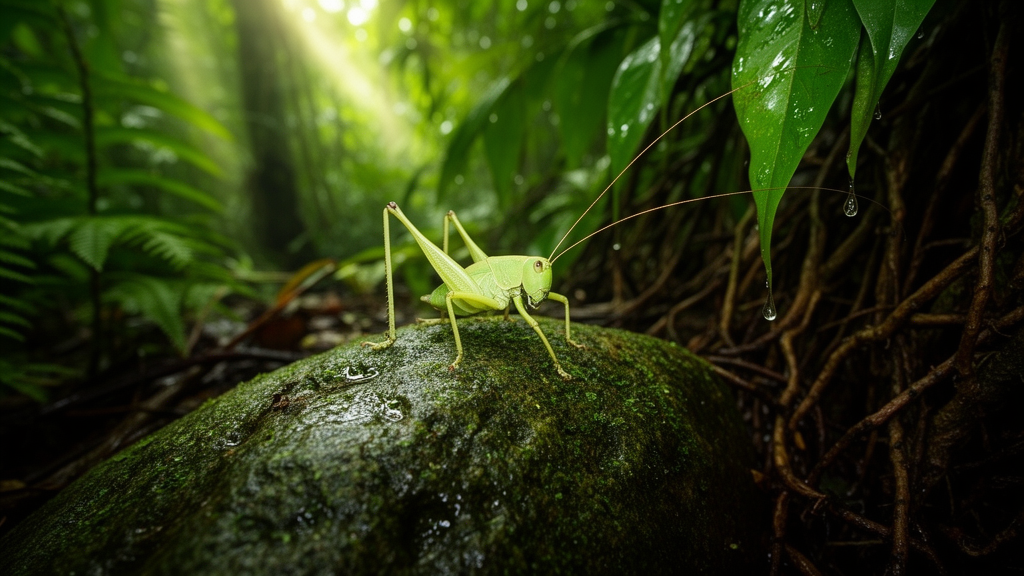
Deep in the eastern reaches of Johor state, Peninsular Malaysia, a forest reserve gazetted nearly a century ago has just yielded one of the most surprising biodiversity hauls in recent memory. A scientific expedition to Gunung Arong Forest Reserve in Mersing district has documented 62 taxa of Orthoptera—the order encompassing grasshoppers, crickets, and katydids—representing 12 families. The survey, published in the Journal of Orthoptera Research, provides the first published checklist of these jumping insects from the reserve and dramatically reshapes what scientists know about insect distributions across the southern Malay Peninsula.
What makes the findings truly viral-worthy is the revelation that several species long thought to be endemic to Singapore—found nowhere else on Earth—are alive and well in Johor’s forests. These include the monotypic genus Singapuriola, the scaly cricket Ectatoderus angusticollis, the cricket Ornebius xinyao, and the katydid Cesasundana lorniensis. Likewise, two species only recently discovered and named from Panti Forest Reserve—Odontogryllodes undatus and Parendacustes aduncus—were also found at Gunung Arong, proving that these creatures are far more widespread than anyone imagined.
Gunung Arong Forest Reserve is no ordinary patch of jungle. Gazetted in 1926 as a 20,000-hectare permanent forest reserve, it contains five distinct forest strata: lowland dipterocarp forest, mangrove forest, peat swamp forest, freshwater swamp forest, and Sundaland heath (Kerangas) forest. Despite nearly a century of protection, studies on invertebrates there have been few—limited mostly to butterflies and dragonflies. No published record of Orthoptera existed until now, making the reserve a veritable blank spot on the entomological map of Peninsular Malaysia.
The research team conducted opportunistic surveys along 11 selected trails during two expeditions: one from September 17 to 21, 2024, and another from April 10 to 15, 2025. Collecting occurred in the morning, afternoon, and night, spanning habitats from beachside grassy patches to freshwater swamp trails. Specimens were preserved in absolute analytical-grade ethanol and later pinned and dry-preserved, with male genitalia dissected and cleaned using aqueous potassium hydroxide for detailed morphological examination. All material is deposited at the Museum of Zoology, Universiti Malaya, and the Zoological Reference Collection at the Lee Kong Chian Natural History Museum in Singapore.
For the suborder Caelifera—the true grasshoppers—the team collected 23 taxa from 3 families and 10 subfamilies. The most speciose family was Acrididae with 12 taxa, followed by Tetrigidae with 10 and Pyrgomorphidae with one. For the suborder Ensifera—the crickets and katydids—the haul was even richer: 39 taxa from 9 families and 20 subfamilies, led by Tettigoniidae with 12 taxa, Gryllidae with 10, Mogoplistidae with five, and Oecanthidae with four. Several species represent first published records for Johor state and even for Peninsular Malaysia as a whole, including the slender Acrida willemsei, the pygmy grasshopper Criotettix saginatus, and the large field cricket Teleogryllus derelictus, previously known only from its type locality in Vietnam.
The team went beyond morphology, deploying bioacoustic recording to capture the calling songs of male crickets and katydids in captivity. Using a Wildlife Acoustics Song Meter Mini acoustic recorder, signals were saved in 12-bit WAV format and analyzed with Raven Lite and the R package warbleR. For Ornebius xinyao, the calling song was described for the first time: at 29.7°C, it consists of echemes made up of 21±4 isolated syllables with an average duration of 1.99±0.46 seconds, a peak frequency of 7.66±0.17 kHz, and a second harmonic at 15.20±0.34 kHz. For Singapuriola separata, males produce continuous trills with an average syllable duration of 8.9±0.2 milliseconds and a fundamental frequency of 5.26±0.03 kHz—remarkably similar to recordings from Singapore populations.
The taxonomic detective work involved careful comparison with published keys spanning nearly 140 years of literature, from Bolívar in 1887 to recent works by Gorochov, Ingrisch, and Tan. Male titillators and phallus structures were photographed using focus-stacking imaging systems and Leica stereomicroscopes to resolve minute diagnostic features. In some cases, the team had to refrain from assigning species status: pygmy grasshoppers of the genus Coptotettix are notoriously taxonomically problematic, and several ensiferan specimens—Agryllus or Acanthoplistus sp., Micrornebius sp., Xabea sp., and Rhaphidophorinae sp.—require broader generic-level revisions before reliable identification is possible.
Geographically, Gunung Arong sits between two better-studied localities: Tioman Island off the coast of Mersing to the east and Panti Forest Reserve roughly 100 kilometers to the south. The reserve shares species with both. Duolandrevus firmus tioman, Protrellius helverseni tioman, Lipotactes maculatus, and Carliphisis leontopolites link Gunung Arong to Tioman Island, while the first three are also found in Panti. Asiophlugis rete and Viriacca viridis are widespread across Peninsular Malaysia and appear in nearby localities as well. This connectivity highlights the dispersal abilities of orthopteran species between island and mainland forests, both comprised of lowland dipterocarp forest.
The ecological diversity of the reserve is reflected in the microhabitats where species were found. The mangrove-restricted cricket Eumarinemobius sundaicus dwells among aerial roots of mangrove trees on muddy or sandy banks. The diurnal cricket Lebinthus luae calls and mates in high density on coastal leaf litter. Ornebius rufonigrus, with its distinctive orange forewings, occupies coastal Kerangas forest near Tanjung Resang—its first record for Peninsular Malaysia. Valanga nigricornis, a large green-yellow grasshopper, was found solitarily foraging on a beachside tree. Even the rice grasshopper Oxya japonica japonica, known for using its laminated hind tibiae to navigate shallow paddy pools, turned up on forest foliage.
As more sampling is conducted across Johor state, scientists expect to better understand species distributions in this underexplored part of the Malay Peninsula and potentially discover more species new to science. The study underscores that a diverse ecosystem of multiple forest strata hides a plethora of orthopteran biodiversity, and that expanding surveys to other seasons is imperative to fully capture the species richness of Gunung Arong and the eastern region of Johor. For now, this once-quiet forest reserve has firmly announced itself as a critical hotspot for one of the planet’s most acoustically gifted insect orders.
Subject of Research: First checklist of Orthoptera from Gunung Arong Forest Reserve, Johor, Peninsular Malaysia, documenting 62 taxa across 12 families and revealing wider distributions of species previously thought endemic to Singapore
Article Title: Orthoptera from Gunung Arong Forest Reserve, Johor, Peninsular Malaysia
Article References: Muhammad, A. A., Tan, M. K., Azizan, I. A., & Abdullah, N. A. (2026). Orthoptera from Gunung Arong Forest Reserve, Johor, Peninsular Malaysia. Journal of Orthoptera Research, 35(1), 117-156. https://doi.org/10.3897/jor.35.159566
Image Credits: AI Generated
Keywords: Orthoptera, Gunung Arong Forest Reserve, Johor, Peninsular Malaysia, biodiversity, endemism, Gunung, Arong, Forest, Reserve, Peninsular, Malaysia
Cite Scienmag News
Margaret Porter. (October 17, 2026). Hidden Cricket Kingdom Discovered in Malaysian Rainforest Reserve. Scienmag. https://scienmag.com/hidden-cricket-kingdom-discovered-in-malaysian-rainforest-reserve/
Margaret Porter. "Hidden Cricket Kingdom Discovered in Malaysian Rainforest Reserve." Scienmag, 17 October 2026, https://scienmag.com/hidden-cricket-kingdom-discovered-in-malaysian-rainforest-reserve/. Accessed 17 October 2026.
Margaret Porter. "Hidden Cricket Kingdom Discovered in Malaysian Rainforest Reserve." Scienmag. October 17, 2026. https://scienmag.com/hidden-cricket-kingdom-discovered-in-malaysian-rainforest-reserve/


