


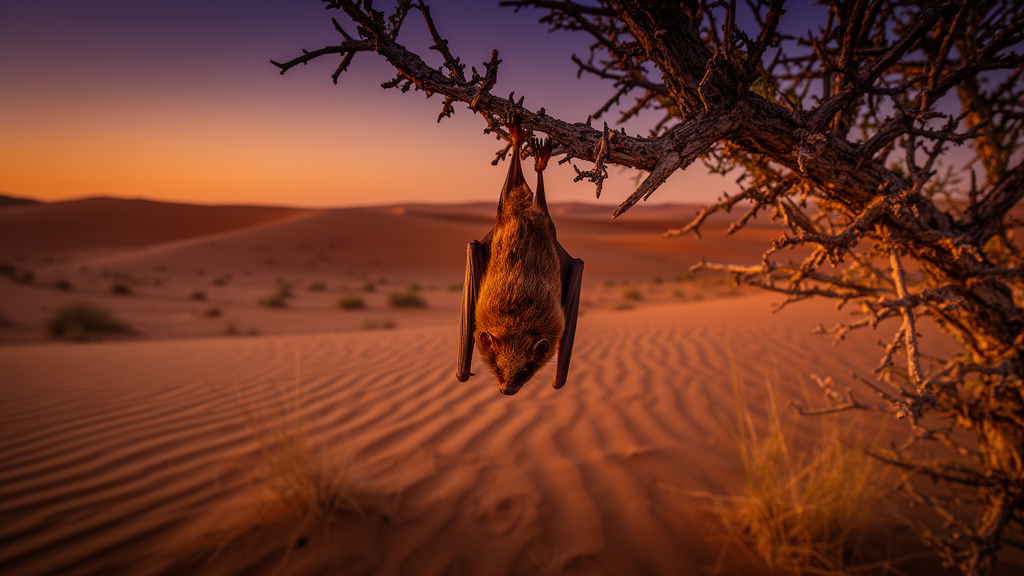
Deep in the Karakum Desert of northern Turkmenistan, on the shore of an artificial lake ringed by sand and scrub, researchers have caught a bat that should not be there. The animal, a subadult male Nathusius’ pipistrelle (Pipistrellus nathusii), was captured on 3 October 2025 shortly after sunset as it left a roost inside the wall of a small building at Altyn Köl, within the Shasenem State Nature Sanctuary. The find, published in Zoosystematics and Evolution, is the first record of this species anywhere in Central Asia, and it extends the known range of a famously long-distance migratory bat nearly 800 kilometres southeast of the closest known summer population along the Ural River in Kazakhstan. The date of capture falls squarely within the species’ autumn migration window, raising an intriguing question: was this animal a one-off vagrant blown far from its usual routes, or is it the first hint of an unknown migration corridor running east of the Caspian Sea?
Nathusius’ pipistrelle is a Western Palearctic faunal element with a nearly pan-European distribution, breeding from Ireland across most of the continent to the Ural River in Russia and Kazakhstan. It is one of the few European bats capable of true long-distance migration, covering up to 2,400 kilometres in a single direction. Migrating individuals routinely cross large water bodies, including the North Sea, the Baltic Sea and the Black Sea, and the species has even turned up as a rare vagrant on Atlantic islands as far as Iceland. Maternity colonies are concentrated in northern and eastern Europe, while migrating bats reach the Iberian Peninsula, Italy, Greece, Anatolia and several Mediterranean islands. Yet despite this well-documented western range, the eastern extent of the species’ distribution and its migration behaviour there have remained almost entirely unknown.
The discovery was made during a two-week bat research campaign in northern Turkmenistan in September and October 2025, part of an ongoing series of expeditions to Central Asia. The team captured bats in foraging areas and at the entrances of potential roosts using nylon mist nets three to twelve metres long. Each animal was removed from the net immediately, identified, measured with a mechanical calliper and photographed. The Nathusius’ pipistrelle was caught in front of a small building near an abandoned ranger station on the shore of Lake Uzynshor, within the Gaplangyr State Nature Reserve. From the same building the researchers also caught a serotine bat (Eptesicus serotinus), while at the nearby main ranger station they observed a colony of common pipistrelles (Pipistrellus pipistrellus) and three subadult greater horseshoe bats (Rhinolophus ferrumequinum). Echolocation sequences of Eptesicus ognevi and the parti-coloured bat (Vespertilio murinus) were recorded along the lake shore.
The captured male was clearly a subadult born in 2025, showing only early signs of epididymal development. Its young age suggests it was undertaking its very first migration from a nursery area to a wintering site. Its forearm measured 32.1 millimetres, at the lower end of the species’ typical size range, with third and fifth finger lengths of 42.1 and 56.9 millimetres respectively. Species-specific dental features and penis morphology allowed for unequivocal identification, which matters because Central Asian members of the genus Pipistrellus differ in external morphology from their western relatives and can be difficult to tell apart in the field.
In the arid Karakum Desert, Nathusius’ pipistrelle might be confused with its two native relatives, P. pipistrellus and P. kuhlii. The new arrival has a dark brown coat with little difference between dorsal and ventral sides and dark wing membranes, typical of a species that breeds in more humid and forested environments. Its two desert-adapted congeners show the usual light ventral fur, yellowish skin around the genital area and pale wing membranes. The most reliable field character lies in the teeth: P. nathusii is the only Central Asian species of the genus with three distinctly pointed tips on the upper incisors arranged in a step-like pattern, whereas in P. pipistrellus the three tips form a straight line and P. kuhlii has only one prominent tip on the first incisor, the second being very small. Additional dental characters help: the first upper premolar is large and sits within the tooth row in P. nathusii but is displaced inward in the other two species, and there is a noticeable gap between the second and third lower incisors that the relatives lack. Males are easy to identify by their brownish or greyish, egg-shaped penis with very long light-coloured hairs and no median hairless groove, in contrast to the more slender, mostly yellowish penises of P. pipistrellus and P. kuhlii in arid regions.
The capture site itself is telling. Lake Uzynshor lies within an artificial network of lakes in the Karakum Desert formed by agricultural wastewater draining toward the Karakum depression. These lakes are essential stopover points for migrating birds such as European cranes and red-necked phalaropes, as well as for bats like Vespertilio murinus, because they support a high biomass of flying insects and create ideal foraging conditions. Roosting sites, however, are extremely limited around many Karakum lakes, since there are no large trees, rocks or buildings. Many cliffs along the Ustyrt Plateau to the north would provide ideal roosting options, but the distance from these sites to settlements and to the Kopet Dagh Mountains in the south exceeds 300 kilometres. Alternatively, cliff lines with potential rock shelters run along the eastern shore of the Caspian Sea and Kara-Bogaz-Gol Bay.
Whether the record indicates a so-far unknown or an emerging new migratory route east of the Caspian Sea, or is simply an isolated event far from typical routes, remains uncertain. Since the species’ summer distribution reaches east beyond the Ural River basin into Western Siberia, a southward migration route east of the Caspian is plausible. The Kopetdag mountain range in southern Turkmenistan and northern Iran might provide hibernation sites structurally and climatically similar to those in the Transcaucasus. Alternatively, individuals from Western Siberia would have to follow a much longer route to hibernation sites west of the Caspian in the Caucasus. Climate change, which is known to alter distributions within decades, might also be reshaping migration routes. A previous record of a male Nathusius’ pipistrelle in Iran south of the Caspian Sea was the first clue of an eastern route to the south, and the new Turkmen specimen now strengthens that picture. The absence of records from northeastern Iran, and from Uzbekistan, Tajikistan and Kyrgyzstan, may simply reflect a lack of fieldwork during the appropriate season, as illustrated by the Caucasus, where multiple records exist in southern Azerbaijan close to the Iranian border but none in adjacent northwestern Iran.
Other temperate-zone bats, notably Vespertilio murinus and Nyctalus noctula, are common migrants through Central Asia, while the greater noctule (Nyctalus lasiopterus) appears to be an irregular vagrant known so far from a single mummified specimen in an Uzbek cave. Understanding bat migration in the region is hampered by a severe shortage of bat experts, unlike in Europe. This data gap is becoming urgent because the exposed terrain east of the Caspian Sea, with its steep cliffs, plateaus and very high wind speeds, is highly attractive for wind energy development, and a rapid increase in wind farms is probable in the next few years. In western Uzbekistan, several large-scale wind and grid projects are already underway or planned, including the Caspian Sea Green Energy Corridor Project, the Kungrad Wind Power and BESS Project of up to 1.5 gigawatts, the Nukus 2 Wind and Battery Energy Storage Project and the Karakalpakstan wind-power portfolio. The eastern Caspian coast, the Ustyurt Plateau and Karakalpakstan form a single geographic and aeroecological unit with similar plateau topography, strong wind patterns and connected migration routes, so findings from western Turkmenistan are directly relevant for impact assessment in western Uzbekistan as well.
As European experience shows, the migratory Nathusius’ pipistrelle is especially vulnerable to wind turbines, with mortality largely undetected where no pre-construction monitoring exists. Because there is currently no reliable risk assessment for the region, owing to a complete lack of data on bat migration, pre-construction monitoring and adaptive mitigation should be considered vital steps for wind-energy planning in western Uzbekistan and Turkmenistan. The lone subadult male on the shore of Lake Uzynshor may prove to be nothing more than a vagrant that wandered far from its nursery area. But if it is instead the first evidence of an unknown Central Asian migration route, its discovery has arrived at a critical moment, just before a wave of wind-energy construction transforms one of the planet’s least-studied migration corridors.
Subject of Research: First record of Nathusius' pipistrelle in Central Asia and its implications for bat migration and wind energy
Article Title: The first record of Pipistrellus nathusii (Keyserling & Blasius, 1839) ( Mammalia , Chiroptera , Vespertilionidae ) from Turkmenistan: a vagrant individual or first evidence for an unknown Central Asian migration route?
Article References: Dietz, C., Gritsina, M., Amanov, A., & Mayer, F. (2026). The first record of Pipistrellus nathusii (Keyserling & Blasius, 1839) (Mammalia, Chiroptera, Vespertilionidae) from Turkmenistan: a vagrant individual or first evidence for an unknown Central Asian migration route?. Zoosystematics and Evolution, 102(4), 943-947. https://doi.org/10.3897/zse.102.189544
Image Credits: AI Generated
Keywords: bats, migration, Turkmenistan, Karakum Desert, Pipistrellus nathusii, Caspian Sea, wind energy, conservation, first, record, Pipistrellus, nathusii
Cite Scienmag News
Drew Townsend. (October 17, 2026). A Lone Bat in the Karakum Desert May Reveal an Unknown Migration Route. Scienmag. https://scienmag.com/a-lone-bat-in-the-karakum-desert-may-reveal-an-unknown-migration-route/
Drew Townsend. "A Lone Bat in the Karakum Desert May Reveal an Unknown Migration Route." Scienmag, 17 October 2026, https://scienmag.com/a-lone-bat-in-the-karakum-desert-may-reveal-an-unknown-migration-route/. Accessed 17 October 2026.
Drew Townsend. "A Lone Bat in the Karakum Desert May Reveal an Unknown Migration Route." Scienmag. October 17, 2026. https://scienmag.com/a-lone-bat-in-the-karakum-desert-may-reveal-an-unknown-migration-route/


