


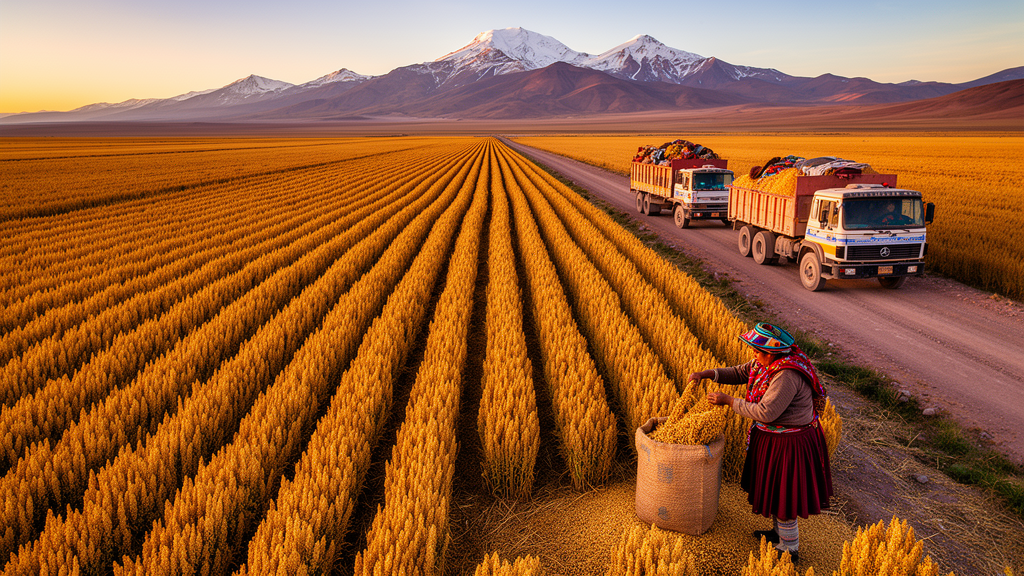
Quinoa has traveled a remarkable distance in the past two decades, from a largely overlooked Andean staple to a fixture of global health-food aisles and international commodity trade. Yet the benefits of that transformation have not been distributed evenly across the countries that grow the ancient grain. A new comparative analysis published in Frontiers in Sustainable Food Systems examines the export trajectories of Ecuador and Bolivia between 2016 and 2024, and the picture it paints is one of two nations operating in entirely different leagues. Bolivia, with its established Quinua Real brand and vast production base on the Altiplano, has sustained export volumes that dwarf those of its northern neighbor, while Ecuador has struggled to convert favorable agroecological conditions and a growing portfolio of quality certifications into a durable competitive position.
The research team, led by Carolina Jaramillo of Universidad Israel in Quito together with Ramiro Jaramillo of Escuela Politécnica de Chimborazo and Lorena Muquis of Universidad Israel, compiled a country-year dataset of 18 observations drawn from official statistical and trade sources, including Ecuador’s Ministry of Agriculture and Livestock, PRO ECUADOR, the Central Bank of Ecuador, and Bolivia’s Bolivian Institute of Foreign Trade. Rather than attempting formal econometric modeling, which the authors judged inappropriate for so small a sample, they organized the study around descriptive longitudinal comparisons of export volume, FOB value, export unit value, growth, and continuity. The central question was deliberately pointed: is Ecuador’s competitive disadvantage primarily a matter of export prices, or does it stem from differences in scale, supply continuity, and production costs?
The answer, on the evidence assembled, leans heavily toward scale and costs rather than price alone. Bolivia’s export volumes ranged from roughly 22,679 to 37,747 tons per year across the study period, with FOB values peaking at US$92.41 million in 2020. Ecuador, by contrast, climbed from just 100 tons in 2016 to a high of 3,060 tons in 2019, when exports were worth US$6.12 million, before declining and stabilizing between 1,000 and 1,700 tons in recent years. The authors are careful to note that aggregate FOB value reflects the combined effect of quantity exported and average value per ton, so a lower FOB figure cannot by itself be read as evidence of inferior pricing or quality. Indeed, Ecuador recorded periods of higher implicit export unit values, particularly toward the end of the period, suggesting that its smaller volumes are not necessarily accompanied by proportionally lower transaction values.
The technical heart of the financial analysis is the benefit-cost ratio, calculated as the implicit export unit value divided by a reference unit cost. Because comparable annual observed production costs were not available for both countries throughout 2016 to 2024, the authors constructed an indicative 2026 scenario rather than estimating realized producer profitability. The implicit export unit value, derived by dividing annual FOB export value by export volume in tons, serves as a summary measure of average transaction value, though the authors caution that it can vary with destination, product quality, contractual arrangements, product mix, and shipment timing. This distinction matters because export values observed at the border incorporate costs and margins from processing, logistics, and marketing stages that never reach the farmer.
Under the reference assumptions for 2026, the gap between the two countries is striking. Ecuador’s reference unit cost stands at USD 1,800 per ton against an indicative export unit value of approximately USD 2,200 per ton, yielding an indicative gross margin of USD 400 per ton and a benefit-cost ratio of 1.22. Bolivia’s reference unit cost is USD 1,200 per ton with an indicative export unit value of roughly USD 2,800 per ton, producing a gross margin of USD 1,600 per ton and a benefit-cost ratio of 2.33. In other words, under these benchmark conditions, Bolivia generates more than four times the indicative gross margin per exported ton that Ecuador does, a difference the authors attribute to the combined influence of lower reference costs and higher implicit export values.
The authors stress repeatedly that these figures are indicative rather than accounting-based. The cost figures are benchmarks, not a complete annual accounting of production, processing, logistics, marketing, and export costs, and the resulting ratios should be interpreted with caution and subjected to sensitivity analysis. The study explicitly avoids claims of net profit or farm-gate profitability, and it does not estimate technical efficiency, judging that the available number of comparable countries is insufficient to support a robust Data Envelopment Analysis. What the indicative scenario does support, the authors argue, is the proposition that the observed financial gap between the two export structures is sensitive to cost conditions and export unit values, a conclusion consistent with the broader literature on economies of scale in agricultural value chains.
Contextual data on Bolivia’s most recent export destinations, presented for 2025 outside the main analytical window, illustrate the international reach of Bolivian quinoa. The United States was the largest buyer, taking nearly 9 million kilograms and demanding white and Royal Quinoa, followed by Germany, which requires organic and Fairtrade certifications, and China, which has become the third-largest market and demands food-safety certifications. Canada and the Netherlands round out the top five, with Dutch buyers reexporting to other European countries under high food-safety standards. These destination patterns underscore how certification requirements have become woven into the very structure of market access for Andean quinoa, with different buyers demanding different combinations of organic, Fairtrade, and food-safety credentials.
Certifications occupy a nuanced position in the study. The authors treat them as institutional mechanisms that may facilitate market access and product differentiation, drawing on literature showing that organic, Fair Trade, food-safety, and Good Agricultural Practices certifications can reduce information asymmetries and open doors to higher-value segments. However, they are explicit that their economic effect cannot be quantified with the available country-level data, which lack transaction-level detail by certification type, exporting firm, destination, product quality, or contract conditions. The economic return of certification, the authors note, depends on compliance costs, consumers’ willingness to pay, producers’ bargaining power, and the extent to which price premiums are transmitted along the value chain. Evidence from Bolivia’s organic and Fair-Trade quinoa chains suggests potential benefits but also highlights certification costs and the concentration of purchasing power among buyers.
The theoretical scaffolding of the analysis draws on established concepts in international trade and agricultural economics. Competitiveness, in the Porterian tradition, is understood as the capacity of a country or productive sector to enter and remain competitive in international markets while generating sustained value over time, shaped not only by farm size but by product quality, differentiation, market access, and compliance with international standards. Balassa’s theory of revealed comparative advantage informs the interpretation of export performance as a reflection of productive specialization, while modern extensions of comparative advantage acknowledge that technology, quality, and institutional resources now matter as much as natural endowments like climate, soil, and altitude. Product differentiation through organic production, fair trade certifications, designations of origin, and nutritional attributes offers a route to higher value-added markets and reduced price competition, though the authors are careful not to attribute causal effects that the data cannot substantiate.
The broader significance of the findings extends beyond the two countries studied. Quinoa’s global expansion has intensified competition, pressured prices, and raised requirements for traceability, quality, and sustainability, reshaping the terms of competition among producing nations. The quinoa boom has also generated important changes in the territorial, social, and productive dynamics of quinoa-growing communities in the Bolivian Altiplano, and the value chain has experienced steady growth in cultivated areas and export volume over the past two decades, supported by flexible policy frameworks and public and private investment. For Ecuador, the study suggests that strengthening export performance may require a combination of productivity improvement, cost management, continuity of supply, market diversification, and value-added differentiation, with certifications complementing rather than substituting for structural improvements in the value chain. Future research, the authors conclude, should incorporate disaggregated information by producer, exporting firm, destination, certification, production system, and cost component, enabling more rigorous testing of the relationships between productivity, costs, certification, market access, and export profitability.
Subject of Research: Agricultural and Food Economics
Article Title: Export competitiveness and indicative financial performance of quinoa in Ecuador and Bolivia: a comparative analysis
Article References: Jaramillo, C., Jaramillo, R., & Muquis, L. (2026). Export competitiveness and indicative financial performance of quinoa in Ecuador and Bolivia: a comparative analysis. Frontiers in Sustainable Food Systems, 10, Article 1927925. https://doi.org/10.3389/fsufs.2026.1927925
Image Credits: AI Generated
DOI: 10.3389/fsufs.2026.1927925
Keywords: quinoa, Bolivia, Ecuador, export competitiveness, agricultural trade, benefit-cost ratio, sustainable food systems, Andean agriculture, Export, competitiveness, indicative, financial
Cite Scienmag News
Alan Morgan. (October 17, 2026). Bolivia Outpaces Ecuador in Quinoa Exports as New Analysis Reveals a Striking Financial Gap. Scienmag. https://scienmag.com/bolivia-outpaces-ecuador-in-quinoa-exports-as-new-analysis-reveals-a-striking-financial-gap/
Alan Morgan. "Bolivia Outpaces Ecuador in Quinoa Exports as New Analysis Reveals a Striking Financial Gap." Scienmag, 17 October 2026, https://scienmag.com/bolivia-outpaces-ecuador-in-quinoa-exports-as-new-analysis-reveals-a-striking-financial-gap/. Accessed 17 October 2026.
Alan Morgan. "Bolivia Outpaces Ecuador in Quinoa Exports as New Analysis Reveals a Striking Financial Gap." Scienmag. October 17, 2026. https://scienmag.com/bolivia-outpaces-ecuador-in-quinoa-exports-as-new-analysis-reveals-a-striking-financial-gap/


