


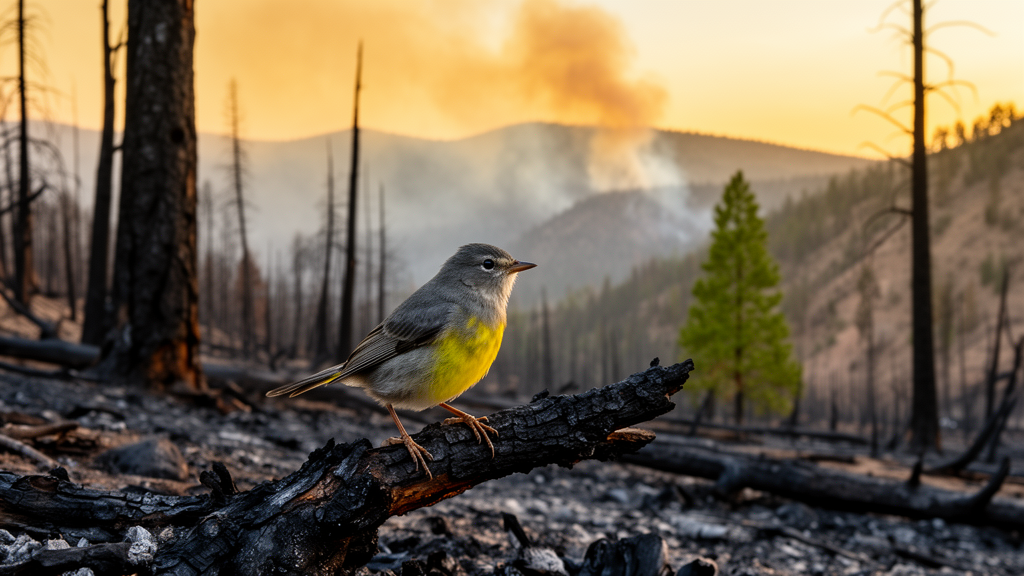
Deep in the mixed conifer forests of California’s Sierra Nevada, a small yellow-throated songbird is quietly telling scientists something alarming about the future of old-growth ecosystems. The Hermit Warbler, a specialist bird that depends on dense, mature forest canopy, declined by 8.3 percent in just four years across the entire western slope of the mountain range, according to a new study published in Frontiers in Bird Science. The research, led by scientists at the Cornell Lab of Ornithology’s K. Lisa Yang Center for Conservation Bioacoustics and the University of Wisconsin-Madison, combined cutting-edge artificial intelligence sound recognition with rigorous statistical modeling to reveal how rising temperatures and catastrophic wildfires are reshaping the distribution of a climate-sensitive species in real time.
The findings carry weight far beyond a single warbler species. The Hermit Warbler has previously been identified as a surrogate species for the California Spotted Owl, and among more than 60 Sierra Nevada bird species analyzed in prior work, 13 are co-associated with the Spotted Owl, none more strongly than the Hermit Warbler. Because the warbler’s small body size means a small home range, researchers can monitor it with far greater sample sizes than the owl, giving them the statistical power to detect subtle population responses to environmental change that will likely apply to the larger, more charismatic species sharing the same old-forest habitat. In this sense, the warbler functions as a biological barometer for an entire community of old-forest specialists facing the combined pressures of warming and intensifying fire regimes.
To capture population dynamics at an ecosystem scale, the research team deployed autonomous recording units, known as ARUs, at 876 locations spanning six National Forests across the western slope of the Sierra Nevada. Each summer from 2021 through 2024, pairs of recorders were placed 500 to 900 meters apart, with 1.5 to 3 kilometers between pairs, and left running for approximately five weeks. The devices recorded continuously through a single omni-directional microphone at a sample rate of 32 kilohertz. For analysis, the team focused on audio captured between 5:00 and 9:00 in the morning and 6:00 to 8:00 in the evening, the windows when Hermit Warbler vocalizations are most likely to be heard. The study area ranged from 328 meters above sea level, where black oak mingles with ponderosa pine, up to 2,528 meters, where white fir dominates the canopy.
The acoustic data were processed with BirdNET, a convolutional neural network capable of identifying Hermit Warbler songs and the vocalizations of thousands of other species by sound. To ensure the AI’s predictions were trustworthy, the researchers manually validated 200 randomly selected BirdNET detections of Hermit Warbler vocalizations, half drawn from a broad score range and half from the upper range, then fit a logistic regression relating the prediction score to the probability that a given detection was correct. Only predictions with a probability of being a true positive of at least 0.99 were retained as observations. At this stringent threshold, precision was a perfect 1.0, meaning every retained detection was correct, while recall was 0.78, meaning the detector captured 78 percent of the target sounds actually present. This combination of extremely high precision and strong recall meant false positives and false negatives would have minimal influence on the final results.
Quantifying the environmental conditions at each recording site required equally sophisticated remote sensing. The team characterized fire severity and history using 30-meter resolution rasters of the Composite Burn Index, generated in Google Earth Engine from random forest models parameterized with latitude, climatic water deficit, and spectral indices from Landsat imagery spanning 1985 to 2023. Composite Burn Index values of 2.25 or higher were categorized as high-severity fire, corresponding to at least 75 percent canopy mortality. Fire data were summarized within a 120-meter buffer around each recorder as the proportion of unburned, low-to-moderate, and high-severity fire occurring 1 to 10 and 11 to 35 years before each sampling year. For the thermal environment, the researchers used 30-meter resolution mean relative summer temperature derived from the Landsat 8 Thermal Infrared Sensor, calculated from 2013 to 2018 as a median across a six-year time series. This in situ thermal measurement, rather than coarser gridded weather data interpolated from sparse stations, captured fine-scale conditions such as slope and aspect in the Sierra’s complex terrain.
A critical statistical challenge emerged because relative temperature and mean tree diameter were strongly negatively correlated, with a correlation coefficient of negative 0.77. Sites with larger trees are simply cooler. To disentangle these effects, the team fit a linear model of relative temperature as a function of tree diameter and used the residuals as a forest-structure-corrected measure of the thermal environment. Positive residuals indicated sites warmer than expected given their tree diameter, negative residuals indicated sites cooler than expected, and the resulting corrected measure was uncorrelated with tree diameter. This allowed the researchers to ask whether the warbler responded to temperature itself, independent of the forest structure that both creates cooler microclimates and defines the species’ preferred habitat.
The population dynamics were analyzed with a dynamic occupancy model, a hierarchical statistical framework that estimates site occupancy, colonization, and local extinction while accounting for imperfect detection. Each breeding season was divided into eight six-day secondary sampling periods, and the team applied careful filters to create encounter histories: observations before June 1 or after July 18 were excluded because they could reflect migration or post-breeding movement rather than stable breeding behavior, and any site with only a single vocalization in June was treated as unoccupied to guard against transient individuals or rare high-scoring false positives. Detection probability was modeled as a function of survey effort and ordinal date. Initial occupancy was modeled as a function of elevation, latitude, mean tree diameter, the temperature-corrected residuals, and the amount of high-severity fire in the prior ten years, while colonization and extinction were modeled against the same covariates. All covariates were scaled to allow direct effect size comparisons, and the team considered a covariate influential if the 85 percent confidence interval around its estimate did not overlap zero.
The results painted a coherent picture of a species contracting its range under pressure from both direct and indirect effects of climate change. Site occupancy fell from 0.658 in 2021 to 0.603 in 2024, an 8.3 percent decline. Initial occupancy was most strongly influenced by mean tree diameter, confirming the warbler’s old-forest association, but even after controlling for forest structure, birds were more likely to occupy sites cooler than expected for their tree diameter. Occupancy showed a striking non-linear latitudinal gradient: approximately 0.1 at the southern end of the study area, climbing to 0.78 slightly north of the midpoint near the South Fork of the American River, and reaching 0.84 at the northernmost extent. Colonization rates were higher in the north while extinction rates were higher in the south, producing a clear northward shift in the relative density of occupied sites. Elevation told a more complicated story: colonization increased with elevation, but extinction displayed a positive quadratic relationship, meaning the lower elevational boundary shifted upslope while the upper boundary did not show an unambiguous corresponding expansion.
The fire response was dramatic. At a completely unburned site, the annual probability of local extinction was 0.106 and the probability of colonization was 0.383. At a fully burned site, extinction probability soared to 0.883 while colonization collapsed to 0.0292. The warbler showed a strong extinction response to severe fire over a 1-to-10-year post-fire period and failed to colonize such areas over the same span, effectively treating locally extensive high-severity fire as a decadal loss of habitat. Notably, colonization was unaffected by high-severity fire occurring 11 to 35 years before the study period, suggesting some capacity for resilience if enough unburned habitat remains. The observed population decline could plausibly be attributed to the several large, severe fires that occurred during the study window, including the Dixie Fire, which burned almost 3,900 square kilometers of the northern Sierra Nevada with more than 20 percent at high severity, along with the Caldor and KNP Complex Fires. The apparent northward shift of the warbler population may have partially offset the Dixie Fire’s local effects, underscoring the importance of regional context when interpreting local studies.
The study’s implications for conservation are sobering but actionable. Limiting the occurrence of large, severe fires will be necessary to preserve this old-forest indicator, the authors conclude, but not sufficient: rising temperatures will lead to population declines even in the absence of habitat loss due to fire. Without proactive strategies that move away from strict fire suppression and incorporate principles of pre-colonial fire stewardship, continued intensification of contemporary fire regimes could drive further declines for the Hermit Warbler and the species that share its habitat. Meanwhile, the mixed evidence for upslope shifts suggests that simply moving to higher elevations may not be a viable climate adaptation strategy for the warbler, the Spotted Owl, or their co-associated species, particularly since high-elevation Sierra forests are not expected to provide short- to intermediate-term climate refugia due to complex interactions between canopy cover, microclimate, and prey. As climate change accelerates, understanding how species respond to shifting environmental conditions will be crucial for guiding adaptive management and ensuring the persistence of biodiversity in fire-prone landscapes, and this four-year bioacoustic monitoring framework offers a scalable template for tracking those responses across entire ecosystems.
Subject of Research: Combined effects of warming temperatures and high-severity wildfire on the range dynamics of an old-forest bird species in the Sierra Nevada
Article Title: Warm temperatures and severe fire drive a range contraction of an avian old-forest specialist in the Sierra Nevada, USA
Article References: Bielski, L., Keyser, S. R., Peery, M. Z., & Wood, C. M. (2026). Warm temperatures and severe fire drive a range contraction of an avian old-forest specialist in the Sierra Nevada, USA. Frontiers in Bird Science, 5, Article 1737313. https://doi.org/10.3389/fbirs.2026.1737313
Image Credits: AI Generated
DOI: 10.3389/fbirs.2026.1737313
Keywords: Hermit Warbler, Sierra Nevada, climate change, high-severity fire, passive acoustic monitoring, dynamic occupancy model, old-growth forest, range contraction, BirdNET, wildfire, bird conservation, Spotted Owl
Cite Scienmag News
Margaret Porter. (October 17, 2026). Heat and megafire push Sierra Nevada songbird into shrinking range. Scienmag. https://scienmag.com/heat-and-megafire-push-sierra-nevada-songbird-into-shrinking-range/
Margaret Porter. "Heat and megafire push Sierra Nevada songbird into shrinking range." Scienmag, 17 October 2026, https://scienmag.com/heat-and-megafire-push-sierra-nevada-songbird-into-shrinking-range/. Accessed 17 October 2026.
Margaret Porter. "Heat and megafire push Sierra Nevada songbird into shrinking range." Scienmag. October 17, 2026. https://scienmag.com/heat-and-megafire-push-sierra-nevada-songbird-into-shrinking-range/


