


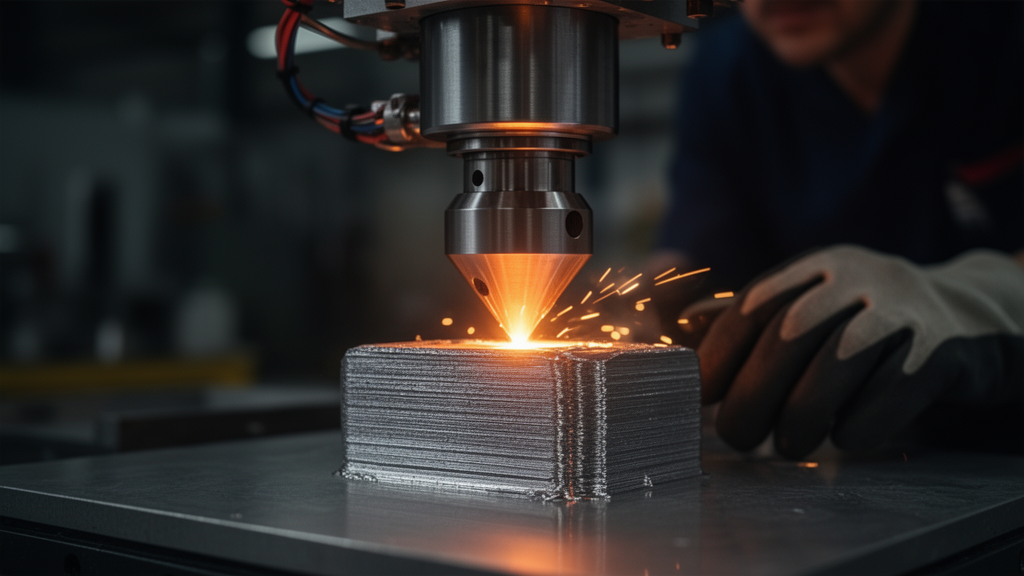
For more than a century, metallurgists have built alloys around one dominant element — iron in steel, nickel in superalloys, aluminium in aerospace alloys — with small additions of others fine-tuning the result. High-entropy alloys, or HEAs, throw that playbook away. By mixing five or more principal elements in near-equal proportions, these materials occupy a vast and largely unexplored compositional space, and they frequently display mechanical, thermal and functional properties that conventional alloys cannot match. A new review published in Frontiers in Materials by Ranjit Kumar Dehury and colleagues surveys how additive manufacturing — the family of 3D-printing technologies that builds metal parts layer by layer — has become the most powerful route yet for unlocking the potential of these extraordinary materials, and why the combination may reshape everything from jet engines to knee implants.
The appeal of HEAs rests on four core effects that researchers have identified as the source of their exceptional behaviour. First, the sheer configurational entropy of mixing many elements stabilises single-phase solid solutions instead of brittle intermetallic compounds. Second, atomic diffusion proceeds sluggishly through the crowded lattice, slowing phase transformations. Third, the wildly different atomic sizes of the constituent elements create severe lattice distortion, which impedes dislocation motion and strengthens the material. Fourth, the so-called cocktail effect produces property combinations that exceed what any single element could deliver. Together, these effects give HEAs a performance envelope that has attracted intense interest from the aerospace, automotive, energy, biomedical and electronics sectors.
Yet conventional processing routes — vacuum arc melting, induction casting, mechanical alloying and physical vapour deposition — struggle to exploit that potential fully. Casting HEAs requires repeatedly remelting and flipping the melt to achieve chemical homogeneity, and post-processing steps are usually needed to tailor the microstructure. Some HEAs demand extremely high cooling rates to suppress unwanted intermetallic phases. These constraints make complex-shaped components difficult and large-scale production impractical. Additive manufacturing changes the equation: it builds near-net-shape parts with minimal waste, offers unprecedented design freedom, and — crucially for HEAs — imposes heating and cooling rates so extreme that the resulting microstructures differ fundamentally from anything a foundry can produce.
Laser powder bed fusion, or LPBF, is the most intensively studied technique. A focused laser selectively melts thin layers of powder, with cooling rates reaching 10^5 to 10^7 kelvin per second. At those speeds, atomic long-range diffusion is effectively frozen out, elemental segregation is suppressed, and many HEAs stabilise as metastable single-phase face-centred cubic or body-centred cubic solid solutions rather than decomposing into equilibrium phases. The process also generates dense dislocation networks and fine cellular substructures of roughly 0.2 to 1.0 micrometres within the primary grains. Reported results are striking: LPBF-fabricated CoCrFeNi showed nearly twice the yield strength of its cast counterpart, and the technique has demonstrated feasibility for refractory HEAs such as WMoTaNbV, candidates for aerospace and chemical-industry service. The trade-offs are real, however — thermal cycling, residual stresses and microcracking near the print–substrate interface remain persistent hazards, demanding careful optimisation of laser energy density.
Selective electron beam melting, or SEBM, takes a different approach. Operating in high vacuum with a powerful electron beam, it preheats the powder bed to between 600 and 1100 degrees Celsius using a defocused beam pass. That preheating reduces thermal gradients and residual stresses, which is invaluable for refractory HEAs that are notoriously crack-prone under laser processing. The vacuum environment eliminates oxidation and contamination, permitting the use of reactive, high-melting-point elements typical of HEA chemistries. SEBM’s cooling rates of 10^4 to 10^5 kelvin per second promote equiaxed grains rather than the fine dendritic structures of LPBF, often yielding refined microstructures and better mechanical properties than casting. But the combination of high vacuum and beam power can selectively evaporate volatile elements such as aluminium, manganese and copper, silently shifting the alloy composition — a problem that demands tight process control.
Directed energy deposition, or DED, uses a laser, electron beam or arc to melt powder or wire feedstock as it is deposited, allowing much larger components and higher deposition rates than powder-bed methods. Its intermediate cooling rates of 10^2 to 10^4 kelvin per second encourage epitaxial columnar grain growth along the build direction, but repeated thermal cycling can trigger dynamic recrystallisation that partially breaks up those columnar structures into finer grains. The sluggish diffusion characteristic of HEAs limits elemental partitioning and helps stabilise single- or dual-phase solid solutions. Notably, DED-produced CoCrFeMnNi showed greater strength and elongation than its LPBF counterpart, an effect attributed to in-situ annealing during thermal cycling that relieves tensile stresses. Defects such as lack-of-fusion, incomplete powder melting and interlayer cracking remain challenges, and the columnar grains and crystallographic texture can introduce mechanical anisotropy.
Perhaps the most radical departure is additive friction stir deposition, or AFSD, a fully solid-state process that combines friction stir welding principles with layer-by-layer building. Frictional heating and severe plastic deformation soften the feedstock above its solidus temperature but below melting — typically around 0.7 to 0.8 of the absolute melting temperature. Because no liquid phase ever forms, the solidification defects that plague fusion-based printing — hot cracking, keyhole porosity, lack-of-fusion pores — simply cannot occur. Severe shear deformation instead drives dynamic recrystallisation, producing highly refined equiaxed grains. In Al0.35CoCrFeNi, phase variations between the advancing and retreating sides of the deposit generated Al-rich BCC particles that promoted Zener pinning and restricted grain growth. AFSD also prevented brittle intermetallic formation at particle–matrix interfaces in AA5083 reinforced with CoCrFeNi particles, boosting both strength and ductility. Its current limitation is practical: the process is best suited to lower-melting-point materials, and high-temperature HEAs require wear-resistant tooling that is still under development.
None of these processes works without high-quality feedstock, and the review identifies powder and wire quality as a decisive factor in whether HEAs can ever reach commercial scale. Gas atomisation is the dominant route for powder-bed AM because it yields pre-alloyed, spherical, compositionally homogeneous powders with suitable density, flowability and particle size distribution. Mechanical alloying, by contrast, produces contaminated, irregularly shaped powders unsuited to powder-bed processing, while water atomisation is cheap but yields irregular particles with poor flowability. On the wire side, researchers have pioneered a novel combined cable wire — seven 0.6-millimetre wires (two nickel, two aluminium, one iron, one cobalt and one 304 stainless steel) bundled around a central core — as filler for wire-arc additive manufacturing of non-equiatomic AlCoCrFeNi, enabling high deposition rates and large near-net-shape components. The review notes bluntly that the commercial use of HEAs has not yet succeeded, primarily because feedstock availability and comprehensive alloy qualification lag behind the science.
The mechanical performance being reported from printed HEAs is remarkable. LPBF-fabricated HEAs have achieved yield strengths approaching 1.3 gigapascals with uniform elongations near 14 per cent, surpassing many additively manufactured metallic alloys, thanks to alternating FCC/BCC nanolamellar structures in which strong BCC lamellae provide strengthening and strain hardening. An SLM-built eutectic HEA, Al18Co30Cr10Fe10Mo1Ni30W1, retained outstanding strength from minus 196 to 760 degrees Celsius — among the highest ever reported for AM-produced HEAs — owing to ultrafine eutectic lamellae of 150 to 200 nanometres. Even more striking are the engineered heterostructures: a CoCrNi–Fe50Mn30Co10Cr10 laminated HEA with a mortise-and-tenon architecture, mimicking traditional woodworking joinery, achieved a yield strength roughly 36.5 per cent above rule-of-mixture predictions, with interface strengthening contributing about 23 per cent of the total. A mechanically interlocked network in SLM-fabricated Fe28Co29.5Ni27.5Al8.5Ti6.5 delivered a tensile strength of about 1152 megapascals with 28 per cent elongation. At cryogenic temperatures, metastable HEAs exploit transformation-induced plasticity: an AMed Co34Cr20Fe34Ni6Mn6 alloy showed an anomalous reversible gamma-to-epsilon transformation at 77 kelvin that roughly doubled tensile strength while preserving ductility.
The review’s authors argue that additive manufacturing has evolved from an alternative fabrication method into a powerful enabling technology, shifting HEA development toward a microstructure-by-design philosophy in which process parameters themselves become design tools. Machine learning is emerging as the accelerant: algorithms from random forest to artificial neural networks have been used to predict phases, screen high-hardness compositions in the AlCoCrCuFeNi system, and forecast the high-temperature yield strength of MoNbTaTiW and HfMoNbTaTiZr alloys at 800 and 1200 degrees Celsius with strong agreement against experiment. Companies are already adopting ML for alloy design in AM. Significant challenges remain — defects, residual stresses, anisotropy, elemental evaporation, phase stability, and the scarcity of data on fatigue, creep, fracture toughness, corrosion and irradiation resistance. Most published work still centres on the CoCrFeMnNi family, while lightweight and refractory HEAs remain underexplored. But the trajectory is clear: as process optimisation, real-time monitoring, multi-scale characterisation and data-driven design mature, printed high-entropy alloys are positioned to move from laboratory marvels to load-bearing components across aerospace, energy, biomedical, nuclear and defence industries — a transformation that could redefine what engineers expect from metal.
Subject of Research: Materials Science
Article Title: Process–microstructure–property relationships in additive manufacturing of high-entropy alloys: recent advances, challenges and future perspectives
Article References: Dehury, R. K., Gupta, V., Joshi, Y. G., & Victor, M. T. (2026). Process–microstructure–property relationships in additive manufacturing of high-entropy alloys: recent advances, challenges and future perspectives. Frontiers in Materials, 13, Article 1964268. https://doi.org/10.3389/fmats.2026.1964268
Image Credits: AI Generated
DOI: 10.3389/fmats.2026.1964268
Keywords: high-entropy alloys, additive manufacturing, laser powder bed fusion, microstructure, mechanical properties, machine learning, refractory alloys, cryogenic deformation, eutectic alloys, metal 3D printing, Process, property
Cite Scienmag News
Denise Maddox. (October 17, 2026). 3D-printed high-entropy alloys are rewriting the rules of metal strength. Scienmag. https://scienmag.com/3d-printed-high-entropy-alloys-are-rewriting-the-rules-of-metal-strength/
Denise Maddox. "3D-printed high-entropy alloys are rewriting the rules of metal strength." Scienmag, 17 October 2026, https://scienmag.com/3d-printed-high-entropy-alloys-are-rewriting-the-rules-of-metal-strength/. Accessed 17 October 2026.
Denise Maddox. "3D-printed high-entropy alloys are rewriting the rules of metal strength." Scienmag. October 17, 2026. https://scienmag.com/3d-printed-high-entropy-alloys-are-rewriting-the-rules-of-metal-strength/


