


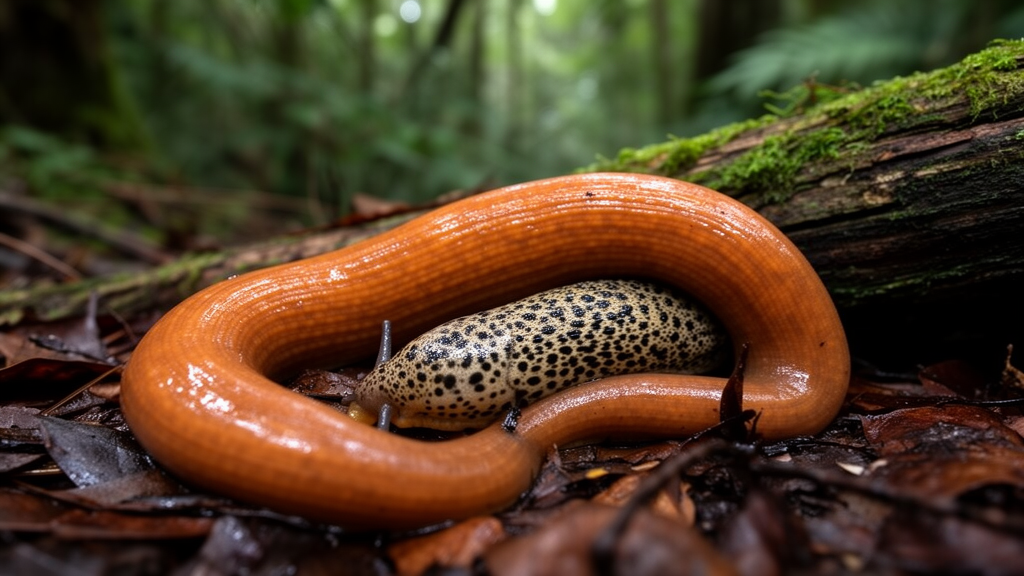
Deep in the temperate rainforests of southern Chile, a predator with a black shiny body, two golden-yellow bands and a pale-blue median stripe has been photographed doing something scientists have rarely documented in the wild: devouring one of Europe’s most successful invasive slugs. In a study published in Neotropical Biology and Conservation, researchers report two field records of the giant land planarian Polycladus gayi preying on Limax maximus, the leopard slug, within native forest habitats. The observations, made by naturalists on two separate trails in the Los Ríos and Los Lagos regions, offer a rare glimpse of a native soil predator attacking an invasive mollusc in its own forest floor domain, and they hint that such interactions may be far more common than the scarcity of records suggests.
Polycladus gayi, known locally in Spanish as ‘Planaria gigante valdiviana’ or ‘Lengua de vaca’ — cow’s tongue — is one of the most striking invertebrates of Chilean forests. This giant flatworm can exceed 15 centimetres in length and is distributed mainly from La Araucanía to Aysén, where it is associated with native forest, with additional populations in the adjacent Nothofagus forests of Argentina. Despite its size and charisma, its ecology remains poorly known. Until recently, the only confirmed prey recorded for the species was the native land snail Macrocyclis peruvianus, documented thanks to citizen science photographs. Land planarians in general are key predators of the forest floor, feeding on terrestrial isopods, snails and slugs, earthworms, insects, springtails, mites, spiders and other flatworms, but data on what they actually eat under natural conditions are scarce, with much of the existing knowledge derived from laboratory experiments.
The new records come from opportunistic encounters on naturalist trails. The first was made on 4 May 2025 in the Llancahue Nature Sanctuary in the Los Ríos Region, a forest dominated by Nothofagus species, Eucryphia cordifolia, Aextoxicum punctatum and Amomyrtus meli. The second occurred on 5 March 2025 at a site called ‘Los Muermos’ in the Los Lagos Region, where the understorey is dominated mainly by Chusquea bamboos and Aextoxicum punctatum. In both cases, observers photographed the planarian in the act of subduing its prey, allowing the researchers to classify the predatory behaviour using the interaction types between terrestrial planarians and their prey established in earlier experimental work.
The Llancahue record was observed for approximately five minutes, long enough to capture a remarkable sequence. Polycladus gayi immobilised the slug using a behaviour known as helicoidal tube formation, in which the planarian twists its body around the prey like a helix, forming a tube that retains the slug and moves it towards the mouth. The photographs show the planarian everting its pharynx — the muscular feeding tube characteristic of flatworms — with part of the slug already inside the predator’s body, all while the planarian maintains its helicoidal grip. This is a technically demanding capture strategy: the prey must be wrapped and held in position while the pharynx is extended and digestion begins, effectively consuming the slug while it is still restrained.
The Los Muermos record was shorter, observed for only 150 seconds, but it revealed a second, distinct predatory tactic. Based on the position of the planarian over the head of the slug, the researchers classified this behaviour as surrounding immobilisation, in which the predator covers and encircles the prey rather than forming a helicoidal tube. The two records therefore suggest that Polycladus gayi can display at least two different types of predatory behaviour against the same prey species, a flexibility consistent with what has been documented for other land planarian species under laboratory conditions. Earlier work has also shown that the same prey type can experience different hunting behaviours from the same planarian species, and that prey type itself — shelled snails versus shell-less slugs — can determine which strategy is deployed.
The choice of prey is what makes these records ecologically significant. Limax maximus is a European slug that has spread widely as an invasive species across Chile, mainly in the central and southern regions, and was first reported in the country in the late 1990s, where it was considered an agricultural pest. For years, the prevailing view was that this slug was restricted to human-dominated environments such as cities and agroecosystems and was absent from native forests. However, long-term monitoring of more than 100 forest fragments has detected the slug in roughly 80 percent of the native forest patches surveyed in central-southern Chile, indicating that the invasive mollusc has penetrated far deeper into natural ecosystems than previously believed. Invasive slugs in forest patches can threaten native plants, particularly herbaceous species and those with glabrous leaves, as well as native invertebrates, owing to their voracity.
Because the reported distributions of Polycladus gayi and Limax maximus overlap substantially across southern Chile, the researchers suggest that the predator-prey interaction documented in the two records might be common, even though formal observations remain rare. To visualise this overlap, the team compiled occurrence records from social media platforms, iNaturalist and the Global Biodiversity Information Facility, using only research-grade verified records from the latter, and mapped the joint distributions with geographic information system software. The maps show green dots for the planarian and yellow dots for the slug clustering across the same central-southern stretch of the country, with the two interaction localities falling squarely within the shared range.
The findings also connect to a classic ecological idea: the biotic resistance hypothesis, proposed by Charles Elton in 1958. This hypothesis posits that the richest native communities are less vulnerable to non-native species invasions, limiting the invaders’ success through predation or competition. Biotic resistance has been demonstrated in successful examples involving marine, freshwater and terrestrial invertebrates, and the new records reveal the potential of Polycladus gayi as a biological control agent on the invasive leopard slug. The researchers are careful, however, to note that the hypothesis must be demonstrated through experiments in which some aspect of the slug’s fitness is shown to be negatively affected by the planarian. Field records alone, however dramatic, cannot establish biotic resistance; they can only suggest where to look for it.
The size relationship between predator and prey adds another layer of interest. Adult individuals of Limax maximus can reach lengths of up to 8 to 9 centimetres, and Polycladus gayi is known to be capable of capturing prey almost as large as itself, as previously documented with the native snail Macrocyclis peruvianus. In both new records, predation was not interrupted to measure the slug, so the exact sizes of the victims remain unknown, but the photographs make clear that the planarian was tackling prey of comparable bulk. With its giant body, the planarian sits at the top of the local soil invertebrate food web, and its ability to switch between capture strategies depending on prey type and size — covering a snail’s shell entrance in one case, twisting into a helicoidal tube around a slug in another — suggests a level of behavioural versatility rarely appreciated in giant soil predators.
The researchers argue that further data on predatory behaviour and on other potential prey, both native and exotic, could enable laboratory prey selection experiments similar to those conducted with other land planarian species, clarifying the potential role of Polycladus gayi in the biological control of invasive slugs and identifying other prey from the native forests of these temperate ecosystems. Citizen science, which has already proved decisive in revealing the planarian’s diet, is likely to remain central to that effort, since naturalist photographs and verified occurrence records are what made these two field observations possible. For now, the records broaden understanding of one of the most remarkable giant soil invertebrates in the native forests of southern Chile, raising new ecological and conservation questions about how a native flatworm and an invasive European slug are reshaping each other’s fortunes on the forest floor.
Subject of Research: Predation of the giant Chilean land planarian Polycladus gayi on the invasive slug Limax maximus in temperate native forests
Article Title: Records of Polycladus gayi ( Tricladida , Geoplanidae ) preying on the invasive slug Limax maximus ( Gastropoda , Limacidae ) in Chile's temperate forests
Article References: Barahona-Segovia, R. M., Quintanilla Iturra, E., Meneses Rubio, C., Silva-Reyes, P., & Hormazábal, L. (2025). Records of Polycladus gayi (Tricladida, Geoplanidae) preying on the invasive slug Limax maximus (Gastropoda, Limacidae) in Chile's temperate forests. Neotropical Biology and Conservation, 20(3), 247-254. https://doi.org/10.3897/neotropical.20.e159659
Image Credits: AI Generated
DOI: 10.3897/neotropical.20.e159659
Keywords: Polycladus gayi, Limax maximus, land planarians, invasive slugs, Chilean temperate forests, predatory behaviour, biotic resistance, citizen science, Geoplanidae, biological control, soil predators, Neotropical ecology
Cite Scienmag News
Gavin Prescott. (October 17, 2026). Giant Chilean flatworm caught preying on invasive leopard slug in native forests. Scienmag. https://scienmag.com/giant-chilean-flatworm-caught-preying-on-invasive-leopard-slug-in-native-forests/
Gavin Prescott. "Giant Chilean flatworm caught preying on invasive leopard slug in native forests." Scienmag, 17 October 2026, https://scienmag.com/giant-chilean-flatworm-caught-preying-on-invasive-leopard-slug-in-native-forests/. Accessed 17 October 2026.
Gavin Prescott. "Giant Chilean flatworm caught preying on invasive leopard slug in native forests." Scienmag. October 17, 2026. https://scienmag.com/giant-chilean-flatworm-caught-preying-on-invasive-leopard-slug-in-native-forests/


