


For decades, measuring how a person walks in three dimensions meant one thing: reflective markers. Small spheres glued to the skin, tracked by banks of infrared cameras in a laboratory, have long been the gold standard of biomechanics. The approach works, but it is expensive, time-consuming, and demands specialized personnel. Worse, markers themselves introduce errors — they can be placed on the wrong anatomical landmarks, and the soft tissue beneath them shifts during movement, distorting the very joint angles clinicians hope to measure. Now a new study suggests that a camera-based, marker-free alternative can deliver impressively consistent measurements in exactly the patients who need gait analysis most: older adults with painful hip or knee conditions.
The research, published in Frontiers in Medical Technology, comes from a team at OTH Regensburg in Germany led by Leonhard Stein. The investigators set out to answer a deceptively simple question: how reliable is markerless motion capture — specifically the Captury system — when used to analyze walking in older patients with hip or knee pathology? The question matters because these are the people for whom objective gait assessment could transform care before and after joint replacement, yet they are also the people whose atypical, antalgic movement patterns fall far outside the training data of most computer-vision algorithms.
Markerless motion capture works fundamentally differently from its marker-based predecessor. Instead of tracking physical markers, it uses machine-learning pose-estimation algorithms trained on vast datasets of human movement to infer body segments and joint centers directly from ordinary video. Patients walk fully clothed, in their own shoes, with no preparation at all. But there is a catch: the algorithms learn from visual priors, and those priors are built predominantly on healthy people moving in typical ways. When a patient limps, compensates, or guards a painful joint, the algorithm must extrapolate beyond its training distribution — a phenomenon computer scientists call domain shift, which has been shown to degrade pose-estimation accuracy when moving from healthy to pathological gait.
There is a second, subtler problem. Patients with hip or knee osteoarthritis typically have compressed ranges of motion. Even if the absolute measurement error of a system remains unchanged between healthy and pathological groups, a smaller true excursion means a larger relative error — and a reduced ability to detect a genuine post-operative improvement against the background noise of measurement. Reliability benchmarks established in healthy volunteers performing high-range-of-motion tasks may therefore be optimistic when applied to a population with stiff, painful joints. Population-specific error estimates are not a confirmation of existing knowledge; they are a clinical necessity.
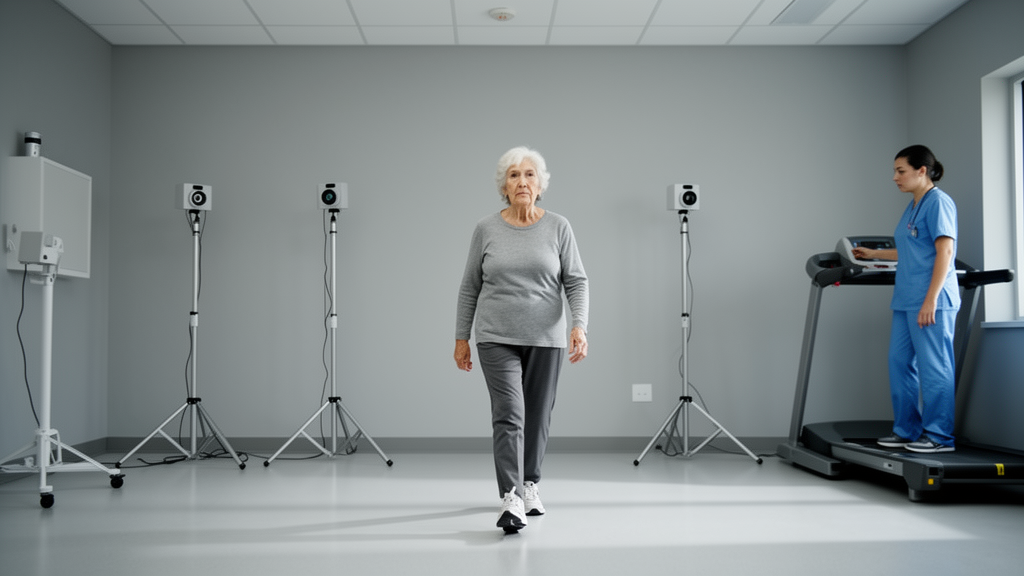
To test this, the Regensburg team recruited 41 participants: 15 patients with hip pathology (mostly osteoarthritis), 13 with knee osteoarthritis, and 13 healthy controls. Patient-reported joint health, measured with validated HOOS-12 and KOOS-12 questionnaires, averaged around 53 out of 100 in the patient groups — moderate severity — compared with substantially higher scores in controls. Each participant performed a dynamic scaling procedure, moving their joints through large ranges so the software could build a participant-specific digital skeleton, then walked eight passes along an 8-meter walkway at a self-selected comfortable pace. Crucially, two identical Captury systems — each with eight RGB cameras arranged around the walkway — recorded the same walking trials simultaneously, with synchronization confirmed by an LED event and cross-correlation of knee flexion trajectories to within a single frame.
The statistical analysis was rigorous and multi-layered. For discrete range-of-motion parameters, the team calculated intraclass correlation coefficients, standard errors of measurement, minimal detectable change at the 95 percent confidence level, and Bland–Altman metrics. For continuous joint-angle waveforms across the gait cycle, they used one-dimensional statistical parametric mapping and root-mean-square error. The results were striking: across 36 joint-plane-group combinations, 18 parameters showed excellent reliability, 10 good, 6 moderate, and only 2 poor. Standard errors of measurement were below 2 degrees for most parameters, and knee flexion — the most clinically relevant outcome for knee patients — remained below 2 percent relative error across all groups. Systematic inter-system differences were minimal, with 27 of 36 parameters showing a mean bias below 1 degree.
The least robust results were consistent across all three groups: trunk flexion and selected transverse-plane variables — hip and knee rotation — showed the highest disagreement. This pattern has a plausible mechanistic explanation. Estimating rotation around a segment’s long axis is fundamentally harder for a vision-based system, because visual landmarks provide less information for axial rotations than for sagittal or frontal-plane motion. The finding mirrors known limitations of conventional marker-based gait analysis, where sagittal-plane variables also outperform transverse-plane rotations. Small differences in camera geometry between the two systems — corresponding cameras were positioned roughly 0.2 to 0.3 meters apart — cannot be excluded as an additional contributor, though both systems followed the same overall configuration.
Perhaps the most important finding was what the team did not observe. In exploratory group comparisons, there was no consistent directional pattern of greater inter-system disagreement in the pathological groups compared with healthy controls. None of 72 contrasts remained significant after false discovery rate adjustment. Both systems similarly detected a clinically plausible reduction in knee flexion range of motion in the knee group compared with controls — reduced sagittal-plane knee motion being a hallmark of degenerative knee pathology. This suggests the system can capture meaningful between-group differences when present, though the modest group sizes mean smaller pathology-related effects on measurement consistency cannot be excluded.
The clinical implications are substantial. Objective, low-burden gait assessment could quantify functional impairment before hip or knee replacement and monitor recovery afterward, reducing reliance on preparation-intensive marker-based testing. But the study’s authors are careful about scope: this was a within-platform reliability test, not a validity study. Two identical systems recording simultaneously isolate the platform’s intrinsic measurement consistency — a lower bound on total measurement variability. Session-to-session variability, calibration differences, clothing changes, operator effects, and biological variation between visits were deliberately held constant and therefore excluded from the error budget. Reliability is a necessary but not sufficient precondition for clinical use: a system that cannot reproduce its own output consistently cannot be meaningfully validated against an external reference, since any observed disagreement would be confounded by within-platform noise.
For clinicians and researchers considering markerless gait analysis in older orthopaedic populations, the message is cautiously optimistic. Most lower-limb sagittal-plane outcomes — knee flexion, hip flexion, ankle flexion — can be measured with small within-platform disagreement in patients with symptomatic hip or knee pathology, even in everyday clothing. Trunk flexion and some transverse-plane rotations warrant greater caution. The study also highlights a practical point often overlooked: software version and processing settings are part of the measurement protocol. The multisampling tracking mode used here performs repeated passes to identify the best result, and its internal implementation is not publicly documented. For longitudinal studies, the exact software version should be reported and kept consistent — or earlier recordings reprocessed with a common version if an update occurs. As markerless systems move from laboratory curiosity to clinical tool, studies like this one provide the population-specific error estimates that turn a promising technology into a trustworthy one.
Subject of Research: Inter-system reliability of markerless motion capture in older hip and knee patients during walking
Article Title: Inter-system reliability of markerless motion capture in older hip and knee patients during walking
Article References: Stein, L., Gschoßmann, L., Barthel, M., & Dendorfer, S. (2026). Inter-system reliability of markerless motion capture in older hip and knee patients during walking. Frontiers in Medical Technology, 8, Article 1940851. https://doi.org/10.3389/fmedt.2026.1940851
Image Credits: AI Generated
DOI: 10.3389/fmedt.2026.1940851
Keywords: Inter-system, reliability, markerless, motion, capture, older, knee, patients, during, walking, scientific research
Cite Scienmag News
Denise Maddox. (October 17, 2026). Markerless motion capture proves reliable for older hip and knee patients during walking. Scienmag. https://scienmag.com/markerless-motion-capture-proves-reliable-for-older-hip-and-knee-patients-during-walking/
Denise Maddox. "Markerless motion capture proves reliable for older hip and knee patients during walking." Scienmag, 17 October 2026, https://scienmag.com/markerless-motion-capture-proves-reliable-for-older-hip-and-knee-patients-during-walking/. Accessed 17 October 2026.
Denise Maddox. "Markerless motion capture proves reliable for older hip and knee patients during walking." Scienmag. October 17, 2026. https://scienmag.com/markerless-motion-capture-proves-reliable-for-older-hip-and-knee-patients-during-walking/


